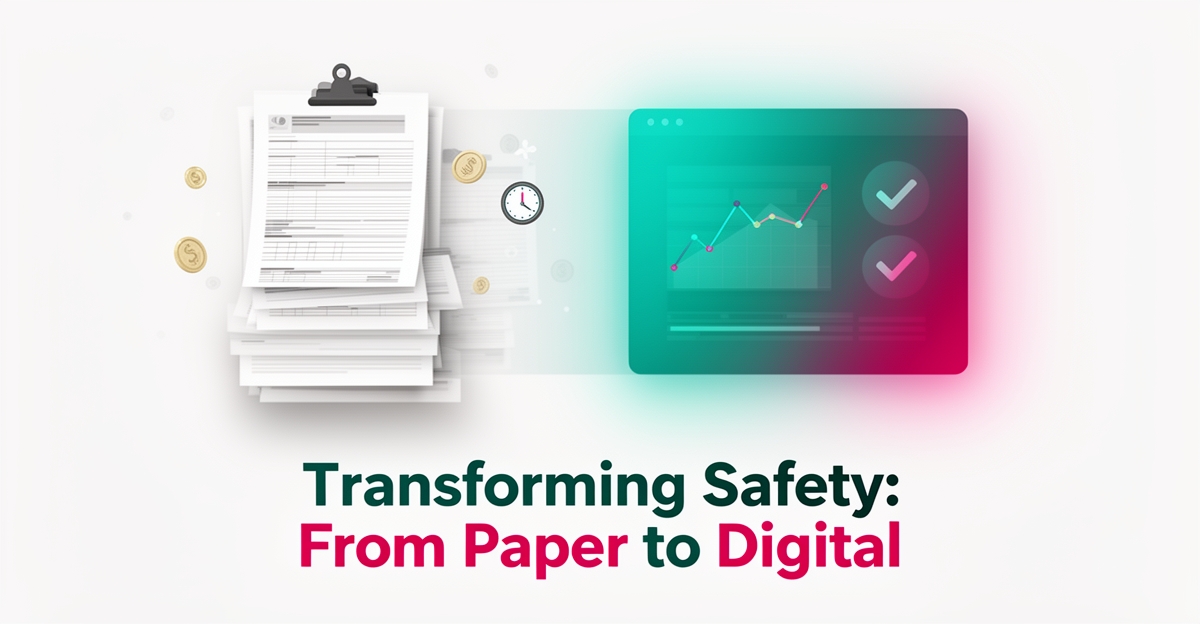
The Real Cost of Paper-Based Safety Records in PPE Distribution
Key Facts
- Industry benchmarking suggests a 15-worker team can lose roughly 2,925 hours annually to paper-based safety workflows versus about 1,170 hours with digital forms according to DIGI CLIP research.
- The same analysis estimates paper forms cost A$122,850 per year in labor for a 15-worker team while digital workflows cost A$49,140 — a potential saving of A$73,710 annually per DIGI CLIP.
- Each paper form is estimated to take 15 minutes to complete, chase, scan, and enter versus roughly 6 minutes for a digital form based on DIGI CLIP benchmarking.
- Canadian provincial OH&S authorities typically require safety records retained for 3-5 years, yet 'shoeboxes of forms' fail audit standards per Make Safety Easy.
- Canadian national data has shown on the order of 277,000 accepted time-loss claims, many linked to documentation gaps that paper systems cannot close according to Make Safety Easy.
- AI-powered voice and photo capture has been reported to cut inspection report time from 30-60 minutes to around 3 minutes in vendor case studies per SoterAI.
- Organizations using AI-powered records management have reported up to 70% less administrative workload and 98% report completion rates based on SoterAI deployments.
Hire a team member that works 24/7 — for less than a part-time wage.
AI receptionists, SDRs, dispatchers and 99+ roles. Trained on your business, fully managed.
Not sure where to start? Ask our AI planner
Hidden Labor Drain: Why Paper Forms Cost More Than Paper
Paper forms feel cheap until you count the hours they steal from your team. In PPE distribution, every signature, scan and spreadsheet entry adds up to a labor drain that hides in plain sight.
A realistic 15-worker scenario shows the scale. With three forms per worker per day, industry benchmarking estimates paper workflows consume 2,925 hours annually versus 1,170 hours with digital forms. At A$42 per hour, that is A$122,850 versus A$49,140 per year.
The difference is time per form. A single paper-based form is estimated at 15 minutes to complete, chase, scan and enter, while a digital form averages around 6 minutes. That gap compounds daily and creates an estimated A$73,710 annual labor saving for the team.
The hidden labor drain shows up in roles that never appear on a safety budget:
- Chasing missing signatures and incomplete forms from drivers and warehouse staff
- Manual data entry from clipboards into spreadsheets for reporting
- Scanning, filing and retrieving records for audits and workers’ compensation claims
- Supervisor time diverted from hazard oversight to paperwork administration
These tasks scale poorly. Adding sites or workers multiplies the administrative headache rather than scaling cleanly, and paper records are prone to physical damage, loss and delayed reporting that obscures emerging trends.
Digital and AI-powered record keeping changes the equation. AI-guided capture via voice, photo and video can auto-populate fields and flag missing details, removing friction that leads to skipped forms. Organizations have reported up to a 70% reduction in administrative workload and real-time dashboards that make safety performance visible instead of waiting for month-end aggregation.
For PPE distributors managing vehicle pre-start inspections, load restraint checks and warehouse audits, the labor cost is only part of the risk. Paper-based systems are slow, error-prone and increasingly incompatible with regulatory demands of provincial OH&S authorities, with “shoeboxes of forms” failing audit readiness.
AIQ Labs works with SMBs to quantify these hidden costs and replace manual record keeping with automated, audit-ready systems — whether that is a single AI Workflow Build for your most expensive process or a fuller AI Operating System that connects safety data across the business.
Compliance Risk Exposure: Audit Failures, Fines, and Claims
A single missing inspection form can derail an entire audit, exposing organizations to fines that far exceed the cost of digitization. Paper records remain vulnerable to physical damage, loss, and the silent risk of incomplete data that only surfaces when a regulator asks for proof. In Canada, provincial OH&S authorities typically require records to be retained for 3-5 years, yet "shoeboxes of forms" do not qualify as compliant evidence during an audit.
- Lost or damaged forms that leave gaps in hazard documentation
- Delayed incident reporting that prevents timely corrective action
- Inability to produce searchable, time-stamped records on demand
- Incomplete safety orientations and missed inspections cited as root causes for claims
These vulnerabilities carry measurable consequences. Canadian national data has shown on the order of 277,000 accepted time-loss claims, many linked to documentation gaps that paper systems cannot reliably close. When records sit in truck gloveboxes for days before reaching safety managers, emerging trends go unnoticed and corrective actions stall. Organizations that cannot produce organized, audit-ready documentation face not only regulatory penalties but also weakened defenses in workers' compensation disputes.
AIQ Labs helps organizations eliminate these blind spots by building custom AI systems that automate record-keeping and generate real-time compliance dashboards. Digital platforms with offline capability ensure data integrity even in remote areas, while AI-guided capture through voice, photo, and video has been shown to reduce manual entry substantially and drive report completion rates toward 98% in vendor-reported deployments. The shift transforms safety management from a reactive scramble into a proactive, auditable process that protects both workers and the business.
AI-Powered Digital Transformation: From Manual Entry to Real-Time Dashboards
Paper-based safety records in PPE distribution create a hidden drain on resources, with manual processes consuming valuable time that could be spent on proactive safety management. A 15-worker team completing three forms daily is estimated to spend over 2,900 labor hours annually on paper-based workflows, costing approximately A$122,850, while digital alternatives reduce this to roughly A$49,140 — a potential annual saving of A$73,710. This contrast highlights how outdated systems silently erode operational efficiency and inflate costs beyond the price of paper and clipboards.
AI-powered digital transformation fundamentally shifts this dynamic by replacing manual entry with intelligent capture methods. Workers can complete inspections using voice or photo input, with vendor case studies reporting completion time dropping from 15–20 minutes for paper or traditional software to around 3 minutes with AI-assisted tools. These systems leverage natural language processing and image recognition to auto-populate fields, cutting manual typing substantially and ensuring critical details like hazard type, location, and severity are consistently captured without relying on worker recall or effort.
The impact on data quality and administrative burden is equally significant. AI-powered systems have achieved reported completion rates around 98% by eliminating friction points such as small-screen typing and unclear prompts, compared to lower rates with manual forms. Organizations adopting these technologies report up to a 70% reduction in administrative workload, freeing supervisors from chasing incomplete paperwork and enabling them to focus on hazard mitigation and team engagement. This shift turns safety management from a reactive, time-consuming chore into a proactive, insight-driven function.
Beyond daily efficiency, AI-powered systems deliver immediate audit readiness and strategic value through real-time dashboards. Unlike paper records — which require manual retrieval and organization, and are vulnerable to damage or loss — digital systems provide instant access to time-stamped, geo-tagged, and searchable data that can be exported to PDF or Excel with a single click. Safety managers gain real-time visibility into trends, such as recurring defects or near-miss patterns, allowing for rapid corrective actions instead of waiting for end-of-month manual aggregation. This capability not only supports provincial OH&S requirements but turns safety data into a decision-making advantage for PPE distribution operations.
Practical Transition Roadmap for PPE Distributors
Paper-based safety records cost PPE distributors in labor hours they never see on an invoice. A 15-worker team completing three forms daily is estimated to burn 2,925 labor hours annually on paper workflows, costing about A$122,850 versus A$49,140 digitally. That gap is A$73,710 per year in recoverable time.
Mobile crews need a migration plan that respects field conditions and builds confidence fast. The goal is audit-ready records without adding admin burden.
Start with platform selection aligned to mobile PPE operations. Choose a system with offline functionality for remote sites, provincial OH&S alignment, and voice/photo capture. Platform guidance for Canadian workplaces stresses offline mode and data residency as non-negotiable for field teams.
Digitize high-volume forms first to prove value quickly. Daily vehicle pre-starts, forklift checks, and toolbox talks deliver immediate time savings. A single paper form is estimated at 15 minutes end-to-end versus 6 minutes digital, so high-frequency forms compound savings fastest.
Run parallel systems briefly, then train for speed. A one-week paper-plus-digital overlap lets crews build trust while maintaining backup. Field workers can complete inspections in under two minutes on simple apps, which reduces adoption resistance.
Leverage AI features to eliminate typing and improve completion. AI-guided capture via voice and photo auto-populates hazard type, severity and location, cutting manual entry substantially. Organizations report up to a 70% reduction in administrative workload and 98% report completion rates with AI-powered records management. Inspection reports that take 30-60 minutes manually have been cut to about 3 minutes with AI voice/photo capture in vendor case studies.
A practical rollout for mobile PPE teams looks like this:
- Select a platform with offline sync, Canadian data residency, and mobile-first design
- Convert daily inspections and toolbox talks first, then expand to incident reports
- Run parallel paper and digital for one week, then train crews on two-minute completions
- Activate AI voice-to-text, photo analysis, and automated form generation for inspections
- Review dashboards weekly and export audit-ready records retained 3-5 years
Once proficiency is proven, eliminate paper to prevent data fragmentation. Real-time dashboards give managers instant visibility into near-miss trends instead of waiting for manual aggregation. AIQ Labs helps SMBs design this transition — typically starting with an AI Workflow Build that rebuilds the one record-keeping workflow costing you the most, at a fixed price and in phases. The result is operational confidence and defensible audit trails, not just cost reduction.
Still paying for 10+ subscriptions that don’t talk to each other?
We build custom AI systems you own outright. No vendor lock-in. Full control.
Not sure where to start? Ask our AI planner
Frequently Asked Questions
How much does paper-based safety record keeping actually cost a small PPE distribution business?
What are the biggest compliance risks of using paper forms for safety inspections?
How does AI-powered record keeping actually improve completion rates and reduce admin time?
How long does it take to complete a safety inspection digitally versus on paper?
What's the best way to transition from paper to digital safety records without disrupting field operations?
Can digital safety records really help during an audit or workers' compensation claim?
Stop Paying the Paper Tax on Safety
The numbers make the case: paper-based safety records quietly drain a PPE distribution operation through thousands of hidden labor hours, audit vulnerabilities, and compliance risks that surface only when it's too late. A 15-worker team can potentially reclaim A$73,710 annually by switching from paper to digital workflows, while AI-powered systems have been shown to reduce administrative workload by up to 70% and push report completion rates toward 98%. The transition doesn't require a leap of faith — start with high-volume forms like daily vehicle inspections, run parallel systems for one week, and let your crew experience two-minute completions firsthand. AIQ Labs builds the systems that make this shift stick, from a single AI Workflow Build for your costliest record-keeping process to a connected AI Operating System across your operation. Ready to quantify your hidden costs and see what automation could recover? Start with a two-minute Fit Check to identify your highest-ROI opportunities, or book a free 30-minute strategy call to map your transition from paper chaos to audit-ready confidence.
Make AI your competitive advantage — not just another tool.
Strategy, implementation and ongoing optimization. One partner, end to end.
Not sure where to start? Ask our AI planner