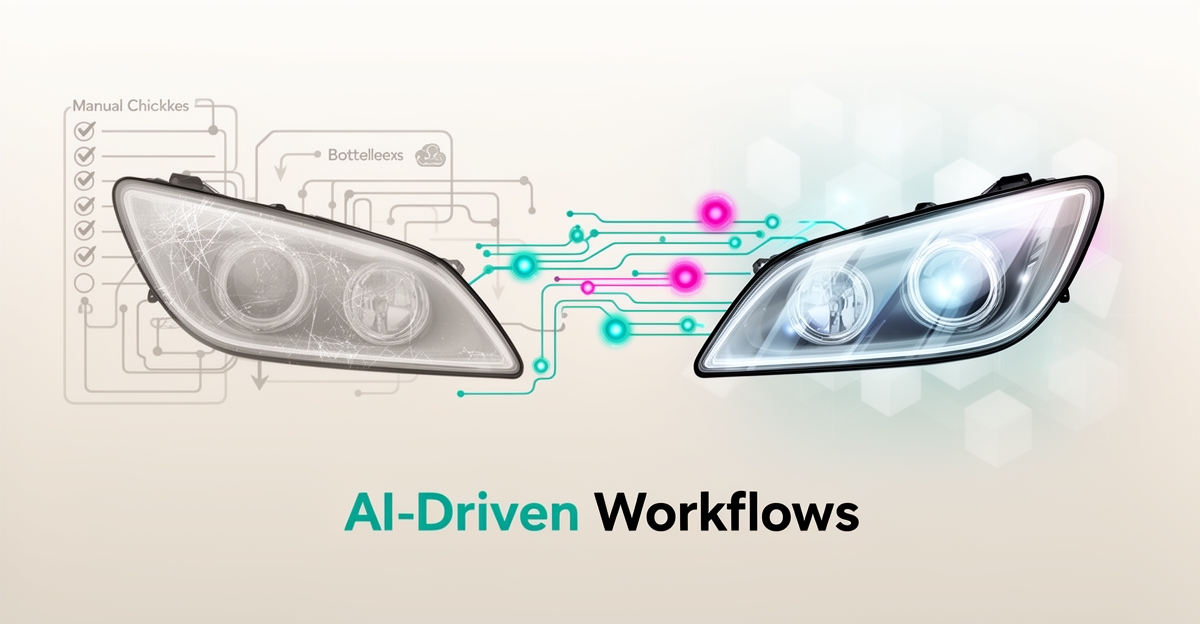
Transforming Headlight Restoration Workflows: From Manual to AI-Driven
Key Facts
- Consumer Reports tested four headlight restoration kits in its buying guide.
- The Sylvania kit provided the greatest improvement in illumination with no noticeable degradation over time per Consumer Reports testing.
- The Fast Brite kit was easiest and fastest to use but made the smallest improvement in light transmission according to testing.
- The average age of vehicles on the road continues to rise, which typically drives steady demand for restoration services.
- Manual restoration depends on technician judgment at every stage, which is the main source of variability between jobs.
- AIQ Labs has deployed 200+ multi-agent systems and runs four live SaaS products daily.
Hire a team member that works 24/7 — for less than a part-time wage.
AI receptionists, SDRs, dispatchers and 99+ roles. Trained on your business, fully managed.
Not sure where to start? Ask our AI planner
The Hidden Cost of Manual Headlight Restoration: Why Traditional Methods Are Holding Shops Back
The hidden cost of manual headlight restoration goes far beyond the price of sandpaper and polish. As vehicles age—with the average age of cars on the road continuing to rise—demand for restoration services keeps growing, yet traditional methods struggle to deliver consistent quality and efficiency. Consumer Reports testing of four headlight restoration kits revealed significant performance variability: the Sylvania kit provided the greatest improvement in illumination with no noticeable degradation over time, while the Fast Brite kit, though easiest and fastest to use, delivered the smallest improvement in light transmission. That kind of inconsistency forces technicians to rely on subjective judgment during polishing and quality checks, leading to rework, wasted materials, and dissatisfied customers. The labor-intensive nature of manual restoration—multiple stages of sanding, polishing, and sealing—creates bottlenecks that limit daily throughput and increase operational strain. Without objective, data-driven benchmarks, shops cannot reliably measure performance or identify where time is lost in the workflow. Process mining offers a way to map these inefficiencies, exposing repetitive tasks that consume skilled labor without adding proportional value. By analyzing each step—from initial assessment to final inspection—shops can pinpoint where automation would reduce variability and free up technicians for higher-value work. Rising vehicle age means more clouded, oxidized lenses requiring attention, amplifying the strain on shops still dependent on manual, inconsistent methods. This growing demand highlights the need for a more reliable, scalable approach—one that minimizes human error and maximizes output without sacrificing quality. AIQ Labs helps uncover these workflow inefficiencies through its AI Workflow Builds, which rebuild the one workflow that costs your shop the most, at a fixed price and in phases.
How Process Mining and AI Identify and Eliminate Restoration Bottlenecks
Headlight restoration workflows are often plagued by repetitive, manual tasks that create bottlenecks and inconsistent outcomes. Process mining offers a data-driven way to visualize these workflows, revealing exactly where time is lost—whether in damage assessment, polishing cycles, or rework due to quality gaps. By analyzing event logs from restoration activities, shops can identify the specific steps that slow down service and increase labor costs. AI adoption across business functions has become mainstream as of late 2026, and the automotive aftermarket is following the same pattern.
Once inefficiencies are mapped, AI-driven automation can be applied to standardize and streamline the most labor-intensive stages. Computer vision systems, for example, can assess lens oxidation and scratch patterns with consistent accuracy, reducing reliance on subjective technician judgment. Multi-agent AI systems then guide polishing equipment or recommend optimal compound applications based on real-time surface analysis. This cuts down on trial-and-error attempts and minimizes material waste and rework—two major contributors to delays in headlight restoration shops. Consumer Reports testing confirmed that top-performing restoration methods deliver lasting improvements, underscoring the value of precision in early-stage assessment.
- Automated damage assessment using computer vision reduces variability in initial inspections
- AI-guided polishing optimizes compound use and minimizes over-correction
- Real-time quality control catches defects early, cutting rework rates
- Workflow standardization enables predictable service times and better scheduling
- Data collected during restoration feeds continuous improvement models
By integrating these AI capabilities with existing shop management tools, restoration businesses gain end-to-end visibility and control. The result is a leaner process where technicians focus on complex judgments while AI handles repetitive, rule-based tasks. The real transformation lies not in the technology itself but in rethinking how work gets done—exactly what process mining and AI enable in headlight restoration workflows.
From Pilot to Profit: Implementing AI in Headlight Restoration with Measurable ROI
Headlight restoration shops face mounting pressure to modernize as AI adoption becomes standard across business functions. For many, the journey begins not with a full overhaul but with a targeted AI workflow fix—such as automating appointment scheduling or damage assessment—designed to resolve one critical bottleneck quickly and visibly.
AIQ Labs' Build in Milestones model enables shops to implement these fixes in phases, approving and paying for each deliverable as it ships while retaining all work completed so far. This approach reduces upfront risk and allows businesses to validate results before scaling—critical, because most organizations get stuck at the pilot stage without structured support for expansion.
By integrating AI into core shop management tools—like CRM and scheduling systems—shops create a unified operational backbone that eliminates manual data entry and reduces errors. Process mining, a foundational step in this phase, maps current workflows to pinpoint repetitive tasks ideal for automation, such as customer follow-ups or invoice generation, ensuring AI is applied where it delivers the highest return.
Scaling gains momentum through AI Employees—managed AI staff that handle defined roles like lead qualification, appointment setting, or dispatch around the clock, without fatigue, at roughly 80% less cost than a human hire. These agents learn from performance data and integrate with existing tools, extending workforce capacity without proportional cost increases. For shops that want everything connected—scheduling, intake, follow-ups, invoicing—AI Operating Systems build one connected operating layer, in phases, that the business owns outright.
The measurable outcomes come not from AI alone but from rethinking processes around the technology. Process redesign—not the tools themselves—is where most of the value in an AI transformation lives, and that is exactly what process mining and phased implementation enable.
For headlight restoration businesses, this means starting small, proving value quickly, and scaling with confidence—turning isolated efficiency gains into a sustainable competitive advantage rooted in owned, optimized systems. The path from pilot to profit is a repeatable framework grounded in real implementations across automotive and adjacent service industries.
Still paying for 10+ subscriptions that don’t talk to each other?
We build custom AI systems you own outright. No vendor lock-in. Full control.
Not sure where to start? Ask our AI planner
Frequently Asked Questions
Why do headlight restoration results vary so much between different methods?
How can AI actually improve the headlight restoration process?
What is process mining and how does it help restoration shops?
Is AI adoption really becoming standard in the automotive service industry?
How can a small shop afford to implement AI without a massive upfront investment?
What kind of ROI can restoration shops realistically expect from AI automation?
Seeing Clearly: The Future of Headlight Restoration
The shift from manual to AI-driven headlight restoration isn't just about keeping up with technology—it's about solving real operational challenges that impact throughput, consistency, and customer trust. As vehicle age rises and demand for restoration grows, shops relying on sandpaper and subjective judgment face increasing strain from rework, wasted materials, and bottlenecks that limit daily capacity. Process mining reveals where time is lost, and AI steps in to standardize assessments, optimize polishing, and catch defects early—freeing technicians to focus on higher-value work while reducing variability and material waste. The result is a leaner, more predictable workflow that scales with demand without sacrificing quality. For shops ready to move beyond pilot projects and build sustainable efficiency, the path forward starts with understanding where AI can deliver the fastest, most measurable impact. Take the 2-minute Fit Check, then book a free 30-minute strategy call to map your biggest bottleneck and explore how AIQ Labs can help you build owned, optimized systems that drive real business value.
Make AI your competitive advantage — not just another tool.
Strategy, implementation and ongoing optimization. One partner, end to end.
Not sure where to start? Ask our AI planner