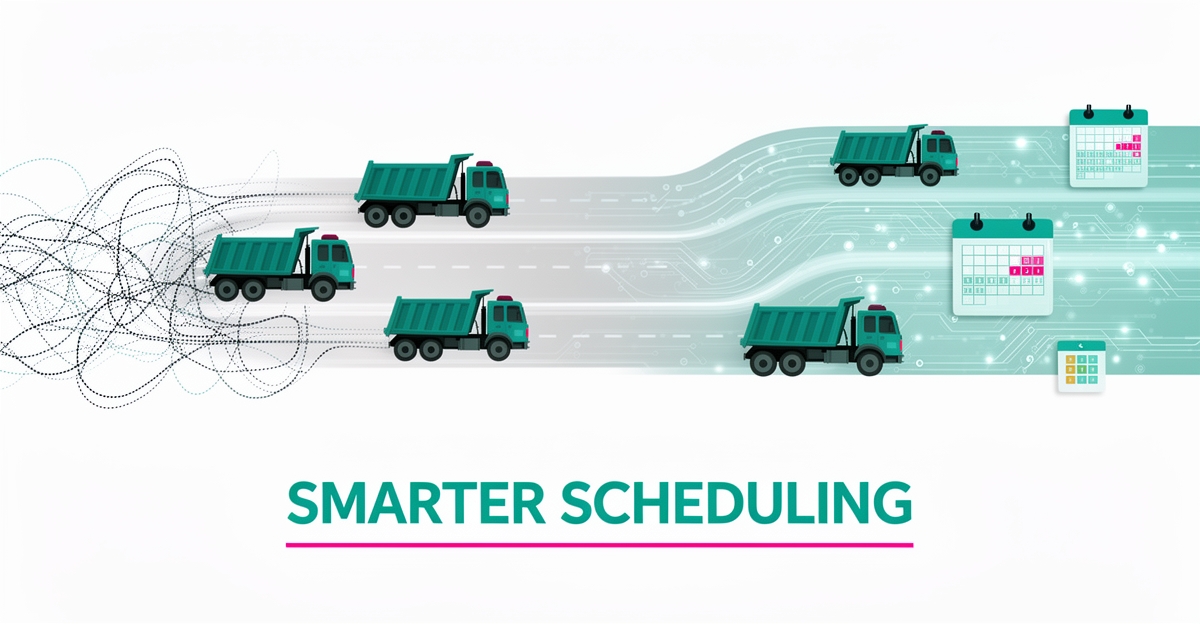
Transforming Manual Scheduling into AI-Driven Workforce Planning for Haulers
Key Facts
- Industry analyses of AI scheduling suggest it can meaningfully reduce downtime, lower operational costs, and improve demand matching—gains that stay locked away when scheduling remains manual.
- Operations teams that adopt AI scheduling tools commonly report reclaiming significant planning time each month—hours currently spent on spreadsheet wrangling.
- AI-powered workforce solutions can automate compliance with labor laws and hours-of-service rules while producing balanced, fair schedules.
- AI scheduling typically combines machine learning on historical data with predictive analytics to improve forecasting and staffing accuracy.
- Manual scheduling creates overbooking and underutilization, causing wasted driver hours, missed deliveries, compliance exposure, and dispatcher time consumed by repetitive schedule-building.
- AI-driven workforce planning matches drivers to jobs based on location, hours worked, certifications, equipment qualifications, and preference history.
- AI adoption across business functions has grown sharply since 2023, and haulers still scheduling by hand are falling behind competitors who plan automatically.
Hire a team member that works 24/7 — for less than a part-time wage.
AI receptionists, SDRs, dispatchers and 99+ roles. Trained on your business, fully managed.
Not sure where to start? Ask our AI planner
The Hidden Cost of Manual Scheduling in Haulage
Every hauler knows the Friday-afternoon scramble: a dispatcher hunched over a spreadsheet, juggling driver availability, customer commitments, and hours-of-service rules—and still getting it wrong. Manual scheduling isn't just tedious; it quietly drains margin from an industry that can least afford it.
The core problem is that humans schedule by instinct, not by data. That produces two costly failure modes: overbooking, where too many jobs land on too few drivers and deliveries slip, and underutilization, where trucks and licensed drivers sit idle while payroll costs accumulate. Either way, the fleet earns less than it should from the same resources.
The financial toll compounds quickly. Industry analyses of AI scheduling across operations-heavy industries point to meaningful reductions in downtime, operational costs, and demand-mismatch—gains that remain locked away when scheduling stays manual. For haulers operating on thin margins, those improvements represent real money in fuel, wages, and recovered capacity.
Then there's the time cost. Teams that adopt AI scheduling tools commonly report reclaiming substantial planning time each month—hours that dispatchers and operations managers currently burn on spreadsheet wrangling rather than customer service and route coordination. In a labor market where driver retention matters, that administrative drag also bleeds into morale.
Compliance risk may be the most dangerous hidden cost of all. Fatigued drivers, missed rest requirements, and poorly distributed overtime don't just create schedule conflicts—they expose haulers to regulatory penalties and safety incidents. Manual processes offer no systematic guardrail; AI-driven solutions, by contrast, can automate compliance with labor laws and regulations while providing balanced scheduling suggestions.
Consider what manual scheduling actually costs a mid-sized fleet:
- Wasted driver hours from mismatched staffing and demand patterns
- Overbooked routes that trigger missed deliveries and penalty clauses
- Compliance exposure from inconsistent hours-of-service management
- Dispatcher time consumed by repetitive schedule-building instead of exception handling
The competitive stakes are rising, too. AI adoption across business functions has grown sharply since 2023, and it shows no sign of slowing as of late 2026. Haulers still scheduling by hand aren't standing still; they're falling behind competitors who forecast demand, assign drivers, and optimize shifts from historical data automatically.
This is precisely the gap AIQ Labs addresses—starting with an AI Workflow Build that rebuilds the one scheduling workflow that costs you the most, at a fixed price and in phases. The question for haulers is no longer whether manual scheduling costs money. It's how much longer they can afford to keep paying it.
How AI Transforms Workforce Planning: Demand Forecasting and Driver Assignment
Manual scheduling in haulage creates a constant tug-of-war between overbooking and underutilization. AI-driven workforce planning replaces guesswork with historical patterns, real-time availability, and predictive demand signals.
AI scheduling uses machine learning algorithms to analyze historical data and identify scheduling trends. It can also incorporate natural language processing to improve scheduling processes and predictive analytics to enhance the accuracy of forecasting and staffing. This approach turns fragmented records into a continuous planning engine.
Demand forecasting starts with past load volumes, seasonality, route times, and external factors. The system learns peak windows and lulls, then projects staffing needs before requests arrive. As AI adoption has climbed steadily across industries since 2023, this kind of forecasting has moved from experimental to standard practice.
Driver assignment becomes dynamic instead of manual. The model matches each job to drivers based on location, hours worked, certifications, equipment qualifications, and preference history. Operational analyses of AI scheduling consistently point to reduced downtime, lower operational costs, and better demand matching as the core outcomes.
Shift optimization balances compliance, fairness, and utilization. AI-powered workforce solutions can automate compliance with labor laws and regulations, providing balanced scheduling suggestions. The system flags risk of overtime violations, rest-period breaches, and uneven shift distribution while still meeting coverage targets.
The practical workflow typically includes:
- Historical demand analysis to forecast loads by day, route, and time window
- Skill and availability matching for automatic driver assignment
- Shift pattern optimization for cost, compliance, and driver preference
- Real-time rebalancing when cancellations or new requests appear
Time savings compound quickly. Teams using AI scheduling software commonly free up large blocks of planning time each month, letting dispatch staff focus on exception handling and customer service instead of schedule-building.
For haulers, this means fewer empty miles, better on-time performance, and drivers who stay longer because schedules feel fair and predictable. AIQ Labs embeds this forecasting and assignment logic into your existing operations—whether that starts as a single workflow build or grows into a full AI Operating System that connects scheduling with dispatch, billing, and compliance in one layer you own outright.
When done right, AI frees up people to do the things only humans can do. It's about amplifying talent, not replacing it.
The Business Case: Cost Savings, Compliance, and Driver Satisfaction
The financial case for AI-driven scheduling isn't theoretical—it's measurable, immediate, and compounding. Haulers who move beyond spreadsheets and whiteboards consistently see returns across three dimensions: time, cost, and compliance.
Start with time. Manual scheduling consumes hours that dispatchers and fleet managers simply don't have. Teams that automate scheduling commonly reclaim substantial planning time every month. That's not a marginal efficiency gain—it's a fundamental shift in how your operations team spends its day, redirecting energy from administrative triage toward strategic fleet decisions.
The cost picture is equally compelling. AI scheduling doesn't just save hours; it optimizes how labor dollars get deployed. Industry analyses show AI scheduling typically reduces downtime, lowers operational costs, and improves demand matching. For a mid-sized hauling operation, those gains translate directly into fewer deadhead miles, better asset utilization, and labor spend that actually aligns with workload demand.
Then there's compliance—a domain where manual processes create genuine legal exposure. Hours-of-service regulations, overtime rules, and labor law requirements demand constant vigilance, and a single oversight can trigger penalties or audit risk. AI-powered workforce solutions automate compliance with labor laws and regulations, flagging potential violations before they occur and generating balanced schedules that respect both legal constraints and driver preferences.
Driver satisfaction often gets overlooked in ROI calculations, but it shouldn't. Fair shift distribution, predictable schedules, and equitable overtime allocation directly affect retention—and replacing a driver costs far more than retaining one. AI scheduling addresses this through:
- Fair distribution of shifts and overtime opportunities across the fleet
- Personalized schedules based on driver skills, certifications, and preferences
- Fewer scheduling conflicts and last-minute changes that erode trust
- Better alignment between staffing levels and actual customer demand patterns
Adoption is accelerating for a reason. AI use across business functions has climbed steadily since 2023 and continues to grow as of late 2026. The haulers seeing the strongest returns aren't waiting for perfect conditions; they're starting with their most painful scheduling bottleneck and building from there.
This is precisely where AIQ Labs focuses: building AI workforce planning that fits your fleet's actual operations, not forcing your team into a generic platform's limitations. You can start monthly, build in milestones, or own the system outright—no lock-in, no inflated promises. The result is scheduling that works the way your business does—only faster, fairer, and far more cost-effective.
Implementation Roadmap: From Manual Chaos to AI-Driven Planning
Haulers stuck in manual scheduling chaos face constant overbooking, underutilization, and reactive firefighting that drains both time and profits. The path forward starts not with a full fleet overhaul, but with a focused, data-driven first step.
Begin by auditing your current scheduling data—historical routes, driver availability, load patterns, and peak demand windows—to identify gaps and inconsistencies. Clean, structured data is the foundation for any AI model, and haulers often find that a large share of scheduling conflicts stem from incomplete or siloed information. Once data is assessed, integrate it into a centralized system that can feed AI forecasting tools, ensuring real-time visibility into driver capacity and load requirements. With AI adoption now standard across industries, the shift from manual to intelligent planning is no longer optional—it's becoming the baseline.
Launch a pilot with a single depot or high-volume route to test AI-driven shift assignments against historical outcomes. Measure key metrics like driver utilization, idle time, and on-time delivery rates before and after implementation. Benchmarks from AI scheduling in adjacent operations-heavy sectors suggest meaningful reductions in downtime and operational cost—use your own pilot numbers as the source of truth. Use this phase to refine the AI's understanding of local traffic patterns, driver preferences, and regulatory constraints—such as hours-of-service rules—while keeping dispatchers in the loop to validate recommendations and build trust in the system.
Scale gradually by adding routes and depots, using insights from the pilot to adjust model parameters and workflows. Throughout this process, prioritize change management: involve drivers early, explain how AI reduces favoritism and creates fairer shift distribution, and emphasize that the technology supports—not replaces—their expertise. Teams that automate scheduling typically free up significant planning time each month, letting supervisors focus on exception handling and driver engagement rather than spreadsheet juggling.
AIQ Labs partners with haulers through a phased approach: start with a fixed-price AI Workflow Build targeting your costliest scheduling workflow, then scale toward an AI Operating System you own outright—ensuring transparency, ownership, and continuous improvement from pilot to full-scale optimization. If you'd rather augment your team first, AI Employees like an AI dispatcher can take over routine scheduling tasks at a fraction of the cost of a human hire.
Still paying for 10+ subscriptions that don’t talk to each other?
We build custom AI systems you own outright. No vendor lock-in. Full control.
Not sure where to start? Ask our AI planner
Frequently Asked Questions
How much time can AI scheduling software save for dispatchers in a hauling operation?
What specific cost savings can haulers expect from implementing AI-driven workforce planning?
Does AI scheduling help with compliance risks like hours-of-service violations?
Will AI scheduling replace my dispatchers or make their jobs obsolete?
How does AI scheduling improve driver satisfaction and retention?
How widely is AI being adopted across business functions, and what does that mean for haulers?
From Spreadsheets to Strategy: Your Next Move in Smarter Haulage
Manual scheduling in haulage isn't just inefficient—it's a silent drain on margins, compliance, and driver morale. AI-driven workforce planning turns guesswork into precision: less downtime, lower operational costs, and reclaimed planning time for dispatch teams. More than cost savings, it builds fairer schedules, stronger compliance, and happier drivers who stay longer. The shift isn't about replacing your team—it's about freeing them to focus on what truly moves your business forward. If you're ready to see where AI can unlock real value in your operations, start with the free, 2-minute Fit Check. It leads to a free 30-minute strategy call where an AI engineer will map your biggest scheduling bottleneck and show you exactly where to begin—no sales pitch, just clarity.
Make AI your competitive advantage — not just another tool.
Strategy, implementation and ongoing optimization. One partner, end to end.
Not sure where to start? Ask our AI planner