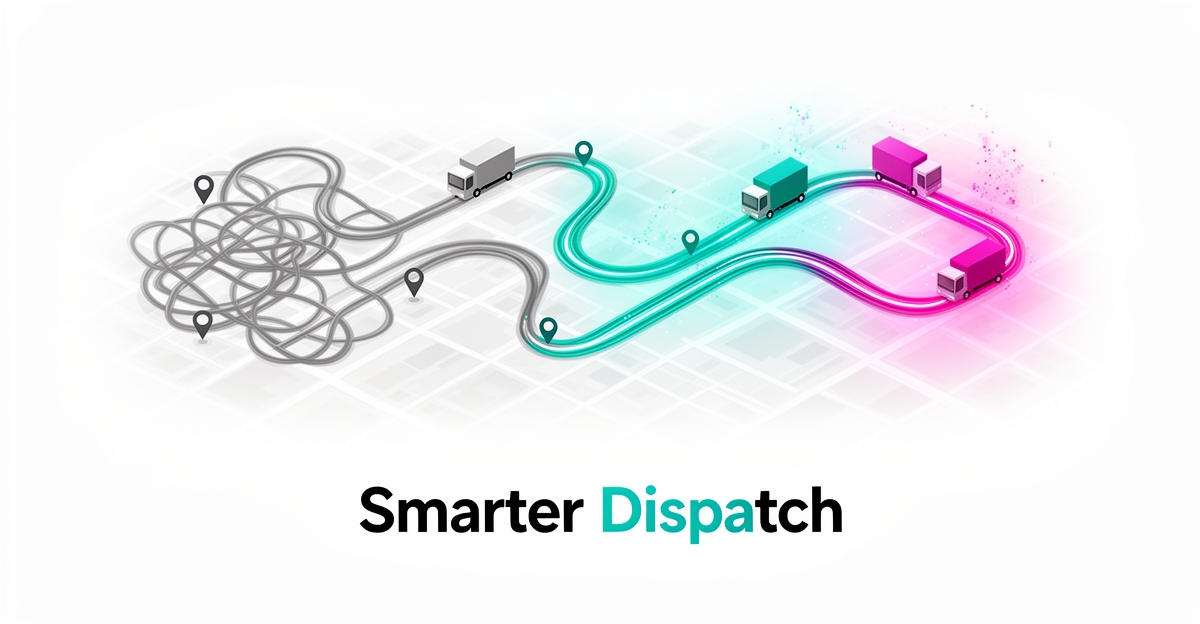
Transforming Moving Operations: From Manual to AI-Powered Dispatch
Key Facts
- Manual route planning adds 15-25% to fuel costs and travel time compared to AI optimization according to industry analysis.
- Customer service reps spend 40-60% of their time on routine status updates in moving companies.
- AI systems can reduce operational costs by up to 30% according to industry analysis.
- AI-based automation saves an average of 3.6 hours per employee per week from repetitive work.
- Manual dispatch becomes inefficient beyond 25 daily moves where AI shows clear advantages.
- Some organizations report 20-30% productivity improvement after automating core processes from manual to AI workflows.
Hire a team member that works 24/7 — for less than a part-time wage.
AI receptionists, SDRs, dispatchers and 99+ roles. Trained on your business, fully managed.
Not sure where to start? Ask our AI planner
The Breaking Point: Why Manual Dispatch Fails Growing Moving Companies
Moving companies often hit a breaking point when manual dispatch methods can no longer keep pace with operational demands. As daily move volumes increase, the hidden costs of juggling phone calls, whiteboards, and status updates begin to erode efficiency and profitability. This tipping point typically emerges around 25 daily moves, where manual processes start to strain under the weight of complexity.
Customer service representatives in moving companies spend 40-60% of their time on routine status updates rather than addressing complex customer needs or securing new business, according to industry analysis. This significant allocation of human resources to repetitive tasks creates a bottleneck that limits growth potential. Meanwhile, manual route planning adds 15-25% to fuel costs and travel time compared to AI-optimized routing, directly impacting the bottom line through inefficient resource utilization.
The cumulative effect of these inefficiencies becomes unsustainable as operations scale. Dispatchers overwhelmed by constant coordination demands experience decision fatigue, leading to scheduling conflicts and suboptimal crew assignments. Manual systems lack the capacity to simultaneously evaluate multiple variables like crew availability, equipment needs, and real-time traffic conditions across dozens of active jobs. This limitation prevents proactive conflict resolution and optimal resource allocation that becomes critical beyond the 25-move daily threshold.
- Routine status updates consume 40-60% of customer service representatives' time
- Manual routing increases fuel costs by 15-25% compared to AI optimization
- Manual processes become inefficient beyond 25 daily moves
- Dispatchers face decision fatigue under manual coordination demands
- Manual systems cannot simultaneously optimize multiple operational variables
For moving companies approaching this inflection point, the limitations of manual dispatch extend beyond immediate operational headaches. The inability to scale efficiently constrains revenue growth while increasing operational costs per move. Companies relying on manual methods often find themselves hiring additional staff just to maintain current service levels, creating a linear cost curve that undermines profitability. This operational strain directly impacts customer satisfaction through delayed responses, inaccurate ETAs, and missed communication opportunities—factors that become increasingly difficult to manage as move volumes grow.
AIQ Labs helps moving companies cross this transition with AI-powered dispatch built around three entry points: AI Employees that handle reception, dispatch coordination, and customer updates at roughly 80% less cost than a human hire, AI Workflow Builds that rebuild the single workflow costing you the most, and AI Operating Systems that connect the whole operation in phases. By automating routine coordination tasks, these systems free human talent to focus on complex problem-solving and relationship-building activities that drive long-term business value. The shift from manual to AI-powered dispatch represents not just a technological upgrade, but a fundamental reimagining of how moving companies can operate efficiently at scale.
What AI Dispatch Actually Does: From Booking to Delivery Confirmation
An AI-powered dispatch system is not a single tool that sends a truck to an address. It is a connected workflow that begins the moment a customer asks for a quote and ends only when the delivery is confirmed and the customer has been notified. Each stage feeds the next, eliminating the handoffs where manual processes break down.
The workflow starts with automated quoting. Instead of a salesperson manually calculating rates, the system generates quotes using historical job data, distance, crew size, and equipment requirements. Once a booking is confirmed, intelligent scheduling takes over. The system weighs crew availability, equipment needs, travel times, and customer preferences across dozens of active jobs simultaneously, flagging conflicts before they happen. According to industry analysis, this capability becomes especially valuable once a company handles 25 to 30 or more moves per day, where manual coordination starts to break down.
From there, the system manages the move in real time. Dynamic route optimization adjusts for traffic, weather, vehicle capacity, and crew schedules continuously, rerouting trucks when conditions change. Manual route planning typically adds 15 to 25 percent to fuel costs and travel time compared to AI optimization, according to the same analysis. While crews are on the road, the system sends automated customer status updates triggered by GPS tracking and job milestones, notifying customers when crews depart, arrive, and complete loading. This matters because customer service representatives in moving companies typically spend 40 to 60 percent of their time on status update calls rather than booking new business or handling complex needs.
The core capabilities connect into one continuous loop:
- Automated quoting using historical data to generate accurate estimates instantly
- Intelligent crew scheduling that balances availability, equipment, and travel time across all active jobs
- Dynamic route optimization that adapts to real-time traffic and weather conditions
- Automated customer updates triggered by GPS and job status changes, from departure through delivery confirmation
What makes this different from a collection of separate tools is that each function feeds the next automatically. A confirmed booking flows into scheduling, scheduling feeds route planning, and route progress triggers customer communication. There is no re-keying of data between systems, no dispatcher manually checking whether a crew is running late. The result is a dispatch operation that runs as one continuous workflow rather than a series of disconnected tasks—exactly the kind of end-to-end system AIQ Labs builds for field service and logistics businesses looking to scale without adding proportional headcount.
The Numbers: Cost, Efficiency, and Scalability Gains
When moving company owners run the numbers on AI-powered dispatch, the financial case becomes difficult to ignore. The gains show up not in one dramatic saving but across labor, fuel, and error costs that compound month after month.
Start with operational costs. According to industry analysis, AI systems can reduce operational costs by up to 30%. The same research found that automation saves an average of 3.6 hours per employee per week—roughly a full month of work recovered each year. For a dispatch team of five, that's more than 900 hours annually redirected from repetitive coordination to bookings and customer care.
Fuel and logistics tell a similar story. Manual route planning adds 15-25% to fuel costs and travel time compared to AI optimization, which factors traffic, weather, vehicle capacity, and crew schedules simultaneously. Across the broader logistics sector, companies implementing AI report 5-20% decreases in logistics costs, alongside 20-30% reductions in inventory costs.
The labor savings deserve special attention in an industry where staffing is a persistent challenge. In UK warehousing, only 13% of employers report no difficulty hiring staff, with more than half anticipating critical skills shortages ahead. Automation offsets this pressure by extracting more capacity from existing teams—some organizations report 20-30% productivity improvements after automating core processes. An AI dispatcher or receptionist from AIQ Labs typically costs around 80% less than an equivalent human hire, which compounds those savings directly against payroll.
The real differentiator, though, is how each model scales:
- Manual processes scale linearly—every increase in daily moves requires proportional increases in dispatchers, coordinators, and support staff.
- AI systems scale through cloud infrastructure, handling additional volume with minimal marginal cost.
- A company managing 10-20 moves per day may coordinate manually, but beyond 25-30 daily moves, AI systems demonstrate clear efficiency advantages.
- Growth stops being a cost problem and becomes a margin opportunity.
This is the economics that matter most for ambitious moving companies. Manual dispatch ties every dollar of growth to a dollar of payroll, while an AI dispatch system built to production standards—like the systems AIQ Labs develops for field service operations—absorbs increased volume through infrastructure rather than headcount. The result is a cost curve that flattens as revenue climbs, turning operational efficiency into a durable competitive advantage.
Your Implementation Roadmap: A Phased Path to AI Dispatch
Transitioning from manual dispatch to AI-powered operations doesn't happen overnight—nor should it. The most successful implementations follow a deliberate, phased approach that builds confidence at each stage while minimizing disruption to daily moves. According to industry research, companies that automate incrementally see 20-30% productivity improvements, while those attempting wholesale replacement often stall at the pilot stage.
Start by mapping every repetitive, rule-based task your dispatch team handles daily—quote generation, crew assignment, status update calls, route planning. A moving industry analysis found that customer service representatives spend 40-60% of their time on routine status updates rather than complex customer needs or new bookings. These high-volume, low-complexity workflows are your prime automation candidates.
- Audit historical booking, route, and crew performance data for quality and completeness
- Select one contained workflow—such as automated customer status notifications—to pilot first
- Define clear success metrics: response time, error rate, crew utilization, customer satisfaction
- Train dispatchers to oversee AI recommendations rather than execute every step manually
- Establish human-in-the-loop checkpoints for exceptions, disputes, and high-value moves
This phased methodology mirrors how AIQ Labs structures every engagement. If one workflow—say, dispatch coordination or customer status updates—is bleeding the most money, an AI Workflow Build rebuilds it end to end at a fixed price, delivered in milestones so you see value before committing further. If you want the whole operation connected—quoting, scheduling, routing, updates, and billing running as one system—an AI Operating System is built in phases and owned outright, with no vendor lock-in. And if the immediate pain is headcount, AI Employees can start monthly, covering roles from receptionist to dispatcher at a fraction of the cost of a human hire. The goal isn't to remove human judgment—it's to elevate your dispatchers from reactive coordination to strategic oversight, where their experience drives the greatest value.
Avoiding the Pitfalls: Data Quality, Change Management, and Keeping Humans in the Loop
Even the most advanced AI dispatch systems can falter without careful attention to data quality, workforce dynamics, and appropriate human oversight. Poor data inputs create systematic errors that scale rapidly—AI systems processing inaccurate customer locations or outdated crew availability can generate cascading scheduling failures that manual processes might catch through human judgment. Model drift remains a persistent risk, where AI performance degrades over time as real-world conditions shift, requiring continuous monitoring and retraining to maintain accuracy. Workforce resistance often emerges not from technophobia but from legitimate concerns about job displacement and loss of professional autonomy, particularly when dispatchers see their expertise undermined by opaque algorithmic recommendations. Over-automation presents another critical pitfall, as removing human judgment entirely eliminates the contextual reasoning needed for complex scenarios like weather-disrupted moves or special handling requirements.
Successful AI adoption requires robust governance practices that keep humans meaningfully in the loop while leveraging automation's strengths. Configurable human-in-the-loop controls allow dispatchers to review and override AI suggestions for high-stakes decisions, maintaining accountability without sacrificing efficiency. Comprehensive audit trails provide transparency into every automated decision, enabling root cause analysis when errors occur and supporting regulatory compliance. Explainable AI interfaces help workers understand why the system made specific recommendations, building trust through visibility into the reasoning process rather than demanding blind acceptance. Regular performance audits detect early signs of model drift, while ongoing change management initiatives address workforce concerns through training that positions AI as a tool enhancing rather than replacing human expertise. These safeguards transform AI from a black-box liability into a reliable operational partner that scales with business growth while preserving the human judgment essential to exceptional moving service. To explore how AIQ Labs builds dispatch systems with these safeguards embedded from the start, take the two-minute Fit Check, then schedule a free 30-minute strategy call.
Still paying for 10+ subscriptions that don’t talk to each other?
We build custom AI systems you own outright. No vendor lock-in. Full control.
Not sure where to start? Ask our AI planner
Frequently Asked Questions
At what point does manual dispatch start to break down for moving companies?
How much of customer service time is wasted on status updates?
Can AI really save money on fuel and travel time?
What kind of cost savings does AI dispatch actually deliver?
Do we need to be a big company to benefit from AI dispatch?
What's the best first step to move from manual to AI dispatch?
The Dispatch Evolution: Where Your Next Move Starts
The shift from manual to AI-powered dispatch isn't just about adopting new technology — it's about changing the economics of growth. Moving companies that cross the 25-move threshold face a clear choice: keep adding headcount to manage complexity, or build a system where additional volume improves margins instead of straining them. The data shows AI dispatch reduces operational costs by up to 30% while recovering roughly a month of productive time per employee each year, according to industry analysis. But the real advantage is structural: manual processes scale linearly, while AI systems scale through infrastructure. AIQ Labs builds production-ready dispatch systems that moving companies own outright — no vendor lock-in, no subscription dependencies. The implementation path starts with a single workflow, proves value, then expands. If you're ready to see what that looks like for your operation, take the two-minute Fit Check at aiqlabs.ai/apply and book a free 30-minute strategy call at aiqlabs.ai/book. No obligation — just a clear picture of your highest-ROI automation opportunity.
Make AI your competitive advantage — not just another tool.
Strategy, implementation and ongoing optimization. One partner, end to end.
Not sure where to start? Ask our AI planner