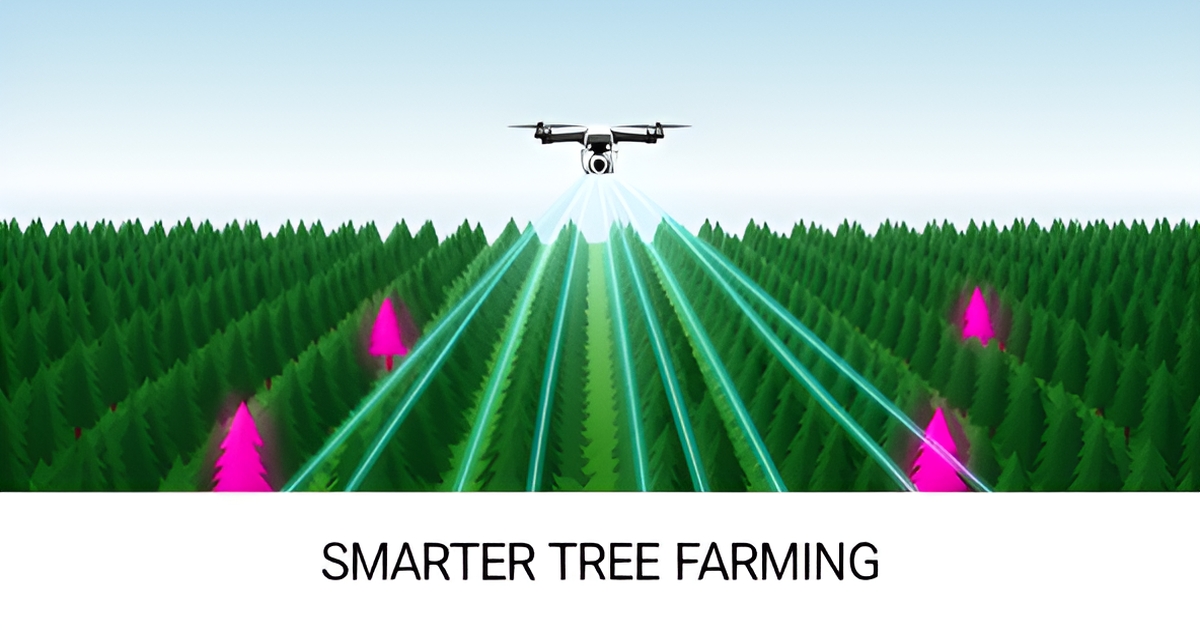
What to Look for in an AI Partner for a Christmas Tree Farm
Key Facts
- Drone- and AI-driven analysis can map large acreage in minutes rather than the days manual field-walking typically requires
- Manual field walking is time-consuming and prone to error on large Christmas tree farms, especially during the compressed harvest window
- Drone operations have shifted from experimental trials to everyday use on tree farms in several growing regions as of late 2026
- LiDAR laser scanning enables drones to generate detailed terrain and vegetation maps
- Autonomous ground-based drones are being tested for steep slopes machinery can't safely reach
- AI operating systems automate crop monitoring by combining satellite imagery, soil sensors, and weather data
Hire a team member that works 24/7 — for less than a part-time wage.
AI receptionists, SDRs, dispatchers and 99+ roles. Trained on your business, fully managed.
Not sure where to start? Ask our AI planner
Why Tree Farms Are Turning to AI Now
Across the Christmas tree industry, the annual ritual of walking rows to count and measure trees by hand is quietly disappearing. What once consumed entire weekends is now being done from the sky in a fraction of the time — and growers who haven't made the switch are feeling the pressure.
The problem with manual counting isn't just speed; it's reliability. On large farms, walking every row introduces human error at exactly the moment when accurate inventory drives pricing, harvest planning, and wholesale commitments. Traditional field-walking methods are time-consuming and increasingly impractical as operations scale.
The alternative has matured remarkably fast. Growers in several regions now use drone- and AI-driven analysis to map large acreage in roughly half an hour — work that would take days on foot — with tree counts that, in well-documented trials, reach accuracy levels manual surveys rarely match. In major growing regions like North Carolina, drone operations have shifted from experimental trials to everyday farm tools, marking a broader transition across the industry from novelty to necessity.
Several forces are converging to drive this shift:
- Labor scarcity: Fewer seasonal workers are available for repetitive field tasks, and those who are cost more each year.
- Accuracy demands: Wholesale buyers and retailers expect precise inventory data, not estimates.
- Falling technology costs: Drone hardware and AI processing have dropped enough that mid-sized farms can now justify the investment.
- Expanding capabilities: Technologies like LiDAR laser scanning now generate detailed terrain and vegetation maps, while autonomous ground drones handle slopes that machinery can't safely reach.
Beyond counting, the underlying technology stack has evolved. Modern AI operating systems in agriculture combine satellite imagery, soil sensors, and weather data to automate crop monitoring and detect stress before it becomes visible to the human eye. For tree farms managing multi-year growth cycles, that kind of continuous intelligence changes how decisions get made.
Yet adoption isn't automatic. Smaller growers still face real barriers — upfront costs, training requirements, and aviation regulations that vary by region. The technology itself is proven; the challenge lies in implementing it in a way that fits a specific farm's acreage, existing systems, and seasonal rhythms.
That's precisely why the choice of partner matters more than the choice of drone. A farm in its second decade of operation has different data infrastructure, different labor constraints, and different risk tolerance than a startup operation — and the AI solution needs to reflect that. Firms like AIQ Labs, which start every engagement with a structured fit assessment, exist to help growers evaluate their current systems and identify where automation delivers real ROI before committing capital.
The farms gaining ground today aren't necessarily the ones with the most advanced technology. They're the ones that matched the right technology to their actual operational reality — and that distinction starts with choosing a partner who understands both.
The Case for AI Over Manual Workflows on the Farm
For Christmas tree farmers, the daily walk through fields to scout for pests, measure growth, and assess health has long been a ritual—but one that's increasingly at odds with the demands of modern agriculture. Manual scouting relies on seasonal labor, expert eyes, and gut instinct, yet it's slow, inconsistent, and misses early warning signs that spread before they're visible to the human eye. As farms grow larger and labor tighter, this approach struggles to keep pace with the precision and speed needed to protect yield and quality.
AI-driven crop monitoring changes that equation by turning satellite and drone imagery into continuous, data-rich insights. Drones equipped with multispectral cameras can map large acreage in around 30 minutes, identifying individual trees, measuring height and canopy density, and tracking growth trends over time — far surpassing the speed and repeatability of ground-based surveys. These systems don't just capture images; they feed them into AI models that detect subtle shifts in plant vigor, water stress, or nutrient deficiencies long before symptoms appear visually, enabling proactive intervention rather than reactive damage control.
Where manual processes depend on scouts walking rows and interpreting symptoms through experience, AI operating systems automate disease detection by analyzing patterns across thousands of data points—leaf discoloration, temperature anomalies, moisture levels—to flag potential outbreaks early. This doesn't replace the farmer's judgment but augments it: AI handles the relentless, repetitive monitoring of vast acreages, freeing experts to focus on complex decisions like treatment timing, resource allocation, and long-term planning. For tree farms facing labor shortages and tightening margins, this shift isn't about eliminating human input—it's about redirecting it toward higher-value work that machines can't replicate.
Five Things to Demand from an AI Partner
Choosing the wrong AI vendor for a Christmas tree farm isn't just a tech headache—it can mean the difference between a profitable season and inventory chaos. The stakes are higher than generic software shopping because farm operations run on tight seasonal windows and unpredictable terrain. Here are five non-negotiables to demand from any partner before signing a contract.
- Proven accuracy in real field conditions. Lab demos don't count. Look for vendors who can cite drone-and-AI validation data from actual farms. In documented trials, growers have replaced manual counting with drone-driven analysis that maps large acreage in around 30 minutes with tree counts reaching the high 90s in accuracy percentage. Ask for similar benchmarks on your species, spacing, and slope.
- Integration, not replacement. The best AI operating systems connect to the tools you already run—CRM, accounting, inventory, mapping—rather than forcing a rip-and-replace. These platforms pull data from multiple sources to create comprehensive operational insights while automating routine monitoring tasks so your team focuses on strategic decisions.
- Right-sized economics for smaller growers. Cost and training are the two barriers cited most often by smaller operations. A partner should offer phased rollouts, transparent pricing models, and a clear ROI map—think "start monthly" or "build in milestones" rather than six-figure platform fees.
- Built for steep, rough terrain and seasonal peaks. Autonomous ground-based drones are already being tested on slopes traditional machinery can't safely reach. Your vendor must demonstrate that their hardware and software survive mud, wind, and the compressed harvest window without constant babysitting.
- Training and change management included. Tools the crew won't use are wasted capital. Demand on-site onboarding, role-based training, and ongoing support so adoption sticks long after the implementer leaves.
AIQ Labs structures engagements around these exact realities—assessment first, then custom workflow builds that plug into existing systems, with managed AI employees that handle seasonal surges and ongoing optimization so the technology actually pays for itself.
Red Flags and Deal-Breakers When Evaluating Vendors
Evaluating AI vendors requires vigilance—especially for smaller Christmas tree farms where resources are tight and operational rhythms are highly seasonal. The wrong partner can introduce complexity, hidden costs, and compliance risks that undermine the very efficiencies AI is meant to deliver. Understanding the common red flags helps farm owners avoid costly missteps and focus on solutions that truly align with their unique needs.
One major warning sign is a vendor with no proven experience in agriculture or seasonal businesses. Smaller growers already face significant hurdles, including technology costs, staff training gaps, and aviation regulations for drone use—challenges that demand specialized understanding. A vendor unfamiliar with these realities may propose solutions that ignore critical workflows like harvest timing, weather-dependent planting cycles, or labor fluctuations during peak seasons. Without this context, even advanced AI tools can become misaligned with daily farm operations, leading to poor adoption and wasted investment.
Another red flag is a one-size-fits-all platform that doesn't adapt to farm-specific processes. AI systems must integrate with existing tools—whether for inventory tracking, irrigation scheduling, or sales management—to deliver real value. Vendors who offer rigid, generic platforms often fail to account for the nuanced decision-making that comes from years of field experience, such as assessing tree health through visual inspection or adjusting planting density based on microclimate variations. This inflexibility can force farms to change how they work to fit the software, rather than the other way around.
Subscription lock-in without clear ownership terms is also a deal-breaker. Many AI vendors operate on models that trap businesses in ongoing payments with no path to owning the underlying technology. For SMBs, this creates long-term dependency and limits control over customization, data, and future upgrades. In contrast, partners who offer true ownership—where the farm retains full rights to the code, data, and AI agents—provide sustainable advantages and eliminate vendor lock-in risks.
Finally, a lack of planning for regulatory compliance and staff training should raise immediate concerns. Drone-based AI applications, for instance, must comply with aviation rules that vary by region and can be complex to navigate. Vendors who don't address training needs or compliance frameworks leave farms exposed to operational disruptions or legal risks. Effective AI adoption requires more than just technology—it demands change management, role-specific training, and ongoing support to ensure teams can use the tools confidently and correctly.
- No agricultural or seasonal business experience
- One-size-fits-all platforms ignoring farm workflows
- Subscription lock-in without ownership
- No plan for regulatory compliance or staff training
Starting Small: A Practical Path to Your First AI Win
Starting with a single high-pain workflow is the most practical way to achieve your first AI win on a Christmas tree farm. Instead of attempting a full-farm overhaul, focus on a critical bottleneck like tree counting during peak season, inventory management, or handling customer inquiries in the November-December rush. These areas often consume disproportionate time and resources when done manually, creating clear opportunities for immediate impact. AIQ Labs helps SMBs identify and solve these specific pain points through a structured, milestone-based approach that delivers value quickly without requiring massive upfront investment.
For many farms, manual tree counting remains a time-consuming and error-prone process, especially during peak harvesting periods. Traditional field walks are not only labor-intensive but also prone to inaccuracies that can affect yield predictions and planning. In contrast, drone- and AI-driven systems can map large areas efficiently—covering substantial acreage in around 30 minutes with tree counting accuracy that documented trials have pushed into the high 90s percentage-wise. This level of precision and speed transforms a historically burdensome task into a streamlined, data-rich process that supports better decision-making across operations.
AIQ Labs' SMB-focused engagement models are designed to make this kind of transformation accessible and low-risk. Through the Start Monthly model, farms can deploy an AI Employee tailored to seasonal demands—such as handling customer inquiries, processing pre-orders, or managing appointment scheduling—typically at a fraction of the cost of a seasonal hire. Alternatively, the Build in Milestones approach allows owners to tackle one workflow at a time, like automating tree inventory tracking, with payment tied to completed phases. And for farms ready to go further, an AI Operating System connects the whole operation in phases the owner approves — with the option to Own It Outright. This ensures transparency and control, letting farms validate results before expanding. To begin, AIQ Labs offers a free 30-minute strategy call to assess your current systems and pinpoint the highest-impact starting point—no obligation, just clarity on where AI can deliver your first measurable win.
- Target a single high-pain workflow like tree counting or seasonal customer support
- Use AI Employees or custom workflow automation to reduce manual burden
- Start with a free strategy call to identify your clearest first win
Match the Partner to the Farm, Not the Hype
The farms pulling ahead aren't chasing the most advanced drone; they're choosing partners who understand seasonal windows, steep terrain, and the need to plug into systems already running the operation. Accuracy in real field conditions, integration with existing farm tools, right-sized economics for smaller growers, hardware that survives mud and harvest peaks, and training that sticks are the non-negotiables that separate a profitable season from inventory chaos. Red flags like no agricultural experience, one-size-fits-all platforms, subscription lock-in without ownership, and missing compliance or change management plans are early warning signs to walk away from. Starting with one high-pain workflow — tree counting, inventory, or peak-season customer support — lets you prove value fast without a full-farm overhaul. AIQ Labs works with SMB growers through fit assessments and custom builds that plug into existing systems, with options like Start Monthly or Build in Milestones so you pay for phases you approve. If you want clarity on where AI can deliver your first measurable win, start the 2-minute Fit Check at https://aiqlabs.ai/apply and book a free 30-minute strategy call at https://aiqlabs.ai/book. We'll map your biggest bottleneck and, if there isn't a clear win, we'll tell you. Drone-and-AI analysis can now map large acreage in around 30 minutes with accuracy manual surveys rarely match — the question is whether your partner can turn that capability into results your crew will actually use.
Make AI your competitive advantage — not just another tool.
Strategy, implementation and ongoing optimization. One partner, end to end.
Not sure where to start? Ask our AI planner