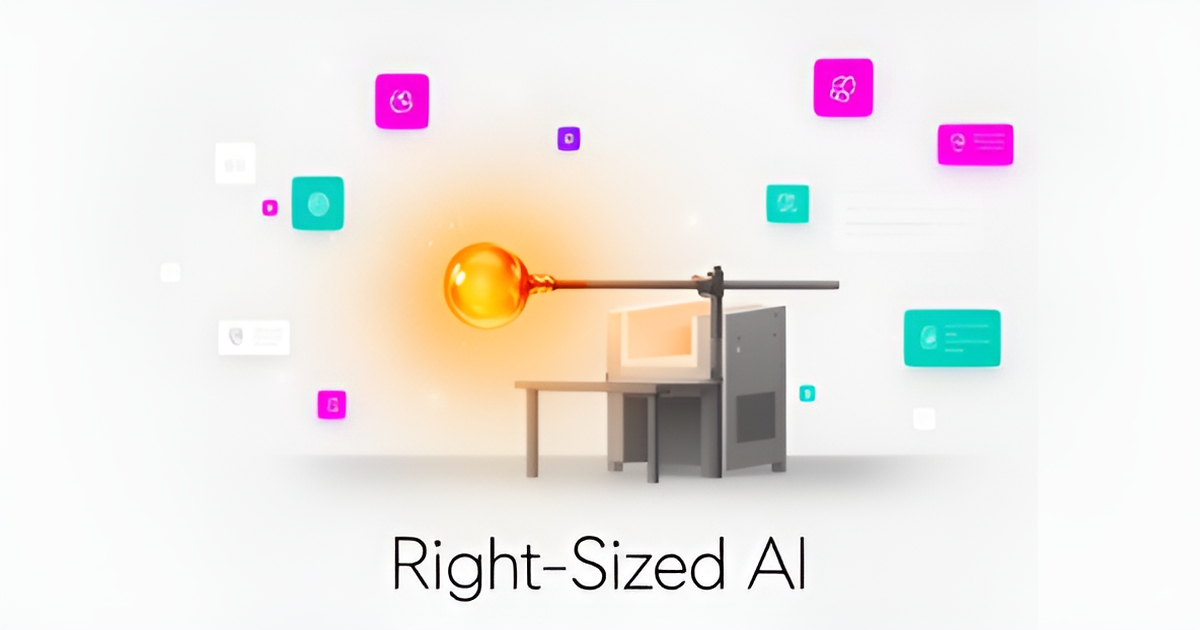
What to Look for in an AI Solution for a Small Glassblowing Studio
Key Facts
- Enterprise AI infrastructure is built for massive scale and creates costly overkill for small creative studios
- Modular AI with smaller, specialized models typically outperforms monolithic enterprise systems for cost-conscious small businesses
- RAG technology grounds AI responses in studio-specific data like glaze formulas rather than generic web content
- Privacy-first design protects proprietary glassblowing techniques and client data from training public AI models
- Multimodal AI capabilities enable visual search of past pieces and color analysis from photos for artisan workflows
- True AI cost includes hidden training hours and integration labor beyond the subscription sticker price
Hire a team member that works 24/7 — for less than a part-time wage.
AI receptionists, SDRs, dispatchers and 99+ roles. Trained on your business, fully managed.
Not sure where to start? Ask our AI planner
The Problem with Enterprise AI for Artisan Studios
Imagine trying to power a single pottery wheel with the electrical grid of a small city. That is the fundamental mismatch when small creative businesses attempt to adopt enterprise-grade AI infrastructure. While tech giants build systems to coordinate swarms of agents across massive data centers, a glassblowing studio needs tools that respect the rhythm of the furnace, not overwhelm it with data-center complexity.
The disconnect begins with scale. Enterprise AI platforms are engineered for Fortune 100 workloads—training models on enormous datasets, serving millions of requests per second, and assuming dedicated IT teams and exabyte-scale data flows. Those metrics are meaningless for a three-person studio managing commission schedules and annealing cycles. When artisan businesses force-fit these solutions, they encounter technical complexity that disrupts rather than supports the tactile, intuitive nature of glasswork.
Cost structures present another barrier. Enterprise platforms emphasize savings through committed-use discounts and spot pricing for batch jobs—models that presuppose massive computational workloads. A studio optimizing kiln firing schedules doesn't need exascale management; it needs affordable, predictable tools. The billions major chipmakers pour into shaving microseconds off server communication highlight how far removed enterprise R&D is from the daily reality of mixing colored glass or managing a gallery client list.
The solution lies not in bigger systems, but in smarter architecture. As of late 2026, AI engineering practice has shifted decisively toward modular, specialized models rather than monolithic enterprise platforms. This approach favors:
- Smaller, task-specific agents that handle discrete workflows like inventory or customer follow-up
- Retrieval-augmented generation (RAG) that grounds AI responses in your specific studio data
- Workflow automation that connects existing tools without requiring a systems engineering degree
- Privacy-first designs that protect proprietary techniques and client information
AIQ Labs approaches this challenge by rejecting the one-size-fits-all enterprise model. Instead of forcing artisan businesses to adapt to rigid corporate infrastructure, effective AI work builds custom systems that mirror existing creative workflows. The goal isn't to replicate a hyperscaler's server farms in a hot shop, but to deploy focused AI Employees that handle administrative overflow—scheduling, invoicing, lead qualification—so artists can focus on the flame.
When evaluating AI for a small studio, the question isn't whether the technology can scale to hyperscale. It's whether it can scale down to the human level, supporting the unique cadence of artisan work without demanding an enterprise budget or a dedicated IT department.
Modular AI: Right-Sized Power for Creative Workflows
The era of monolithic, one-size-fits-all AI systems is giving way to a more surgical approach that favors small creative businesses. Current AI engineering practice favors smaller, specialized models and distributed agent teams rather than relying on single massive systems.
For a glassblowing studio, this modular philosophy means you can automate specific operational bottlenecks without rebuilding your entire technology stack. Instead of purchasing an enterprise platform designed for multinational manufacturers, you deploy targeted solutions that handle discrete tasks while integrating seamlessly with your existing creative workflow.
This approach delivers three immediate advantages for artisan businesses:
- Kiln scheduling and firing optimization that coordinates your production calendar without disrupting creative flow
- Inventory management for raw materials like glass rods, colorants, and gases, tracking usage patterns without enterprise-level complexity
- Gallery commission tracking that manages client communications and delivery timelines while protecting your artistic process
- Cost monitoring that ensures you only pay for the computational power you actually use
The efficiency gains are substantial. Modular AI systems let businesses monitor model costs and performance with precision, avoiding the waste associated with oversized infrastructure. While enterprise solutions might promise scale, they often burden small studios with unnecessary features and steep learning curves that pull focus from the torch.
Industry practice confirms that agentic AI teams—specialized agents handling research, scheduling, or workflow automation—typically outperform single bots for small business applications. These distributed systems allow your studio to maintain human oversight on creative decisions while automating the administrative overhead that consumes studio time.
AIQ Labs builds these right-sized systems using multi-agent architectures that treat each business function as a distinct module. With 200+ multi-agent systems deployed and four live SaaS products the company runs daily, this approach is proven in production, not just in demos. Rather than forcing your studio into a rigid corporate framework, it respects the irregular rhythms of artistic production while ensuring your kiln schedules, inventory levels, and commission pipelines operate with enterprise reliability.
The result is sustainable automation: technology that scales with your artistic practice rather than constraining it, allowing you to focus on the furnace while the AI handles the logistics.
Essential Features: RAG, Multimodal Support, and Privacy
Choosing an AI solution for a glassblowing studio means looking past generic chatbots to features that protect craft and workflow. The right stack grounds responses in your studio data, understands visual work, and keeps creative IP private.
Retrieval-Augmented Generation is non-negotiable for artisan businesses. RAG techniques are essential for making AI responses grounded and useful. For a studio, that means the system can pull from your glaze formulas, firing schedules, client preferences, and past commissions instead of hallucinating generic advice. Drawing on live information and multiple data sources improves practical utility for artisan workflows.
Implementation quality matters more than model size. Core AI engineering skills for small businesses include RAG implementation, chunking and indexing documents for vector databases, and building smart search and retrieval pipelines. A modular AI approach using smaller, specialized models and distributed agent teams is particularly relevant for small businesses that need cost-effective, focused solutions rather than enterprise-scale systems.
Multimodal support is critical for visual arts businesses. Glassblowing lives in images, sketches, and short videos, not just text. Tools should handle visual, written, and potentially audio content related to artistic processes. That enables visual search for previous pieces, analysis of color and form from photos, and richer client brief capture.
Privacy-first design protects creative IP. Privacy-first principles are critical for building trustworthy AI systems, and ethical frameworks must be prioritized as systems scale to maintain compliance and user trust. Your formulas, designs, and client data should never train public models.
When evaluating vendors, check for:
- RAG grounding with studio-owned data sources, not generic web retrieval
- Multimodal inputs for photos of pieces, sketches, and video notes
- Privacy-first architecture with data isolation and clear ownership
- Modular AI that fits artisan workflows without demanding technical overhead
Efficiency trends in enterprise infrastructure show why cost and reliability monitoring matters even at small scale. Hyperscalers obsess over squeezing more output from every accelerator because compute is their biggest line item. Studios won't run that hardware themselves, but the same pressure applies to any AI solution you buy: you should be able to see what it costs, whether it's working, and where it's wasting money.
Not all AI tools are designed for small, creative businesses, making it essential to evaluate key features such as ease of use, creative compatibility, and support for artisan workflows. AIQ Labs ensures that every build is tailored to the unique needs of glassblowing studios, with change management and training built into delivery.
True ownership and privacy-first design keep your studio's creative advantage yours.
Evaluating True Cost: Beyond the Subscription Price
Subscription price is the easiest number to compare and the least honest one for a small studio. The real investment shows up in training time, integration headaches, and features you never use.
DIY enterprise tools look affordable until you price the hidden workload. Teams spend hours learning complex consoles, mapping artisan workflows to rigid templates, and troubleshooting connections between creative tools. That labor cost rarely appears on an invoice but it drains the studio every week.
Managed AI employee models change the math by bundling build, training, integrations, monitoring, and improvements into a flat monthly plan—typically at a fraction of the cost of a human hire for the same administrative work. You pay for outcomes, not seat licenses, and you can pause or adjust anytime. That structure aligns with how small creative businesses operate: low overhead, flexible capacity, and no dedicated IT staff.
Total cost of ownership for AI should be measured beyond the sticker price. Consider these inputs before committing:
- Setup and training hours required from studio owners and staff
- Integration effort to connect scheduling, inventory, CRM, and payment tools
- Ongoing monitoring of cost, reliability, and performance across the setup
- Utilization rate of features versus what is actually needed for artisan workflows
Model cost management is a core discipline for any business running AI, covering monitoring of cost, reliability, and performance across the setup. Without that visibility, costs creep as usage grows and prompts become more complex.
Enterprise infrastructure data shows why active cost control matters. Hyperscalers save substantially on batch and flexible-start workloads through spot pricing and dynamic scheduling—but those savings depend on active management, not a static subscription. A small studio should expect the same discipline from its vendor, not be asked to provide it.
For a glassblowing studio, the practical equivalent is choosing solutions built for ease of use and creative compatibility rather than raw compute. Modular AI approaches using smaller, specialized models and distributed agent teams are particularly relevant for small businesses that need cost-effective, focused solutions rather than enterprise-scale systems. That philosophy reduces waste and keeps the tool aligned with real studio tasks like appointment setting, lead qualification, and inventory notes.
AIQ Labs designs with this reality in mind. Whether you start monthly with managed AI Employees, build one high-cost workflow in milestones at a fixed price, or own your AI operating system outright, the payment model matches the risk to your studio—not the other way around. When the plan includes build, training on your business, tool integrations, monitoring, and improvements, the studio can evaluate true cost against time saved and revenue protected, not just software fees.
Implementation: From Selection to Studio Integration
Deploying AI in a glassblowing studio requires a deliberate, phased approach that respects both creative processes and operational realities. Starting with a clear assessment of current workflows—such as order tracking, inventory management, or customer communication—helps identify where AI can add value without disrupting the hands-on nature of the craft. This initial phase should focus on mapping pain points and defining measurable goals, ensuring any technology introduced serves the artist, not the other way around.
A pilot project is the safest way to test AI integration, allowing the studio to evaluate usability and impact on a small scale before broader adoption. For example, using an AI agent to handle appointment scheduling or lead follow-up can free up studio time while maintaining the personal touch essential to client relationships. Modular AI approaches—leveraging smaller, specialized models and distributed agent teams—are particularly effective for small businesses seeking cost-effective, focused solutions rather than enterprise-scale systems. This method reduces complexity and supports smoother adoption by non-technical users.
Scaling should only follow successful pilot results, with continuous feedback loops to refine the AI's role in supporting artisan workflows. Throughout this process, maintaining human-in-the-loop governance is critical; AI should augment decision-making, not replace the nuanced judgment required in glassblowing. Structuring vendor relationships around flexibility and co-development ensures the technology evolves with the studio's creative needs, preserving ownership and adaptability over time. AIQ Labs supports this journey through phased builds and ongoing optimization tailored to small, creative businesses—starting with a free 30-minute strategy call to map your biggest bottleneck.
Still paying for 10+ subscriptions that don’t talk to each other?
We build custom AI systems you own outright. No vendor lock-in. Full control.
Not sure where to start? Ask our AI planner
Frequently Asked Questions
Why doesn't enterprise AI infrastructure designed for big tech work for a small glassblowing studio?
What specific features should I look for in an AI solution for my glassblowing studio?
How can I avoid paying for AI features I'll never use as a small studio?
What's the true cost of AI beyond the subscription price for a small creative business?
How do I implement AI in my glassblowing studio without disrupting my creative process?
Keep the Flame, Automate the Logistics
The right AI for a small glassblowing studio isn't about matching enterprise scale — it's about matching studio rhythm. Enterprise hypercomputers and exascale pricing solve problems you don't have, while creating complexity, cost creep, and creative friction you can't afford. What matters is modular, task-specific agents grounded in your own data with RAG, multimodal support for photos and sketches, and privacy-first design that protects proprietary techniques and client trust. True cost is measured in training time, integration effort, and how much of the tool you actually use, not just the subscription price. Implementation works best as a phased pilot — map one pain point, prove value, then scale with human-in-the-loop oversight. As AI adoption keeps expanding across businesses of every size, the studios that win will be those that keep the craft human and let focused automation handle the admin. If you want clarity on where that fit is for your studio, start the 2-minute Fit Check at aiqlabs.ai/apply for a free 30-minute strategy call to map your biggest bottleneck and identify high-ROI automation opportunities.
Make AI your competitive advantage — not just another tool.
Strategy, implementation and ongoing optimization. One partner, end to end.
Not sure where to start? Ask our AI planner