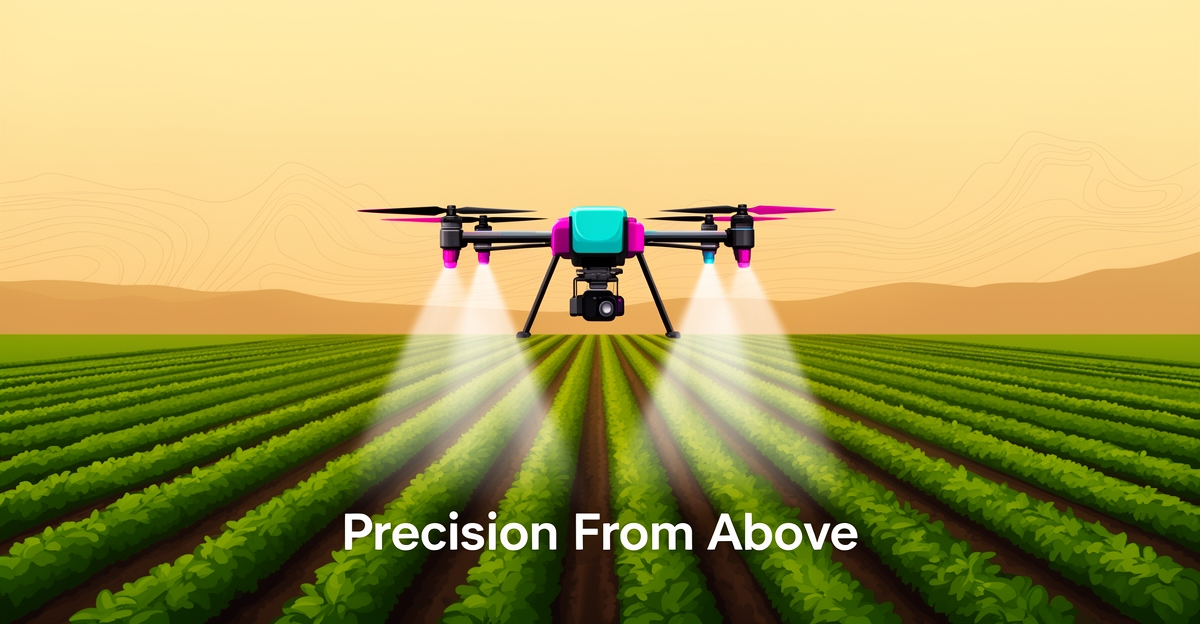
What to Look for in an AI Solution for Crop Dusting Operations
Key Facts
- Low-altitude drones reduce chemical drift by 90% compared to traditional crop dusters, according to industry research
- Precision spraying drones cut chemical use by 30% while driving droplets deep into dense canopies for superior coverage, according to agricultural data
- AI-powered systems like John Deere See & Spray reduce herbicide use by up to 80% compared to broadcast methods, according to industry analysis
- Terrain-following sensors enable safe flight at consistent heights over uneven ground using high-accuracy GPS and real-time field mapping, according to operational data
- Agricultural drones operate post-rain and navigate waterlogged fields or dense canopies without delays when ground rigs cannot access fields, according to field research
- Precision drift control systems regulate spray flow rate, droplet size, and speed in real-time to minimize chemical waste, according to drone specifications
- The best AI agriculture tools deliver predictive analytics and real-time insights rather than simple automation for in-flight corrections, according to industry analysis
Hire a team member that works 24/7 — for less than a part-time wage.
AI receptionists, SDRs, dispatchers and 99+ roles. Trained on your business, fully managed.
Not sure where to start? Ask our AI planner
Why Generic AI Fails in Agricultural Aviation
Generic AI solutions often promise broad capabilities but lack the specialized understanding required for effective crop dusting operations. These off-the-shelf tools are typically designed for general agricultural data and fail to address the complex interplay of terrain variability, weather sensitivity, and regulatory constraints inherent in aerial spraying. Without deep domain integration, such systems deliver superficial insights that do not translate into safer, more efficient flight paths or reduced chemical drift.
Crop dusting demands real-time adaptation to micro-environmental conditions that generic platforms cannot interpret. For instance, drones used in precision spraying operate at low altitudes to reduce drift by up to 90% compared to traditional crop dusters, a capability that requires AI models trained specifically on altitude-sensitive spray dynamics and localized wind patterns. Similarly, targeted spraying enabled by AI-driven nozzle systems can cut chemical use by 30% while improving coverage—benefits only achievable when the AI understands crop canopy density, spray droplet behavior, and field-specific topography in real time.
- AI must process high-accuracy GPS and terrain-following data to maintain consistent flight height over uneven ground
- Intelligent flight path planning avoids obstacles like power lines and trees while minimizing battery usage
- Precision drift control adjusts spray flow, droplet size, and speed in real time based on sensor feedback
Generic AI lacks the regulatory awareness needed to navigate spraying restrictions near water sources, residential zones, or protected habitats—compliance factors that vary by region and change with weather conditions. It also fails to integrate meaningfully with flight logistics software, payload management systems, or pilot communication tools used in crop dusting operations. As a result, farmers and spraying contractors face increased risk of over-application, environmental penalties, or ineffective treatment due to AI that cannot operationalize field-level nuances.
AIQ Labs addresses this gap by building purpose-built AI systems that embed agricultural aviation expertise directly into the model’s decision-making logic. Rather than adapting generic tools, we develop solutions that reflect the operational realities of low-altitude spraying—where safety, precision, and environmental stewardship are non-negotiable. This ensures AI doesn’t just analyze data, but actively supports mission-critical decisions in the cockpit and on the ground.
The Four Non-Negotiable Capabilities for Crop Dusting AI
Selecting the right AI platform for aerial application means separating purpose-built intelligence from generic automation wrapped in agricultural branding. The operational stakes—chemical costs, regulatory exposure, and pilot safety—demand systems that understand the physics of spray drift and the reality of variable field conditions. AIQ Labs evaluates these solutions against the same deployment standards we apply to our own production AI portfolio, where 70-plus agents operate daily in regulated, real-world environments.
Industry-specific knowledge forms the baseline. Effective AI must model droplet behavior across canopy densities, adjust for thermal inversions, and optimize swath width for specific airframes—whether fixed-wing, rotorcraft, or heavy-lift UAVs. Research confirms that low-altitude drone operations reduce drift by 90% compared to traditional crop dusters, but only when flight control systems integrate real-time meteorological data with nozzle-level precision. Generic computer vision models cannot replace domain logic built on spray physics and chemical label requirements.
Regulatory compliance tracking is non-negotiable. EPA pesticide labels, state restricted-use permits, buffer zone mandates, and Part 137 operating certificates create a compliance matrix that changes by field, crop, and application window. AI systems must embed these constraints into mission planning—automatically flagging setback violations, wind-speed exceedances, and record-keeping gaps before the aircraft leaves the ground. The precision drift control systems on modern crop dusting drones demonstrate how integrated sensors regulate flow rate and droplet size in real time to maintain legal compliance across variable conditions.
Seamless integration with existing fleet management, mapping, and precision ag platforms determines whether AI becomes a force multiplier or a data silo. The operational workflow depends on field boundary imports from GIS systems, prescription maps from agronomy platforms, and as-applied data exports for grower reporting and insurance. AI that cannot ingest shapefiles, write standard log formats, or synchronize with dispatch software creates more friction than value.
- Spray physics modeling tuned to airframe and chemical properties
- Automated regulatory validation against EPA and state databases
- Native interoperability with major ag data platforms and fleet tools
- Real-time performance telemetry across weather and terrain variability
Real-time performance monitoring closes the loop. Variable field conditions—wind shear at field edges, temperature gradients across rolling terrain, humidity shifts during long missions—require continuous adaptation. Systems that log only planned versus actual coverage miss the diagnostic data needed to improve subsequent passes. The best AI agriculture tools deliver predictive analytics and real-time insights that enable in-flight correction and post-mission optimization, turning each application into a calibration event for the next.
How Precision AI Reduces Chemical Waste and Drift by 30-90%
The gap between traditional aerial spraying and AI-guided precision application isn't marginal—it's transformational. According to industry research, drones operating at low altitudes reduce chemical drift by 90% compared to conventional crop dusters while cutting overall chemical use by 30%.
These results stem from three technical capabilities working in concert. First, real-time droplet size adjustment allows systems to modify spray characteristics mid-flight based on wind speed, humidity, and target canopy density. This dynamic control ensures chemicals land where intended rather than drifting onto neighboring properties or waterways.
Second, terrain-following sensors maintain consistent altitude above crops regardless of field topography. As noted in agricultural drone analysis, this technology enables safe flight at consistent heights over uneven terrain, ensuring uniform application that ground rigs and fixed-altitude aircraft cannot match.
Third, intelligent flight path optimization calculates the most efficient routes before takeoff. The software maps obstacles, plans overlapping spray patterns for complete coverage, and minimizes battery consumption—eliminating the guesswork that leads to over-application or missed strips.
When evaluating AI solutions for your operation, verify these specific capabilities:
- Variable rate technology that adjusts flow based on prescription maps and real-time sensor data
- Obstacle detection and automatic route recalculation for complex field boundaries
- Post-application analytics showing actual versus planned coverage and chemical usage
- Integration with existing farm management software for seamless data flow
The environmental and economic stakes are significant. Recent industry analysis shows that targeted spraying systems can reduce herbicide use by up to 80% compared to broadcast methods, while precision application protects soil structure and root health by eliminating ground compaction.
AIQ Labs builds these systems specifically for agricultural realities—weather variability, rugged terrain, and strict regulatory compliance. Rather than adapting generic drone software, we architect solutions that account for your specific crop types, field topography, and chemical handling requirements, ensuring the 30-90% efficiency gains translate directly to your bottom line.
Building AI That Works in Real Field Conditions
When evaluating AI solutions for crop dusting, the most critical test is whether the system survives contact with reality. Field conditions rarely cooperate with algorithms trained on pristine datasets or controlled environments.
Real-world agricultural operations demand AI that functions when fields are waterlogged, canopies are dense, and terrain becomes unpredictable. According to industry research, effective agricultural systems must operate post-rain and navigate dense canopies while maintaining precision. This isn't optional functionality—it's the baseline requirement for any serious crop dusting operation.
Integration with existing GPS and weather systems separates viable solutions from expensive experiments. The AI must process real-time meteorological data to adjust spray patterns dynamically, accounting for wind shifts and humidity changes that alter droplet behavior. Systems that require manual recalibration every time conditions change create operational bottlenecks that negate efficiency gains.
When assessing vendor claims, demand a rigorous evaluation framework that tests against actual field variability:
- Post-rain adaptability: Verify the system maintains accuracy when soil moisture levels spike and access becomes limited
- Dense canopy penetration: Confirm the AI can drive droplets deep into thick vegetation for superior coverage, potentially reducing chemical use by 30% through targeted application
- Terrain compensation: Ensure the solution handles uneven ground and elevation changes without manual intervention
- Drift reduction capabilities: Look for systems that operate at low altitudes with precision control, potentially reducing drift by up to 90% compared to traditional methods
- Actionable data output: Require real-time analytics that provide immediate operational insights, not just historical reports
Many vendors showcase impressive demos using ideal conditions. However, operational data indicates that true value emerges when AI maintains performance during the challenging windows—immediately after rainfall or during peak canopy density—when treatment timing proves most critical.
AIQ Labs approaches implementation by stress-testing systems against these exact agricultural realities. Rather than deploying generic automation tools, the focus remains on building custom solutions that account for weather variability, terrain complexity, and the specific regulatory requirements of aerial application.
The evaluation process should include field trials during suboptimal conditions, not just perfect weather demonstrations. Request documentation showing how the AI adjusts flight parameters when GPS signals weaken or when weather stations report sudden changes in wind speed. Industry analysis emphasizes that the best agricultural AI tools provide predictive analytics and real-time insights rather than simple automation.
Ultimately, the right AI solution transforms crop dusting from a weather-dependent gamble into a data-driven operation. By prioritizing systems that excel in mud, humidity, and dense vegetation—rather than just sunny test plots—operators ensure their investment delivers returns when it matters most.
Still paying for 10+ subscriptions that don’t talk to each other?
We build custom AI systems you own outright. No vendor lock-in. Full control.
Not sure where to start? Ask our AI planner
Frequently Asked Questions
Why do generic AI tools fail for crop dusting operations?
How much can AI-guided drone spraying actually reduce chemical drift and usage?
What regulatory compliance features should I look for in crop dusting AI?
Can these AI systems handle real-world field conditions like mud, dense canopies, and sudden weather changes?
How does AI-guided spraying integrate with my existing farm management software and GIS data?
What's the difference between basic drone software and purpose-built AI for agricultural aviation?
From Test Plots to Real Fields: Choosing AI That Earns Its Keep
Crop dusting AI only delivers value when it understands spray physics, terrain variability, weather shifts, and the regulatory matrix that changes by field and application window. Generic platforms miss the mark because they can’t process high-accuracy GPS and terrain-following data, adapt nozzle flow and droplet size in real time, or embed EPA and state compliance into mission planning. The right solution combines industry-specific knowledge, automated regulatory validation, seamless integration with fleet and farm management tools, and continuous performance telemetry so each pass improves the next. That purpose-built approach is what turns the documented gains of low-altitude precision — up to 90% less drift compared to traditional crop dusters — into safer operations, lower chemical costs, and defensible compliance. AIQ Labs builds custom AI systems for agricultural aviation realities rather than adapting generic drone software, ensuring the 30-90% efficiency improvements translate to your bottom line. Start the Fit Check at https://aiqlabs.ai/apply for a free 30-minute strategy call to map your biggest bottleneck and identify high-ROI automation opportunities, with no obligation if there isn’t a clear win.
Make AI your competitive advantage — not just another tool.
Strategy, implementation and ongoing optimization. One partner, end to end.
Not sure where to start? Ask our AI planner