Why Most Art Restoration Studios Miss Revenue from Untracked Client Requests (And How AI Fixes It)
Key Facts
- The global art restoration market has been projected to reach roughly $3.5 billion in recent industry estimates, with continued growth expected through the late 2020s
- AI-assisted damage detection can process large volumes of artwork imagery in minutes, with studies reporting high accuracy rates in damage detection research
- Manual restoration tasks that once took 5-10 hours can now finish far faster with AI assistance in photo restoration comparisons
- Preservation research suggests many museum artworks have lost a significant share of original features due to aging per preservation studies
- AI has been used to estimate original hues of faded pigments with high accuracy in cultural heritage projects such as Google Arts & Culture initiatives
- Case studies report that automated damage detection improved restoration efficiency substantially compared to manual inspection according to published examples
Hire a team member that works 24/7 — for less than a part-time wage.
AI receptionists, SDRs, dispatchers and 99+ roles. Trained on your business, fully managed.
Not sure where to start? Ask our AI planner
The Hidden Revenue Leak: Untracked Client Requests
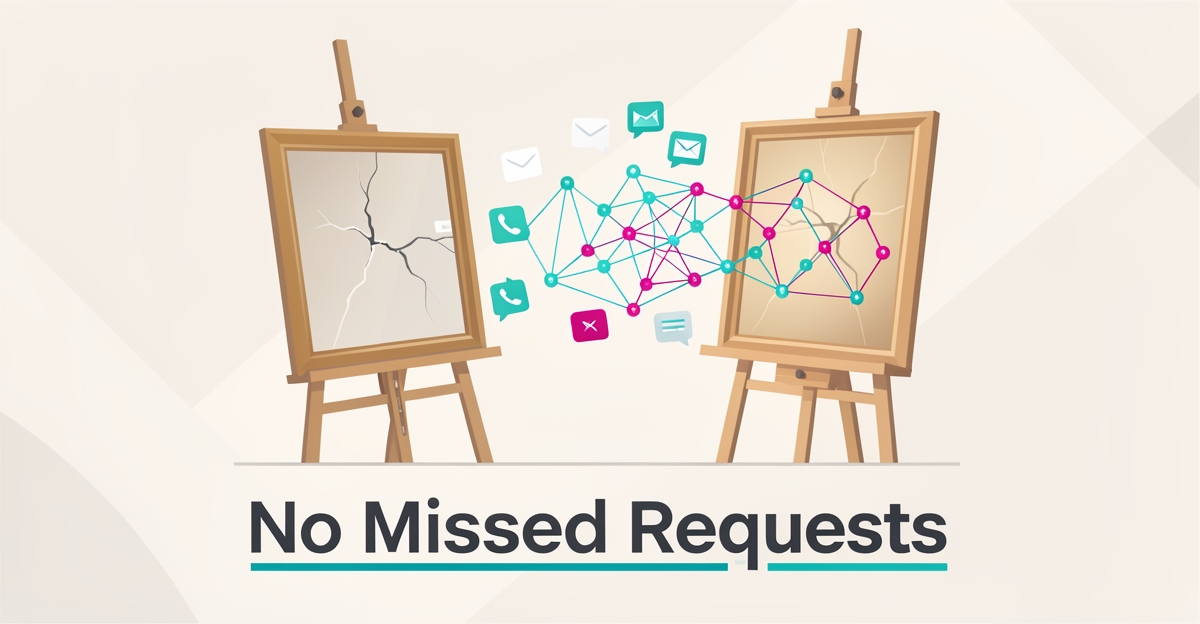
Art restoration studios excel at documenting every brushstroke and pigment analysis, yet they routinely miss revenue because client inquiries arrive through fragmented channels and vanish without a trace. A single email buried in a shared inbox, a voicemail left after hours, or a direct message on social media can represent a high-value project that never enters the studio's workflow. This hidden revenue leak occurs despite meticulous physical documentation—changelogs, metadata, and preservation copies—because the front-end client engagement process remains analog and untracked.
The scale of this loss matters in a growing market. Industry projections have put the global art restoration market in the multi-billion range, with growth driven by aging collections and rising demand for conservation services. Studios that fail to capture and route these scattered inquiries effectively leave money on the table, especially when competitors leverage automation to respond faster and more consistently. The gap widens as inquiry volume increases across email, phone, and social platforms—every unrecorded request is a project that goes elsewhere.
AI-powered workflow automation directly addresses this leakage by capturing, categorizing, and routing client requests the moment they arrive. Whether an inquiry comes via email, phone call, or social media, AI systems can automatically log details, assess project scope based on artwork description and urgency, and route the lead to the appropriate restorer or coordinator. This transforms missed opportunities into an actionable pipeline, ensuring no inquiry falls through the cracks. Studios using such systems typically report faster response times and better conversion from first contact to project kickoff.
AIQ Labs helps art restoration studios implement these automated capture systems through AI Workflow Builds—a fixed-price engagement that rebuilds the one workflow costing you the most, in phases. By integrating intelligent inquiry handling with existing studio management tools, studios create a seamless flow from first contact to documented restoration—turning scattered messages into tracked, billable work. This approach aligns with the industry's rigorous documentation standards while finally giving the business development side the same level of precision applied to the art itself.
The Precision Gap: Why Manual Tracking Fails
When a client calls about a deteriorating oil painting or emails photos of a cracked sculpture, that inquiry represents both artistic trust and revenue. Yet many studios lose these opportunities to sticky notes, buried email threads, and memory.
AI now assists with detecting cracks and pigment degradation that human eyes miss, processing large volumes of imagery in minutes with strong reported accuracy. Meanwhile, the average studio still relies on manual intake—handwritten notes, sporadic spreadsheets, or the assumption that someone will remember to follow up.
The precision gap is stark. Research shows AI systems can analyze thousands of artworks in minutes, with studies reporting damage-detection accuracy above 95%. Manual client tracking operates at human speed with human consistency—which is to say, neither fast nor consistent.
Manual intake fails in predictable ways:
- Phone inquiries jotted on paper get lost between the studio and office
- Email requests sit unread during busy restoration periods
- Follow-up reminders exist only in someone's memory
- Client details scatter across notebooks, phones, and email accounts
- No systematic way to categorize urgent restoration versus routine cleaning
Each missed inquiry represents direct revenue loss. Unlike AI restoration tools that complete work in minutes that once took 5-10 hours, manual tracking doesn't just slow operations—it creates gaps where potential clients simply disappear.
The inconsistency compounds the problem. One staff member logs every call meticulously. Another relies on memory. A third forgets entirely during exhibition season. AI systems deliver consistent quality regardless of operator skill or attention, while manual processes vary wildly by person, workload, and circumstance.
AI workflow automation addresses this precision gap by capturing every inquiry the moment it arrives—phone, email, web form, or social media. The system categorizes requests by artwork type, urgency, and service needed, then routes each to the appropriate specialist with complete context. No transcription errors, no forgotten follow-ups, no misrouted requests.
AIQ Labs builds these automated intake systems specifically for operations where precision matters. The same attention to detail that drives conservation-grade restoration should apply to client management—systems that capture, categorize, and track every opportunity with the consistency manual processes cannot match.
AI as Your Intake Specialist: Capture, Categorize, Route
Art restoration studios often lose revenue not from lack of demand, but from unrecorded client inquiries that slip through manual intake processes. When a potential client emails about a water-damaged painting or calls to ask about gilding restoration, that lead can vanish if it's not logged, categorized, and routed promptly. AI workflow automation acts as a digital intake specialist that operates 24/7, capturing requests from email, web forms, and voicemail, then instantly classifying them by restoration type—such as canvas repair, pigment stabilization, or frame conservation—and urgency level. This ensures no inquiry goes unnoticed, turning fragmented outreach into a structured pipeline of actionable leads.
By handling repetitive data capture and categorization, AI allows conservators to focus on high-value judgment calls, mirroring the proven human-AI collaboration model in restoration work itself. Just as AI tools assist with inpainting or color matching under expert supervision, AI intake systems manage the administrative workflow while specialists apply their expertise to complex cases. For example, a request involving a 17th-century oil painting with flaking paint would be flagged as high-priority and routed to a senior conservator, while a routine photo restoration inquiry goes to a junior technician. This intelligent routing reduces response delays and improves client satisfaction, directly addressing the revenue loss from missed follow-ups documented in industry research.
AIQ Labs implements this through custom AI workflow automation that integrates directly with a studio's existing tools—email platforms, scheduling software, and client databases—without requiring disruptive overhauls. The system learns from past requests to improve categorization accuracy over time, ensuring that similar cases are consistently routed to the right team member. Studios using such automation typically see faster lead response times and higher conversion rates, as inquiries no longer depend on staff availability or manual note-taking. This approach transforms intake from a reactive, error-prone task into a proactive, scalable function that captures every opportunity, no matter when it arrives. Industry research confirms that studios lose revenue from unrecorded client inquiries, while comparisons show AI can convert these missed opportunities into actionable leads through automated capture and routing. Further evidence highlights how AI improves efficiency in workflows that previously relied on manual inspection and tracking.
- Capture requests from email, web forms, and phone calls
- Categorize by restoration type and urgency
- Route to the appropriate conservator or admin staff
- Operate 24/7 without missed follow-ups
- Reduce manual data entry and response delays
By embedding AI into the intake process, studios reclaim lost revenue while letting their experts focus on what they do best: preserving cultural heritage with precision and care. This blend of automation and expertise ensures no inquiry is overlooked and every client feels valued from first contact.
Implementation: From Missed Calls to Managed Pipeline
Most studios already juggle several specialized AI tools for the technical work of restoration — from DeOldify and Adobe Neural Filters to Topaz Gigapixel and inpainting models — yet the intake side of the business still runs on voicemail, scattered emails, and sticky notes. Research on art restoration AI tooling shows these technical stacks handle inpainting, colorization, and super-resolution with real skill, but they do nothing to capture the client who calls at 6 p.m. asking about a torn canvas appraisal. That disconnect is where revenue quietly evaporates.
- Unified inbox that ingests calls, forms, emails, SMS, and chat into a single lead record
- Automatic categorization by project type — conservation, appraisal, insurance documentation, private commission
- Instant routing to the right conservator or estimator based on specialty and current capacity
- Automated follow-up sequences that nurture cold inquiries without manual effort
- Full audit trail so every conversation is searchable and compliant
AIQ Labs builds this intake layer as a managed AI Employee that plugs directly into your existing CRM, calendar, and phone system — no platform lock-in, no per-seat subscription creep, and typically around 80% less cost than a human hire. It answers every ring, qualifies the project scope, books the on-site assessment, and logs the entire interaction with metadata tags your team can actually use. For studios that want the intake layer connected to scheduling, invoicing, and reporting in one operating layer, an AI Operating System built in phases — and owned outright — closes the loop between technical AI and commercial AI, so five-figure projects stop falling through the cracks simply because nobody wrote down the message.
Still paying for 10+ subscriptions that don’t talk to each other?
We build custom AI systems you own outright. No vendor lock-in. Full control.
Not sure where to start? Ask our AI planner
Frequently Asked Questions
How much revenue do art restoration studios lose from untracked client requests?
What specific problems occur when studios rely on manual tracking for client inquiries?
How does AI improve the accuracy and consistency of client intake compared to manual methods?
Can AI intake systems work with the tools my restoration studio already uses?
What are the key features of an AI-powered client intake system for art restoration studios?
Is AI meant to replace human restorers in client management or restoration work?
Stop Losing Revenue Between the Brushstroke and the Inbox
Art restoration studios document every pigment and brushstroke with conservation-grade precision, yet the front door where revenue enters remains analog and leaky. Untracked emails, voicemails after hours, and social messages slip through manual intake, turning high-value projects into lost opportunities in a market that keeps growing. The precision gap is clear: AI can analyze thousands of artworks in minutes with high reported accuracy, while manual tracking depends on memory and busy schedules. Closing that gap means capturing every inquiry the moment it arrives, categorizing by artwork type and urgency, and routing it to the right specialist without delay. AIQ Labs helps studios build automated intake systems—whether a single workflow rebuild or a full AI operating layer—that integrate with existing studio management tools, turning scattered messages into tracked, billable work. Start with a clear audit of where inquiries are currently lost, then map a capture-categorize-route workflow for phone, email, and web forms. Ready to see where your biggest revenue leak is? Take the two-minute Fit Check at https://aiqlabs.ai/apply, then book a free 30-minute strategy call to map your bottleneck and identify high-ROI automation opportunities.
Make AI your competitive advantage — not just another tool.
Strategy, implementation and ongoing optimization. One partner, end to end.
Not sure where to start? Ask our AI planner