Why Most ATV/UTV Dealerships Fail at AI Implementation
Key Facts
- Industry analyses as of late 2026 estimate that a large majority of AI projects fail to deliver measurable value.
- Research such as RAND Corporation's analysis attributes most AI failures to leadership and organizational issues, not broken technology.
- While most organizations now use AI somewhere, only a small minority report a meaningful earnings impact, per recent McKinsey survey findings.
- Gartner has estimated that roughly half of AI projects never reach production, stalling before delivering any business value.
- Successful AI teams typically spend 50-70% of project time on data readiness before scaling.
- A phased “Safety Zone” approach—validating AI internally before any customer exposure—has produced accuracy benchmarks around 90% in dealership pilots.
Hire a team member that works 24/7 — for less than a part-time wage.
AI receptionists, SDRs, dispatchers and 99+ roles. Trained on your business, fully managed.
Not sure where to start? Ask our AI planner
The Real Reason AI Projects Fail in Dealerships
Here's an uncomfortable truth for ATV/UTV dealership owners investing in AI: the technology usually works. The project around it is what collapses. Research consistently shows that AI failure is a strategy and organization problem, not a software problem—and dealerships that understand this before spending a dollar are the ones that see returns.
The numbers are stark. Industry analyses as of late 2026 estimate that most AI projects fail to deliver measurable business value, and research such as RAND Corporation's analysis attributes roughly 84% of those failures to leadership and organizational factors—shifting objectives, lack of team buy-in, unrealistic timelines—rather than broken technology. Gartner has estimated that around half of AI projects never even reach production.
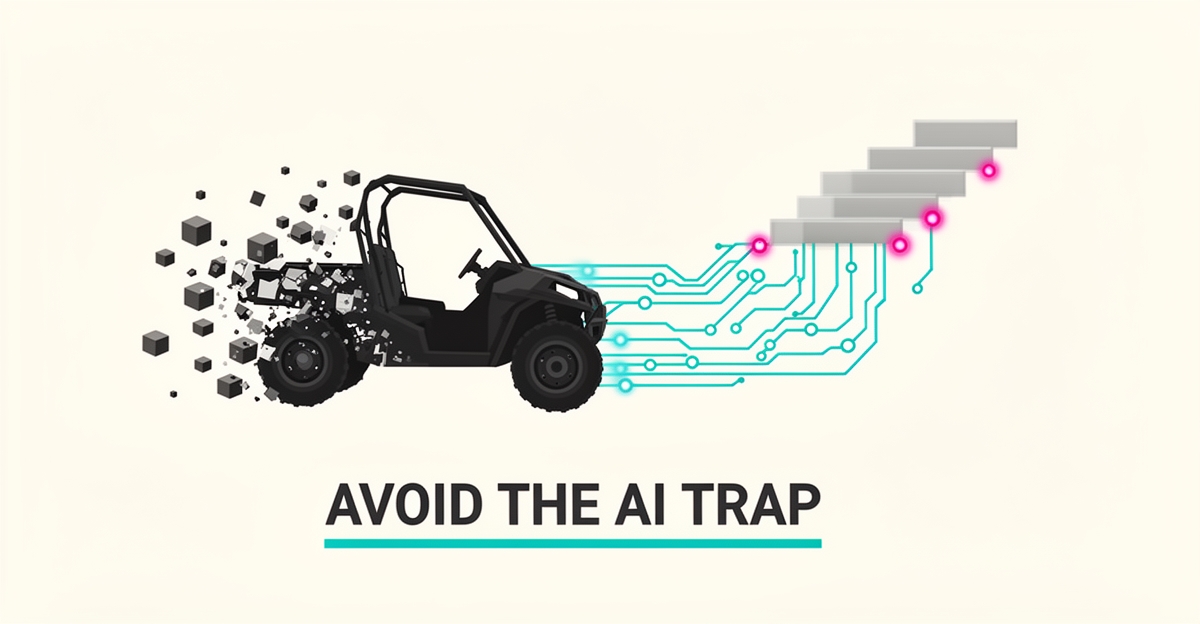
The most common trap is chasing technology before defining a business problem. A dealership buys an AI tool because a vendor pitched it at a trade show, then scrambles to find a use for it. As RAND's research puts it, AI doesn't fail because the technology is broken—it fails because companies chase the technology before they understand the problem.
For ATV/UTV dealerships, this shows up in predictable ways:
- Fragmented data scattered across the DMS, service scheduler, and parts inventory, leaving AI disconnected from core workflows
- Processes that were never redesigned, so AI gets bolted onto broken workflows
- Teams given no training on how to evaluate or trust AI output
- No single manager who owns the KPI the AI was supposed to improve
The result is what industry analysts call the "extra tool" trap: AI that sits unused on a screen while staff keep working the way they always have. Most dealerships don't fail because the model is weak—they fail because the data is fragmented, the process isn't redesigned, the team isn't trained, and the KPI isn't owned by management.
The broader market tells the same story. While McKinsey's 2025 survey found 78% of organizations now use AI in at least one function, only 17% reported it contributing more than 5% of their earnings. Adoption is nearly universal; value is rare.
This is exactly why AIQ Labs begins every dealership engagement by identifying the one workflow that costs the most—whether that's missed service calls, slow dispatch, or unconverted leads—before recommending any technology. The right starting question isn't "should we use AI?" It's "which process should AI improve first to create margin fast?" Dealerships that answer that question honestly, before buying anything, avoid becoming another failure statistic. That's the thinking behind our AI Workflow Builds, which rebuild a single high-cost workflow at a fixed price, in phases.
Why Service and After-Sales Is Your Safest AI Starting Point
For ATV/UTV dealerships, the most reliable path to AI value begins not with flashy sales tools, but in the service and after-sales department. This area is a proven data-rich environment where AI can protect existing revenue and deliver measurable improvements quickly. Starting here avoids the common pitfall of chasing technology before understanding the problem, a misstep responsible for the vast majority of AI project failures according to RAND Corporation research. Leadership and organizational factors drive most failures, not the technology itself, making a low-risk, high-impact starting point essential.
The service drive is already profitable, interacts with customers more frequently than sales, and contains clean, actionable data ideal for initial AI applications. Focusing on specific processes like appointment booking, recall and maintenance reminders, or workshop scheduling allows dealerships to target high-impact use cases with measurable outputs. The goal is not to be first with AI, but to be right with AI—improving a service process to create margin fast. Starting in the service drive protects fixed operations revenue by identifying at-risk customers and optimizing workshop efficiency, where even small improvements can significantly impact profitability.
A phased approach ensures safety and scalability. Begin with an internal-only "Safety Zone" phase—using AI for tasks like document processing—to reach high accuracy (around 90%) before any customer exposure. Controlled testing follows, exposing AI to a small percentage of customer interactions with human oversight. Gradual scaling over roughly 8 weeks (0% → 20% → 50% → 100% exposure) minimizes risk while building confidence. This method aligns with how AIQ Labs deploys AI Employees—managed AI receptionists, dispatchers, and service coordinators that work alongside your team at a fraction of the cost of a human hire, with accuracy validated before full handoff. By grounding AI in service operations first, dealerships establish a reliable foundation for broader transformation.
The 3-Phase Pilot Framework That De-Risks AI
The path to AI success begins not with technology, but with a process. For dealerships, starting in the service drive offers the safest, highest-impact entry point where data is clean and ROI emerges quickly. A structured, phased approach is essential to avoid the failure pattern that plagues AI initiatives due to strategic missteps rather than technical flaws.
The 3-Phase Pilot Framework provides a clear roadmap to de-risk implementation. Phase 1, the Safety Zone, focuses exclusively on internal processes with no customer exposure. Teams work with limited data sets to reach a minimum 90% accuracy target—mirroring results seen in real-world pilots where document processing hit this benchmark before any customer interaction. This phase runs under a fixed discovery budget with explicit go/no-go criteria based on accuracy and data integration milestones.
Phase 2, Controlled Testing, introduces AI to 20% of customer interactions while maintaining parallel human oversight. Real-time monitoring and immediate fallback options ensure any issues are caught before they impact the customer experience. Budget protection continues through weekly review points, allowing teams to pause or adjust based on performance data rather than assumptions.
Phase 3, Safe Scaling, uses a gradual exposure timeline: 0% customer exposure in weeks 1-2, 20% in weeks 3-4, 50% in weeks 5-6, and full implementation by weeks 7-8. Scaling only occurs after validating accuracy and workforce readiness in prior phases. This method prevents the "extra tool" trap where AI sits unused alongside legacy processes by ensuring data flows are integrated across DMS, service agenda, and advisor workflows before scaling.
AIQ Labs supports dealerships through each phase with milestone-based builds, readiness checks, and governance frameworks that turn AI from a risky experiment into a sustainable capability. You can start monthly, build in milestones, or own the system outright—so you're never locked into a large upfront bet before the pilot proves itself. The framework's strength lies in its discipline—prioritizing internal validation, budget control, and team readiness over speed or spectacle. By following this phased approach, dealerships convert AI's promise into measurable margin without exposing their operations to unnecessary risk.
Data, Governance and Workforce Readiness as Margin Multipliers
Data fragmentation across dealership management systems and service platforms is the silent killer of AI initiatives. When customer, inventory, and service data live in disconnected silos, AI models lack the holistic view needed to drive meaningful automation. Most dealerships fail not because the AI technology is flawed, but because fragmented data turns AI into an "extra tool" instead of a productivity engine. Winning teams recognize that 50–70% of project effort must go into data readiness—integrating flows across DMS, service agenda, and advisor workflows—before any model sees production.
Governance must precede scale to prevent operational risk and ensure accountability. Deploying AI without clear oversight frameworks creates exposure, especially in regulated contexts where responsibility cannot shift to the algorithm. As noted in tech industry analysis, organizations that layer AI onto human-built processes without updating governance face unclear handoffs and undefined escalation paths. AIQ Labs emphasizes building governance infrastructure early, giving domain stewards real authority over model performance and establishing audit trails before expanding use cases. For dealerships that want everything connected—DMS, service, parts, and communications under one operating layer—our AI Operating Systems offering is built in phases and owned outright, so governance and data flows are designed in from day one.
Workforce readiness is the final margin multiplier, transforming skepticism into sustained adoption. Junior staff reviewing AI output without structured training create significant risk, as validating AI requires different skills than generating it. Successful implementations invest in formal programs that teach employees when to trust AI, when to question it, and when to escalate—turning potential liability into a competitive advantage. This disciplined approach ensures AI becomes embedded in daily workflows rather than abandoned as another underused tool.
Still paying for 10+ subscriptions that don’t talk to each other?
We build custom AI systems you own outright. No vendor lock-in. Full control.
Not sure where to start? Ask our AI planner
Frequently Asked Questions
Why do so many ATV/UTV dealerships fail at AI even when the tech works?
Is it true that most AI projects never deliver real business value?
Where should we start with AI in a dealership to avoid wasting money?
How can we de-risk an AI pilot before exposing customers?
What’s the biggest hidden reason AI becomes just another unused tool?
Do we need governance before we scale AI?
Turn AI Potential into Service-Drive Profit
The pattern is clear: AI projects in ATV/UTV dealerships don’t fail because the technology is weak—they fail when strategy, data, and people aren’t aligned. Most AI implementation breakdowns stem from leadership and organizational factors, not software flaws. The path forward starts not with chasing tools, but with targeting a high-impact service process—like appointment booking or recall management—where clean data and fast ROI create a foundation for scale. By beginning with an internal Safety Zone phase, investing in workforce readiness, and integrating AI across DMS and service workflows, dealerships avoid the 'extra tool' trap and turn AI into a measurable margin driver. If you're ready to assess where AI can create real value in your service drive without the risk, take AIQ Labs' 2-minute Fit Check to see if there’s a clear win—no obligation, just clarity. From there, a free 30-minute strategy call maps your biggest bottleneck and the highest-ROI place to start.
Make AI your competitive advantage — not just another tool.
Strategy, implementation and ongoing optimization. One partner, end to end.
Not sure where to start? Ask our AI planner