Back to Blog

Why Most Civil Engineering Firms Still Use Manual Field Data Logging (And How to Fix It)

AI Business Process Automation > AI Workflow & Task Automation21 min read

Why Most Civil Engineering Firms Still Use Manual Field Data Logging (And How to Fix It)

Key Facts

  • Civil engineering firms save hours or even weeks by automating Civil 3D tasks like plan production.
  • AI-based visual inspection achieves 97% to 99% detection accuracy in specific bridge inspection cases.
  • Automating repetitive administrative tasks leads to a notable reduction in human error and enhances workflow consistency.
  • A shortage of AI-literate personnel and cultural resistance are major barriers to automation adoption.
  • Manual processes like paper checklists and static PDFs are significant productivity bottlenecks in monthly reporting.
  • Generative AI systems like AutoRepo automatically generate complete and compliant site inspection reports from drone imagery.
  • Obtaining sufficient labeled data is especially hard for rare events like structural failures, limiting supervised learning.
AI Employees

What if you could hire a team member that works 24/7 for $599/month?

AI Receptionists, SDRs, Dispatchers, and 99+ roles. Fully trained. Fully managed. Zero sick days.

Introduction: The Paper Trail That's Holding You Back

Your most valuable field data is currently trapped in a paper trail that’s holding you back, creating invisible bottlenecks that stifle growth. While your competitors race toward automation, many civil engineering firms remain anchored by manual logging, risking accuracy and profitability in an increasingly fast-paced industry.

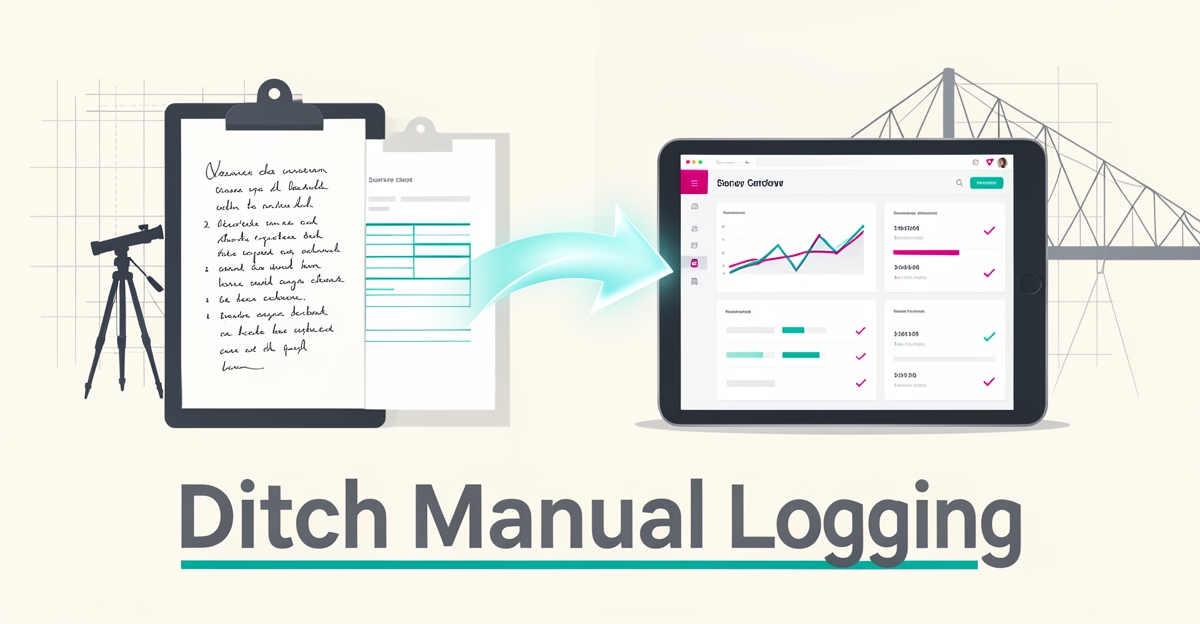
This outdated approach relies on paper checklists, static PDFs, and spreadsheet-based data entry rather than integrated digital systems. These manual methods are not just inconvenient; they are significant productivity drains that consume time better spent on strategic engineering work.

According to recent industry analysis, the shift from manual workflows to smarter, automated processes is no longer optional but essential for survival. IMAGINiT research highlights that rising project demands and tighter timelines are forcing firms to abandon traditional methods for efficiency.

The cost of inaction is steep. Manual data handling creates fragmented data systems that hinder decision-making and increase the risk of costly errors. When data sits in silos, it cannot inform real-time project adjustments or predictive modeling.

Consider the typical monthly reporting cycle. Engineers spend hours compiling data from disparate sources, a process that Kreante Agency identifies as a major source of administrative delay. This repetitive work delays project valuations and reduces overall team velocity.

"The path forward is modernization - adopting smarter, more automated processes that reduce effort and improve results." — Alan Bliss, ISD Expert

Beyond efficiency, data integrity is at stake. Manual entry is prone to human error, which can compromise structural safety assessments and compliance records. Automation offers a notable reduction in human error, ensuring consistency across all project documentation and reporting phases.

The solution isn't just digitizing forms; it's about AI-driven data processing that transforms raw field notes into actionable insights. Technologies like Natural Language Processing (NLP) and Computer Vision (CV) are now capable of automating report generation with remarkable precision.

For instance, AI-based visual inspection systems have demonstrated 97% to 99% detection accuracy in specific bridge inspection cases. This level of precision is impossible to sustain manually, especially over large-scale infrastructure projects.

Frontiers in Built Environment reports that AI models can automatically detect structural damage from drone imagery, replacing tedious manual visual checks. This capability allows firms to process complex datasets in real-time rather than weeks later.

However, adoption faces hurdles. Many firms struggle with cultural resistance from engineers trained in traditional methods and a shortage of AI-literate personnel. Overcoming this requires a strategic approach that emphasizes interpretability and ease of use.

Firms that successfully navigate this transition gain a sustainable competitive advantage through predictive insights and faster delivery. They shift focus from low-value data entry to high-value strategic contributions, fundamentally changing their operational model.

AIQ Labs bridges this gap by providing engineering-specific AI systems that turn field logs into actionable project data. Our solutions reduce errors and improve reporting speed by integrating seamlessly with your existing workflows.

Let’s explore why manual logging persists and how targeted automation can redefine your firm’s potential.

The Hidden Costs of Manual Field Logging

Civil engineering firms are bleeding profit margins through the silent drain of manual field data logging. When engineers spend hours transcribing handwritten notes into spreadsheets, they aren’t just losing time—they are sacrificing strategic value for administrative drudgery.

This inefficiency creates a tangible gap between field reality and project profitability. Manual workflows introduce costly errors and delay critical decision-making, eroding the very margins firms strive to protect.

Every hour spent on data entry is an hour stolen from high-value engineering tasks. Traditional methods like paper checklists and static PDFs force skilled professionals to act as data clerks rather than problem solvers. This misalignment of talent and task creates a significant productivity bottleneck.

Automation of repetitive administrative tasks leads to a notable reduction in human error and enhances workflow consistency according to industry automation experts. By removing the manual burden, firms can redirect engineering talent toward complex design challenges and client strategy.

Consider a mid-sized firm where senior engineers spend 20% of their week reconciling field logs. That is thousands of dollars annually in wasted billable hours. Instead, automation allows teams to focus on design quality rather than repetitive tasks as noted by IMAGINiT.

Key takeaways on productivity loss:

  • Time Drain: Manual transcription consumes hours or even weeks of effort per project according to IMAGINiT.
  • Error Costs: Human transcription introduces data discrepancies that require costly rework.
  • Opportunity Cost: Senior engineers are underutilized on low-value administrative work.

Manual logging creates silos of information that delay project visibility. When data exists only in paper notebooks or disparate spreadsheets, it cannot be easily analyzed or shared. This fragmentation hinders accurate project valuations and monthly reporting.

The industry is shifting toward mobile-ready forms to address these inefficiencies according to IMAGINiT. Digital collection ensures that field data is structured and accessible immediately, rather than buried in physical logs.

Furthermore, automation of Civil 3D tasks like plan production reduces manual effort significantly as reported by IMAGINiT. This speed translates directly to faster month-end closes and more accurate financial forecasting for project stakeholders.

In civil engineering, data accuracy is not just about convenience—it is a safety imperative. Manual entries are prone to typos, missed fields, and inconsistent formatting. These small errors can compound, leading to flawed structural assessments or incorrect project valuations.

AI-driven visual inspection achieves 97%–99% accuracy in detecting defects like cracks and spalling according to Frontiers in Built Environment. This level of precision is impossible to maintain with human-only data entry, especially under tight field conditions.

When firms rely on paper-based workflows, they accept a higher risk of oversight. Automated systems provide a single source of truth for field data, ensuring that every inspection note and sensor reading is captured accurately and consistently.

The solution lies in integrating AI-driven technologies that capture and process real-time data from drones, GPS, and sensors. AIQ Labs provides engineering-specific AI systems that turn field logs into actionable project data, eliminating the manual bottleneck entirely.

By adopting mobile-first data collection and AI processing, firms can reduce errors by up to 95% in automated workflows according to automation studies. This shift transforms field data from a liability into a strategic asset.

AIQ Labs helps civil engineering firms move beyond manual entry by building custom AI workflows that integrate seamlessly with existing project management tools. This approach ensures that data flows automatically from the field to the office, enabling real-time insights and predictive analytics.

Why Automation Has Stalled: Cultural & Technical Barriers

Civil engineering firms often blame budget constraints for their reliance on manual field data logging, but the real culprits are deeper. Cultural resistance from engineers accustomed to traditional methods and significant workforce skill gaps create invisible walls around modernization efforts.

Even when technology is available, data fragmentation prevents seamless integration. Teams struggle to trust AI outputs when they cannot see the underlying logic, leading to a paralysis where pilot projects stall before they can deliver value.

The hesitation to adopt automation isn’t just about money; it’s about confidence in the technology. Many civil engineers view AI as a "black box," lacking the interpretability required for safety-critical decisions. This opacity creates a trust barrier that no amount of marketing can easily dismantle.

When engineers cannot understand why an AI model flagged a structural crack, they default to manual verification. This skepticism is compounded by a shortage of AI-literate personnel who can bridge the gap between technical capabilities and practical application.

  • Interpretability: Engineers require clear rationales for AI-driven insights.
  • Safety Concerns: Lack of transparency risks errors in high-stakes environments.
  • Skill Gaps: Current teams often lack the training to validate AI outputs.

To overcome this, firms must prioritize systems that offer explainable results. For example, AI-driven visual inspection systems that highlight specific image regions for detected defects build immediate trust. This transparency transforms AI from a mysterious tool into a reliable assistant, allowing teams to focus on high-value strategic contributions rather than mundane data validation.

Beyond culture, technical infrastructure often holds firms back. Field data is frequently scattered across paper checklists, static PDFs, and disparate spreadsheets. This fragmented data infrastructure makes it nearly impossible for AI models to learn accurately or generate comprehensive reports.

Without a "single source of truth," automated reporting becomes a chore rather than a benefit. The effort required to clean and consolidate data often outweighs the perceived time savings, causing projects to stall at the pilot stage.

  • Inconsistent Formats: Mixed digital and analog records confuse AI parsers.
  • Data Scarcity: Rare events like structural failures lack sufficient labeled data.
  • Integration Silos: Tools like BIM 360 and field apps rarely communicate directly.

Consolidating these sources is a prerequisite for successful automation. By implementing mobile-first data collection, firms can digitize field entries immediately, creating the structured datasets needed for AI processing. This foundational step reduces the significant productivity bottleneck of monthly reporting and prepares the firm for advanced automation.

A common fear is that automation will replace engineers, leading to internal resistance. In reality, the industry faces a shortage of AI-literate personnel, making retention and upskilling critical. The goal of automation is not to eliminate jobs but to eliminate the repetitive administrative tasks that drain professional energy.

When engineers are freed from manual data entry, they can redirect their expertise toward design quality and complex problem-solving. This shift requires a strategic investment in change management and training programs.

  • Reframing the Narrative: Position AI as a tool for efficiency, not replacement.
  • Targeted Training: Focus on AI literacy for existing technical staff.
  • Efficiency Gains: Automating routine tasks reduces human error and fatigue.

By addressing these cultural and technical barriers head-on, firms can move beyond pilot paralysis. The path forward involves modernizing workflows to reduce effort while improving results, setting the stage for seamless AI integration.

The AI-Driven Solution Stack: From Drones to Automated Reports

Manual field logging is no longer just an inefficiency; it is a critical liability in civil engineering. The integration of Computer Vision (CV) and Natural Language Processing (NLP) transforms raw field data into actionable intelligence, eliminating the human error inherent in paper-based systems.

By capturing real-time survey data from drones, GPS devices, and IoT sensors, firms can bypass traditional bottlenecks. This technological stack allows for instantaneous processing of complex datasets, ensuring that project managers have accurate insights when they need them most.

  • Computer Vision detects structural defects like concrete cracks with high precision.
  • NLP automatically summarizes inspection notes and classifies incident reports.
  • IoT Integration provides continuous environmental and structural monitoring data.
  • Automated Reporting generates compliant site documentation without manual entry.

According to Frontiers in Built Environment research, AI-based visual inspection achieves detection accuracies ranging from 97% to 99% in specific bridge inspection cases. This level of precision far exceeds manual visual checks, reducing the risk of oversight in safety-critical infrastructure.

The shift from static PDFs to mobile-ready digital forms is the first step toward this automated ecosystem. As noted by IMAGINiT, this digitization enables faster data collection directly in the field, creating a structured foundation for AI processing.

Once data is captured, the real value lies in how it is processed. AI models utilize this influx of information to identify patterns that human analysts might miss. For instance, Convolutional Neural Networks (CNNs) analyze drone imagery to detect subtle structural anomalies.

Simultaneously, NLP systems parse unstructured text from field logs. These systems can extract key metrics, flag safety violations, and categorize issues automatically. This dual approach ensures that both visual and textual data contribute to a comprehensive project overview.

  • Automated Defect Classification: AI categorizes structural damage types instantly.
  • Natural Language Summarization: Long inspection notes are condensed into key findings.
  • Real-Time Anomaly Detection: Sensors trigger alerts for immediate structural concerns.
  • Data Standardization: Unstructured field notes are converted into uniform digital records.

A concrete example of this capability is the "AutoRepo" system, which connects drone image analysis with multimodal Large Language Models. As reported by Frontiers in Built Environment, this system automatically generates complete and compliant site inspection reports, drastically reducing the time engineers spend on documentation.

Furthermore, IMAGINiT highlights that automating tasks like Civil 3D plan production can save "hours or even weeks" of manual effort. This time savings allows engineering teams to redirect their focus from repetitive data entry to high-value strategic design work.

Despite the clear benefits, adoption faces hurdles such as the "black box" nature of AI models. Engineers often resist technologies that lack interpretability, especially in safety-critical decisions. To address this, firms must prioritize explainable AI that provides transparent rationales for its outputs.

Additionally, a shortage of AI-literate personnel and cultural resistance remain significant challenges. Successful implementation requires not just technology, but also robust change management strategies and workforce upskilling.

  • Explainable AI Interfaces: Visual highlights showing why a defect was flagged.
  • Staff Training Programs: Upskilling engineers to trust and utilize AI tools.
  • Hybrid Workflows: Combining human expertise with AI efficiency for validation.
  • Data Consolidation: Creating a single source of truth to feed AI models.

By addressing these trust and skill gaps, firms can fully leverage their AI-driven solution stack. The result is a streamlined operation where data flows seamlessly from the field to the final report.

This foundation of automated data collection and processing sets the stage for broader operational transformations. The next step involves integrating these insights into comprehensive business systems for predictive project management.

Implementation Roadmap: From Pilot to Production

Transitioning from manual field data logging to automated systems requires a phased approach that prioritizes data integrity and team adoption. Many firms get stuck in the "pilot paradox," where successful small-scale tests fail to scale due to fragmented data infrastructure.

To avoid this, you must build a scalable foundation before deploying complex AI models. This roadmap ensures your transition enhances active projects rather than disrupting them.

Before implementing AI, you must solve the "black box" trust issue by ensuring your underlying data is clean and interpretable. Engineers resist automation when they cannot verify the source of insights.

Start by consolidating fragmented data sources into a single source of truth. This eliminates the manual effort of cross-referencing spreadsheets and static PDFs.

  • Digitize Paper First: Replace paper checklists with mobile-ready forms to create structured digital inputs immediately.
  • Standardize Formats: Ensure all field logs, drone imagery, and sensor data follow uniform naming and metadata conventions.
  • Establish Governance: Define clear protocols for data ownership and security compliance before integration begins.

This consolidation directly addresses the notable reduction in human error achieved by automating repetitive administrative tasks, as noted by industry experts.

Select a single, high-value workflow for your initial pilot rather than attempting a firm-wide overhaul. This minimizes risk and allows your team to learn the new system in a controlled environment.

Focus on replacing the most time-consuming manual processes, such as monthly report generation or plan production. AI-driven visual inspection can achieve 97% to 99% accuracy in detecting structural defects, making it an ideal candidate for early adoption.

Pilot Success Metrics: * Time Savings: Measure the reduction in hours spent on data entry and report compilation. * Accuracy Comparison: Compare AI-detected defects against manual engineering reviews. * User Adoption: Track how quickly field staff begin relying on the new digital tools.

For example, automating Civil 3D tasks can save hours or even weeks of manual effort, proving immediate ROI to skeptical stakeholders.

Once the pilot validates the technology, integrate AI capabilities into your broader operational workflow. This phase leverages AI employees and custom development to scale success across multiple projects.

AIQ Labs provides engineering-specific AI systems that turn field logs into actionable project data. We build production-ready systems that integrate with your existing CRM, project management, and accounting tools.

  • Deploy AI Employees: Implement managed AI staff for tasks like dispatch coordination or intake processing.
  • Automate Reporting: Use NLP and Computer Vision to auto-generate compliant inspection reports from drone imagery.
  • Expand Use Cases: Apply trained models to new project types or additional field data streams.

This approach aligns with the industry shift toward smarter, more automated processes that reduce effort and improve results.

The final phase involves continuous monitoring and refinement to ensure long-term value. AI systems improve over time as they process more data and adapt to specific project nuances.

Establish a feedback loop between field engineers and your AI systems. This ensures the technology remains interpretable and addresses the shortage of AI-literate personnel through practical training.

  • Monitor Performance: Track key metrics like error rates and time-to-report generation.
  • Retrain Models: Update AI models with new data to maintain high accuracy as conditions change.
  • Scale Strategically: Identify new high-ROI workflows for automation based on performance data.

By following this roadmap, you transform manual bottlenecks into strategic advantages. The next step is evaluating your current data readiness to identify your highest-impact starting point.

Conclusion: The Competitive Advantage of Automated Field Intelligence

Conclusion: The Competitive Advantage of Automated Field Intelligence

The era of manual field data logging is ending, replaced by a new standard of precision and speed. Civil engineering firms clinging to paper checklists and static PDFs face a widening gap between their operational reality and industry expectations.

According to recent industry analysis, the shift from manual to automated workflows is no longer theoretical but is transitioning into practical deployment across the project lifecycle as reported by Springer. This transition is driven by rising project demands and the critical need for accuracy in safety-critical decisions.

Manual processes create significant productivity bottlenecks, particularly in monthly reporting and project valuations. These methods are prone to human error and consume valuable professional time that could be redirected toward strategic engineering work.

The Urgency of Adoption

Delaying automation means accepting inefficiency as a cost of doing business. Engineers trained in traditional methods often resist change, yet the industry trend is unmistakable.

Experts emphasize that the path forward is modernization—adopting smarter, more automated processes that reduce effort and improve results according to ISD experts. Automation allows teams to focus on design quality rather than repetitive tasks.

The data supports immediate action. AI-based visual inspection detection accuracies now range from 97% to 99% in specific bridge inspection cases.

This level of precision is impossible to achieve consistently with manual logging. Furthermore, automating repetitive administrative tasks leads to a notable reduction in human error and enhances workflow consistency.

The Implementation Path

Implementing AI-driven field intelligence requires a strategic approach that addresses both technology and culture. Civil engineering firms must move beyond basic digitization to embrace integrated AI systems.

Successful implementation involves three key steps:

  • Deploy Computer Vision and NLP: Integrate AI systems that use Computer Vision to analyze drone imagery and Natural Language Processing to summarize field logs automatically.
  • Address the "Black Box" Trust Issue: Select AI vendors or build systems that provide transparent decision-making rationales to build trust among engineering staff.
  • Invest in Workforce Upskilling: Develop training programs focused on AI literacy, framing AI as a tool that eliminates mundane tasks.

A concrete example of this transformation is seen in the deployment of systems like "AutoRepo." This platform connects drone image analysis with multimodal Large Language Models to automatically generate site inspection reports that are complete and compliant.

This integration directly reduces the significant productivity bottleneck of monthly report generation. By automating these workflows, firms can reduce manual effort by hours or even weeks in tasks like plan production.

AIQ Labs: Your Transformation Partner

AIQ Labs provides the engineering-specific AI systems that turn field logs into actionable project data. We don’t just consult on AI—we build and operate production AI systems daily.

Our team architects custom systems that businesses own, deploy managed AI employees that work alongside human teams, and guide organizations through every stage of their AI maturity journey.

We serve small and medium-sized businesses seeking to harness AI without the complexity, risk, or massive investment typically required. Unlike vendors who deliver point solutions, AIQ Labs commits to end-to-end partnership.

Our proprietary platforms demonstrate our engineering capabilities, including multi-agent orchestration and real-time research systems processing thousands of data points daily.

We help firms overcome the "black box" nature of AI by building transparent, interpretable models. This ensures that engineers receive the clear, data-driven insights they need for confident decision-making.

By partnering with AIQ Labs, civil engineering firms can eliminate operational inefficiencies and create sustainable competitive advantages. We provide the complete spectrum of AI services—from strategic consulting through custom development to managed AI workforce.

The choice is clear: continue with error-prone manual processes or embrace the future of field intelligence. AIQ Labs is ready to architect your competitive advantage.

AI Development

Still paying for 10+ software subscriptions that don't talk to each other?

We build custom AI systems you own. No vendor lock-in. Full control. Starting at $2,000.

Frequently Asked Questions

How do I fix manual field data logging if my team is resistant to new technology?
Start by replacing paper checklists with mobile-ready forms to create structured data immediately, which addresses basic digitization barriers. Then, deploy AI systems that provide transparent, explainable outputs (like highlighting specific image regions for defects) to overcome the "black box" trust issue and engage your team.
Is AI detection accurate enough to replace manual visual inspections for safety-critical decisions?
Yes, AI-based visual inspection systems have demonstrated detection accuracies ranging from 97% to 99% in specific bridge inspection cases. While this high precision is proven, you must ensure the AI provides interpretable rationales for its findings to maintain engineer confidence in safety-critical scenarios.
What are the first steps to automate monthly reporting and project valuations?
Consolidate fragmented data sources into a "single source of truth" by digitizing field entries before deploying advanced AI. You can then use NLP to summarize inspection notes and Computer Vision to analyze drone imagery, which automatically generates compliant site inspection reports and reduces the productivity bottleneck of manual compilation.
Will automating field data tasks replace our senior engineers?
No, automation is designed to eliminate repetitive administrative tasks, allowing engineers to redirect their expertise toward high-value strategic contributions and complex design challenges. This shift addresses the industry's shortage of AI-literate personnel by upskilling existing staff rather than replacing them.
How much time can we save by automating tasks like Civil 3D plan production?
Automation of Civil 3D tasks, such as plan production and sheet creation, can reduce manual effort by "hours or even weeks" per project. This significant time savings allows firms to accelerate project delivery and improve month-end closes without adding headcount.
What should we do if we don't have enough labeled data for AI training?
Data scarcity is a known challenge, especially for rare events like structural failures, so start by standardizing your data infrastructure to ensure consistency. Focus on consolidating existing digital records and using mobile-first collection to build a clean, structured dataset that can eventually support supervised learning approaches.

Unlocking Field Intelligence: From Paper Trails to Predictive Power

The shift from manual field data logging to automated intelligence is no longer optional for civil engineering firms—it is a critical imperative for survival and growth. As this article highlights, reliance on paper checklists and static spreadsheets creates fragmented data silos that hinder decision-making, delay project valuations, and introduce costly human errors. To thrive in an increasingly fast-paced industry, firms must modernize by adopting smarter, automated processes that reduce effort while improving results. AIQ Labs specializes in turning this manual burden into a strategic advantage. By debunking the myth that field data collection is too complex for automation, we provide engineering-specific AI systems that capture and process real-time survey data from drones, GPS, and sensors. Our solutions transform raw field logs into actionable project data, significantly reducing errors and accelerating reporting speeds. Stop letting outdated workflows stifle your firm’s potential. Contact AIQ Labs today to discover how we can architect your competitive advantage and help you build smarter infrastructure workflows.

AI Transformation Partner

Ready to make AI your competitive advantage—not just another tool?

Strategic consulting + implementation + ongoing optimization. One partner. Complete AI transformation.

Join The Newsletter

Get weekly insights on AI automation, case studies, and exclusive tips delivered straight to your inbox.

Ready to Increase Your ROI & Save Time?

Book a free 15-minute AI strategy call. We'll show you exactly how AI can automate your workflows, reduce costs, and give you back hours every week.

P.S. Still skeptical? Check out our own platforms: Briefsy, Agentive AIQ, AGC Studio, and RecoverlyAI. We build what we preach.