Why Most Construction Firms Fail at AI Implementation (And How to Avoid It)
Key Facts
- AI in construction isn't the starting point — it's a multiplier of connected systems, a conclusion echoed across industry research on construction AI adoption
- Manual takeoff on a ~12,000 SF tenant improvement can take several hours, while AI-assisted takeoff typically generates initial quantities in under an hour (plus review time)
- Break-even for AI takeoff tools typically lands around 10–12 bids per year, depending on software costs and project size
- Estimators typically need 4–6 weeks of regular use before they trust AI-generated quantities without over-reviewing
- Project data lives in one tool, financials in another, and field reports elsewhere — fragmenting visibility and starving AI of unified inputs
- Over-automating broken workflows — instead of augmenting connected ones — is a recurring pattern in failed AI rollouts
Hire a team member that works 24/7 — for less than a part-time wage.
AI receptionists, SDRs, dispatchers and 99+ roles. Trained on your business, fully managed.
Not sure where to start? Ask our AI planner
The Hidden Trap: AI as a Multiplier, Not a Starting Point
Construction firms keep buying AI tools and wondering why the promised efficiency never arrives. The problem isn't the models — it's the foundation they're asked to run on.
Across industry research on construction AI, the same picture repeats: project data lives in one tool, financials in another, and field reports somewhere else, making it difficult to get a clear view of what's happening throughout the business. Key functions — project management, accounting, and field operations — often run on separate platforms. Without integration, data doesn't flow, visibility is fragmented, and AI lacks the inputs it needs to generate meaningful insight.
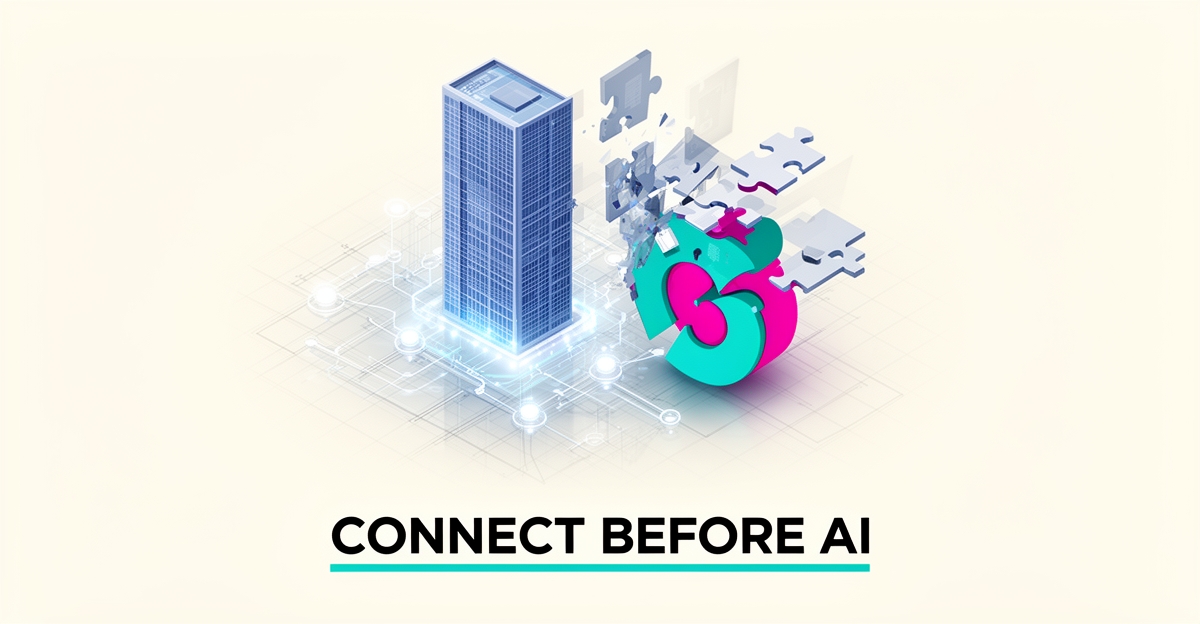
This fragmentation drives a fundamental misconception. AI in construction isn't the starting point — it's a multiplier. The real opportunity lies in connecting the systems you already rely on so they work together supporting faster decisions, earlier risk detection, and stronger performance. Treating AI as a starting point rather than a multiplier of existing connected systems leads to failed implementations.
The pattern shows up in how AI is actually used. When teams adopt AI tools, the bulk of interactions tend toward automation rather than augmentation — a tendency that mirrors construction's rush to automate broken workflows. Automation without augmentation means tools are layered on top of fragmented data, not integrated into it.
A foundation-first approach requires a connected, reliable, and clean digital environment before AI can deliver. Firms that succeed focus on building a strong digital core first, connecting existing systems rather than replacing them.
Foundational gaps that block AI value include:
- Well-integrated tools that communicate with each other across project management, cost control, scheduling and procurement
- Accurate and consistent data with standardized capture across projects
- Teams empowered to act on insights where they can make the biggest difference
Operational readiness is equally critical. Leaders are understandably cautious about introducing change without a clear return or proven plan for adoption, because construction projects run tight schedules and tighter margins. The perceived risk outweighs the potential benefit when data quality and change management are missing.
This is where change management and training become decisive. Poor change management, lack of data integration, or over-reliance on tech without process redesign are common pitfalls that stall pilots before scaling. AIQ Labs helps firms avoid that trap with AI Workflow Builds — rebuilding the one workflow that costs the most, at a fixed price and in phases — so adoption is structured, not improvised.
When implemented with focus, AI can reinforce what's working, enhance decision-making, and strengthen how teams operate across every project phase. Without the connected core first, AI simply amplifies noise.
The Data Silo Reality: Why Fragmented Systems Kill AI ROI
Construction firms often invest in AI pilots only to see them stall before scaling — not because the technology fails, but because the data it needs remains trapped in isolated systems. Project data lives in one tool, financials in another, and field reports somewhere else, making it difficult to get a clear view of what's happening throughout the business. This fragmentation means AI cannot access the unified, real-time inputs required to generate meaningful insights, no matter how advanced the models are.
When project management, accounting, and field operations run on disconnected platforms, critical information stops flowing between teams. Cost variances aren't flagged in time, schedule risks go unnoticed, and field-reported issues never connect to financial impacts. Without integration, AI lacks the complete picture it needs to predict delays, optimize resource allocation, or protect margins — turning promising pilots into expensive experiments that never deliver ROI.
AIQ Labs helps construction firms overcome this barrier by focusing on integration first — connecting existing systems rather than replacing them. Through AI Operating Systems, built in phases and owned outright by the firm, we unify data streams across project tracking, accounting, and field reporting to create the reliable digital core AI needs to function as a true multiplier. This foundation enables AI to surface actionable insights, automate manual reconciliation, and support decisions with cross-project visibility — moving firms beyond pilot purgatory into sustainable transformation. The connected approach is where AI's real value emerges: strengthening accountability, improving forecasts, and catching cost variances earlier — but only when the data flows freely. To build this foundation, start with the 2-minute Fit Check to map your data landscape and identify integration priorities.
Operational Readiness: The Change Management Gap Most Firms Ignore
Construction leaders' caution about AI adoption is rational given the industry's tight margins and demanding schedules. Introducing change without a clear return or proven adoption plan often feels too risky when delays and cost overruns can have severe financial consequences. This perceived risk frequently outweighes the potential benefit, especially when teams lack the bandwidth to manage disruption.
The human factor proves critical in estimating workflows, where trust in AI takeoff tools develops slowly. Estimators typically need 4–6 weeks of regular use to become comfortable verifying AI-generated quantities without over-reviewing. During this period, many firms abandon the technology prematurely, mistaking initial hesitation for failure rather than recognizing it as a necessary adaptation phase.
Without dedicated data teams to manage integration and quality, construction firms remain dependent on legacy processes that undermine AI's value. Manual data entry, static spreadsheets, and inconsistent reporting methods create fragmented inputs that AI cannot effectively process. Most firms lack the technical and data capacity to support new technology initiatives, leaving them unable to realize AI's potential for protecting margins or improving forecasts. This gap between technological capability and operational readiness explains why many AI pilots stall before scaling, despite promising early results in speed and accuracy. AIQ Labs addresses this through structured, phased builds that align training, stakeholder engagement, and rollout pacing with real-world estimating timelines — and, where headcount is the bottleneck, AI Employees that handle defined roles at roughly 80% less cost than a human hire.
The Foundation-First Framework: Building Your Digital Core Before AI
Most construction firms try to bolt AI onto broken foundations and wonder why nothing sticks. The pattern is consistent: AI is a multiplier, not a starting point, and it only delivers when the digital core underneath is connected, reliable and clean.
Project data lives in one tool, financials in another, and field reports somewhere else — making it difficult to get a clear view of what's happening throughout the business. Without integration, AI lacks the inputs it needs to generate meaningful insight, and initiatives stall at pilots.
The Foundation-First Framework flips the approach. Instead of replacing systems, successful firms connect the systems they already rely on and standardize how data flows between them. That means unifying field data with financials, automating manual reporting, and establishing consistent capture across projects so AI can protect margins by catching cost and schedule variances earlier.
A practical sequence emerges from this approach:
- Start with business priorities, not technology, and assess where data lives across project management, cost control, scheduling and procurement.
- Identify low-hanging fruit use cases where AI can drive immediate improvement, such as forecasting labor shortages or anticipating procurement delays.
- Establish ownership and governance so guidance cascades through the organization and teams are empowered to act on insights.
- Build a strong digital core by connecting existing platforms rather than ripping and replacing them.
- Unify field data with financials, automate manual processes, and standardize data capture to enable portfolio-wide visibility.
This foundation-first mindset is where change management and training become critical. Leaders are cautious about introducing change without a clear return, and construction carries high operational risk with tight schedules and margins. Poor change management, lack of data integration, or over-reliance on tech without process redesign are common pitfalls that stall adoption.
The payoff shows up in real workflows. Comparisons of takeoff methods generally find that manual takeoff on a ~12,000 SF tenant improvement takes an experienced estimator several hours, while AI can generate initial quantities in under an hour with additional review time on top. Break-even for AI takeoff implementation is typically estimated at around 10–12 bids per year, with a 4–6 week comfort curve for estimators.
AIQ Labs works with firms on exactly this foundation work through AI Workflow Builds — fixed-price, phased rebuilds of the workflow that costs the most — and, when firms are ready to go further, AI Operating Systems that connect everything into one layer the firm owns outright. The goal is not to chase shiny tools, but to create a connected digital core where AI can reinforce what's working, enhance decision-making, and strengthen performance across every project phase.
Hybrid Implementation: The Practical Path for Construction Firms
Hybrid implementation offers a practical path forward for construction firms navigating AI adoption. Rather than attempting full automation overnight, leading estimators use AI for initial takeoffs on clean plans — cutting hours of manual work per bid — while reserving manual methods for revisions and complex scopes where AI struggles with accuracy and workflow disruption. This approach acknowledges current tool limitations while capturing immediate efficiency gains.
The break-even point for AI takeoff investment typically sits around 10–12 bids per year, making it financially viable mainly for firms with sufficient volume on larger projects. Below this threshold, higher software costs and the 4–6 week training period can outweigh time savings. Firms must realistically assess their bid frequency before committing resources.
Successful hybrid implementation follows a phased sequence: start with a single workflow (e.g., initial concrete takeoffs), refine processes through feedback loops, then expand to department-level automation (e.g., the full estimating team), and finally integrate into a complete business AI system. This gradual rollout keeps change management aligned with operational realities, avoiding the pitfalls of over-reliance on technology without process redesign — a common reason AI initiatives stall in construction environments where tight schedules amplify resistance to disruption. AIQ Labs supports this evolution with milestone-based builds: start monthly on a single workflow, build in milestones as it proves out, and own the system outright once it's running your business. See pricing models for how the payment structure works.
Still paying for 10+ subscriptions that don’t talk to each other?
We build custom AI systems you own outright. No vendor lock-in. Full control.
Not sure where to start? Ask our AI planner
Frequently Asked Questions
Why do most construction AI pilots fail to deliver ROI?
Should we replace our existing construction software before implementing AI?
How much does AI takeoff software cost compared to manual methods?
How long does it take for estimators to trust AI takeoff tools?
What's the difference between automation and augmentation in construction AI?
How can we overcome resistance to AI adoption in our construction firm?
Build Your Foundation, Then Let AI Multiply Your Impact
The path to AI success in construction isn't about chasing the latest tool — it's about building a connected digital core where data flows freely between project management, accounting, and field operations. AI only delivers value when it multiplies a strong foundation, not when it's bolted onto fragmented systems. Start by unifying your data, standardizing capture, and empowering teams to act on insights. From there, AI can protect margins, improve forecasts, and strengthen decisions across every project phase. The firms that win aren't the first to adopt AI — they're the ones who lay the groundwork first. Ready to map your data landscape and identify where AI can drive real impact? Take the 2-minute Fit Check, then book a free 30-minute strategy call to see what's possible for your business.
Make AI your competitive advantage — not just another tool.
Strategy, implementation and ongoing optimization. One partner, end to end.
Not sure where to start? Ask our AI planner