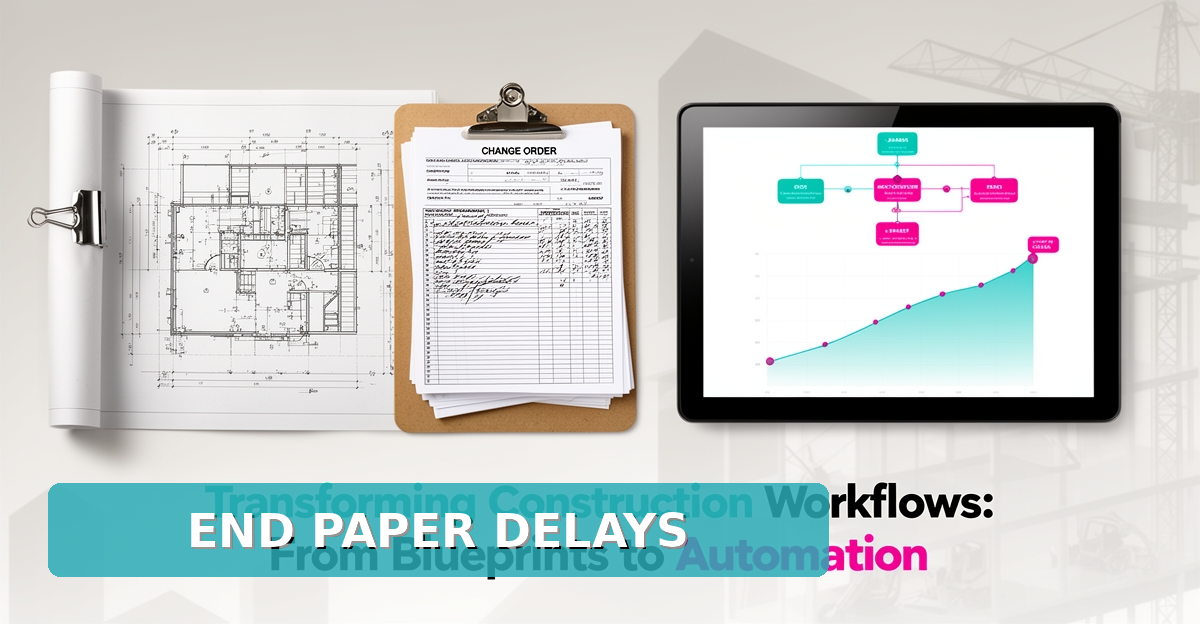
Why Most Design-Build Firms Still Use Paper-Based Change Orders (And How to Fix It with AI)
Key Facts
- Industry research has reported that a manual change order can take roughly 24 days from T&M ticket to submission — during which work is already performed and costs incurred.
- Average profit margins on construction projects are typically under 7%, making disputed change orders a direct threat to profitability.
- A large majority of US construction projects experience cost overruns, with change orders among the primary drivers.
- Dispute values in North America rose sharply (a 42% jump was documented in the 2023 Arcadis Global Construction Disputes Report), a trend that rewards firms with clean, timestamped records.
- AI-powered systems can compress change order processing from weeks to a few days or less.
- Firms selecting platforms based on workflow automation depth, mobile field capture, and integration breadth report substantially higher adoption rates than those choosing on brand recognition.
- Only a small fraction of AEC firms feel ready to use AI at an advanced level, and very few characterize their generative AI rollout as mature.
Hire a team member that works 24/7 — for less than a part-time wage.
AI receptionists, SDRs, dispatchers and 99+ roles. Trained on your business, fully managed.
Not sure where to start? Ask our AI planner
The Hidden Cost of Paper-Based Change Orders in Design-Build
Most design-build firms don't realize how much a single paper-based change order actually costs them — until the margin report comes in at the end of the project. By then, the damage is already buried in disputed invoices, stalled draws, and a paper trail that can't defend itself.
The core problem is time. According to industry research on change order management, the average manual process has been reported to take roughly 24 days from T&M ticket to submitted change order — and during that window, the work has typically already been performed and the cost already incurred. Any dispute about what was agreed happens in retrospect, against documentation that was never designed to serve as legal evidence.
That delay hits a financial structure with almost no slack. Industry data on change order economics shows average profit margins typically sit under 7% on construction projects, with GC fees often running just 3–5% on the original contract. When a change order is disputed or goes unapproved, the difference between work performed and payment received comes directly out of that margin. A handful of disputed changes can erase a project's profitability entirely.
The downstream effects compound quickly:
- Cash flow disruption — change orders stuck in approval queues stall pay applications, leaving GCs carrying performed work on their balance sheet
- Schedule uncertainty — crews wait for direction while procurement decisions freeze
- Relationship breakdown — disputed changes erode trust, making every subsequent approval harder
- Compliance exposure — informal documentation creates audit gaps that surface at the worst possible moment
The scale of the problem is industry-wide. Research shows the vast majority of US construction projects experience cost overruns, with change orders among the primary drivers — and the average commercial project processes dozens of change orders over its lifecycle, according to practical guides on AI change order workflows. Multiply a multi-week cycle across 40+ changes, and you get a project permanently out of sync with its own budget.
Disputes are getting more expensive, too. The 2023 Arcadis Global Construction Disputes Report documented a 42% jump in dispute values in North America — a trend that rewards firms with clean, timestamped records and punishes those relying on memory and email threads.
This is precisely the gap AI document processing is built to close. AIQ Labs builds audit-ready systems that capture change events the moment they happen — structured, timestamped, and tied directly to budget impact — rather than reconstructing them weeks later from field notes. In a business where margin lives or dies on documentation quality, that shift isn't a convenience. It's protection.
Why Firms Resist AI Despite Clear Inefficiencies
Despite the clear inefficiencies of paper-based change orders, many design-build firms resist AI adoption not because the technology lacks value, but because of deep-seated resistance to change and a misunderstanding of what AI actually does. According to Cindy W. Baldwin, President of VDCOTech, the core issue is perception: “The problem I have with AI is everybody just thinks of it as Artificial Intelligence. It's an umbrella term... You're really augmenting your intelligence.” This mindset shift—from seeing AI as a replacement to recognizing it as an augmentation tool—is critical for overcoming hesitation in an industry where control and governance are paramount.
Compounding this is a widespread lack of familiarity with AI's everyday presence, which Brian Skripac of DBIA highlights as a key barrier. “Part of it is normalizing... helping people understand how they are already using AI –– even in everyday life –– and showing them how it applies in industry settings will help alleviate some of the apprehension surrounding it.” He points to simple, relatable examples like email autocomplete: “Your email finishes your sentences; that's AI. It's not scary.” These analogies help demystify the technology and position AI not as a disruptive force, but as a quiet enhancer of existing workflows—much like how spellcheck supports writing without taking over the author's voice.
This resistance is further entrenched by operational inertia, particularly in an industry where only a small share of AEC firms feel ready to use AI at an advanced level, and very few characterize their generative AI rollout as mature. For firms already overwhelmed by manual processes—where a single change order can take weeks to process—adding new technology can feel like another burden rather than a solution. Yet the data shows that when platforms are selected based on workflow automation depth, mobile field capture, and integration breadth—not brand recognition—adoption rates climb dramatically compared to poorly fitted systems. AIQ Labs supports this transition by focusing on practical integration and change management, ensuring AI serves as a seamless extension of human expertise rather than a replacement for it.
How AI-Powered Change Order Systems Eliminate Manual Delays
The math is brutal: a manual change order can take weeks from T&M ticket to submitted change order, and during that window the work has already been performed and the cost already incurred. Any dispute happens in retrospect, against documentation that was never designed to serve as legal evidence. AI-powered change order systems attack that delay directly—and they compress it dramatically, cutting processing time to a few days or less.
The difference comes down to four core capabilities working together.
First, real-time budget impact analysis. When an AI model can read the live contract, the current master budget, the approved change order log, and committed cost records simultaneously, it calculates budget impact before submission and flags changes that overlap with existing modifications. Budget updates stop being a lagging manual entry and become automatic the moment a change order is approved.
Second, automated documentation from field capture. Instead of a paper ticket or scattered notes, AI turns field notes and voice memos into structured, timestamped records tied to the relevant contract and cost code. It can also summarize long comment threads and document sets so nobody has to scroll to find the decision. This matters commercially: with average profit margins typically under 7% on construction projects, a handful of disputed change orders can erase profitability entirely.
Third, intelligent routing. AI routes change orders automatically based on value thresholds, project type, or client requirements, so each one lands with the right approval authority. When an approval sits pending past a defined threshold, automated reminders fire; past a second threshold, escalation goes to the approver's supervisor. Nothing dies in an email chain.
Fourth, audit-ready trails that build themselves. Every approval is captured digitally with timestamp and identity, and the executed change order document generates automatically into the project's document management system. That documentation exists at the moment of change—not reconstructed weeks later—which is exactly what disputes and audits demand. Given the 42% jump in dispute values documented across North America, that evidence trail is no longer optional.
One caution: capability alone doesn't guarantee results. According to platform comparison research, a significant share of automation failures stem from poor integration with accounting systems, so any AI system must connect bidirectionally with accounting, scheduling, and project management tools. Firms that evaluate platforms against criteria like workflow automation depth, mobile field capture, and integration breadth see far higher adoption rates than those choosing on brand recognition alone.
This is the approach we take at AIQ Labs: rather than bolting AI onto a broken process, we rebuild the change order workflow end to end—structured intake, intelligent routing, real-time budget sync, and audit trails the client owns outright—so the system eliminates manual handling instead of just digitizing it. That's the model behind our AI Workflow Builds, where we rebuild the one workflow that costs you the most at a fixed price, and our AI Operating Systems, which connect your entire operation in phases you own outright.
Selecting and Implementing the Right AI Platform for Lasting Adoption
Choosing the right AI platform for change order management requires more than brand recognition—it demands a focus on functional capabilities that drive real adoption. Firms that prioritize workflow automation depth, mobile field capture, and integration breadth report substantially higher full adoption rates than those selecting based on brand or peer recommendation alone, according to industry data. This stark difference underscores that sustainable adoption hinges on how well the platform fits into existing workflows, not how well-known it is.
Successful implementation begins with structured intake—capturing change events at the source using timestamped, form-driven inputs tied to contract details and cost codes as outlined in practical implementation guides. From there, automatic routing based on predefined rules ensures the right approvers see the right changes at the right time, reducing bottlenecks. Digital approvals with built-in audit trails eliminate lost emails and manual tracking, while automated reminders and escalations keep pending items from stalling in approval queues.
Real-time budget updates upon approval connect every change directly to financial impact, preventing surprise overruns and supporting proactive decision-making, industry research confirms. AIQ Labs supports this transition by designing AI-powered systems that embed these capabilities into custom workflows—ensuring seamless integration with accounting, scheduling, and project management tools while maintaining audit readiness and user adoption from day one. With 200+ multi-agent systems deployed and four live SaaS products we run daily, we build what we use ourselves.
Still paying for 10+ subscriptions that don’t talk to each other?
We build custom AI systems you own outright. No vendor lock-in. Full control.
Not sure where to start? Ask our AI planner
Frequently Asked Questions
Why do design-build firms still rely on paper-based change orders despite the delays and costs?
How long does the average manual change order process take from T&M ticket to submission?
What financial impact do disputed change orders have on construction projects with thin profit margins?
How much can AI-powered systems reduce change order processing time compared to manual methods?
What factors lead to the highest adoption rates when selecting an AI change order platform?
What is a common reason for automation failure in change order management systems?
The Margin You Save Is the Margin You Keep
Paper-based change orders don't just slow projects down—they quietly erode the thin margins design-build firms depend on. With margins typically under 7% and manual processing stretching to weeks, every delayed approval or disputed invoice chips away at profitability. AI-powered systems flip that equation: structured intake, real-time budget sync, and audit-ready trails compress cycles to days while protecting the documentation that wins disputes. The firms seeing results aren't chasing brand names—they're choosing platforms that fit their workflows and integrate with the tools they already use. If your change order process still relies on paper and email chains, the gap between what you build and what you keep is wider than it needs to be. AIQ Labs builds custom AI systems that eliminate manual handling and protect your margins from day one. Start the 2-minute Fit Check to see where automation can close the gap—it leads to a free 30-minute strategy call.
Make AI your competitive advantage — not just another tool.
Strategy, implementation and ongoing optimization. One partner, end to end.
Not sure where to start? Ask our AI planner