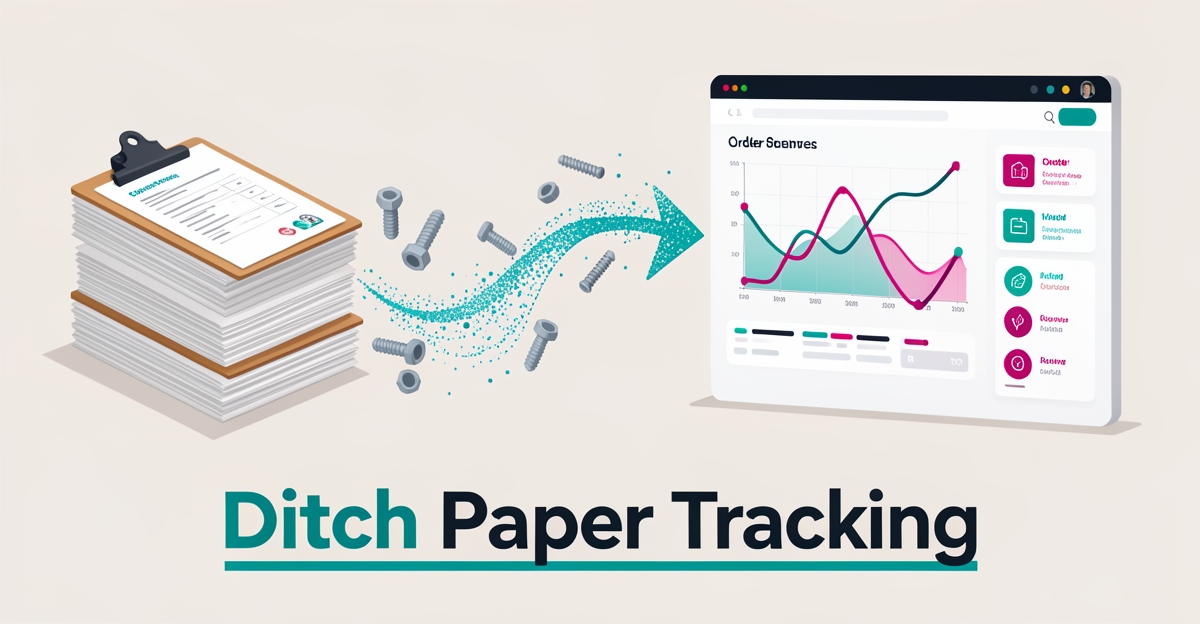
Why Most Fastener Distributors Still Use Paper-Based Order Tracking (and How to Fix It)
Key Facts
- Fastener distributors manage tens of thousands of SKUs with complex, inconsistent descriptions—manual paper lookup becomes impractical at that scale
- AI-powered semantic search lets staff and customers find products using natural language, even when terminology doesn't match catalog entries
- Document field mapping automates extraction of critical data from purchase orders and invoices, reducing manual data entry errors
- AI-driven inventory taxonomy categorizes and tags products automatically, eliminating manual re-tagging of existing catalogs
- Organizations implementing automation typically report meaningful reductions in overhead and gains in productivity, often within the first year
- AI adoption for process automation is accelerating across distribution-heavy industries as of late 2026
Hire a team member that works 24/7 — for less than a part-time wage.
AI receptionists, SDRs, dispatchers and 99+ roles. Trained on your business, fully managed.
Not sure where to start? Ask our AI planner
The Hidden Cost of Paper-Based Order Tracking in Fastener Distribution
Despite a decade of digital transformation across wholesale and distribution, many fastener distributors still rely on paper-based order tracking—and it creates significant operational drag. Manual processing of high-SKU inventories with complex product descriptions leads to frequent delays as staff sift through physical documents to locate critical information. That inefficiency is compounded by the risk of data loss: paper orders can be misplaced, damaged, or illegible, resulting in incorrect shipments or missed deadlines. Compliance risks also mount, because auditable trails become fragmented or impossible to reconstruct when records exist only in physical form. For distributors managing tens of thousands of SKUs, manual lookup simply doesn't scale, and the fastener industry's vast inventories and inconsistent product descriptions make traditional search methods a poor fit.
The cumulative impact of these paper-driven bottlenecks extends beyond inconvenience, eroding profitability and customer trust. Manual data entry from paper orders into accounting or inventory systems introduces errors that require time-consuming corrections—often discovered only after shipment or invoicing. Staff spend excessive hours on repetitive tasks like filing, retrieving, and reconciling documents, time that could go toward customer engagement or strategic planning. The lack of real-time visibility into order status also prevents proactive issue resolution, leading to frustrated customers and avoidable returns. Across industries, a large share of organizations are actively working to minimize manual tasks—a clear signal that this pain point is widely recognized. For fastener distributors specifically, the inability to quickly trace an order's journey from receipt to delivery undermines service reliability and increases operational overhead.
These inefficiencies carry measurable financial consequences. Paper-based systems force distributors to absorb hidden costs through overtime labor, expedited shipping to correct errors, and lost sales from delayed fulfillment. The absence of automated tracking also hinders accurate forecasting, since historical order data stays locked in non-searchable formats. Over time, that lack of insight prevents optimization of inventory levels and supplier relationships, creating a cycle of reactive rather than proactive management. As of late 2026, AI adoption for data analytics and process automation is accelerating across distribution-heavy sectors—manual methods are increasingly seen as liabilities. For fastener distributors still reliant on paper, the cost of inaction grows as competitors adopt digital tools that eliminate these avoidable expenses.
- Increased labor costs from manual document handling
- Higher error rates leading to returns and corrections
- Delayed order fulfillment impacting customer satisfaction
- Compromised audit readiness and compliance exposure
- Inability to leverage historical data for forecasting
Recognizing these hidden costs is the first step toward modernizing order tracking—laying the groundwork for AI-driven solutions that automate data capture, improve searchability, and deliver end-to-end visibility without requiring a massive IT overhaul. AIQ Labs' Workflow Builds are designed for exactly this: rebuilding the one workflow that costs you the most, at a fixed price, in phases.
How AI-Powered Automation Solves Core Order Tracking Challenges
AI-powered automation directly addresses the operational bottlenecks that plague paper-based fastener distribution. Current AI technologies enable distributors to automate order tracking, invoice processing, and delivery confirmation while sharply reducing the manual data entry errors that have long plagued the sector.
Semantic search is the most immediate win for fastener distributors managing tens of thousands of SKUs. Traditional search fails when customers describe products using different terminology than catalog entries, but AI-powered semantic search understands query intent and maps natural language to the correct SKUs even when descriptions don't match directly. This transforms the customer experience by eliminating failed searches and cutting the time sales teams spend hunting for products across vast inventories.
Document field mapping automates the extraction of critical data from purchase orders, invoices, and shipping labels. Rather than manually keying information from paper documents into digital systems—a process prone to transcription errors and delays—AI systems extract the relevant fields automatically. Organizations implementing this kind of automation typically report meaningful reductions in overhead alongside productivity gains.
Inventory taxonomy powered by AI automatically categorizes and tags products as they're added to the system. This eliminates the manual classification workload that typically burdens distributors when expanding product lines or onboarding new suppliers, and ensures consistent categorization across the entire catalog so products stay discoverable through both traditional and semantic search.
The measurable improvements extend beyond operational efficiency. Distributors implementing AI-driven order tracking typically see:
- Faster order processing with fewer transcription errors
- Reduced overhead from eliminated manual data entry
- Shorter payback periods when implementations start with the highest-cost workflow
- Real-time visibility that enables proactive issue resolution
AIQ Labs builds custom AI systems that integrate semantic search, document processing, and inventory management into unified platforms that fastener distributors own outright. Rather than cobbling together subscription tools, these custom solutions connect directly to your existing business systems—no vendor lock-in, no ongoing subscription dependencies.
The technology also enables instant access to business intelligence through natural language queries. Distributors can ask questions like "Which customers haven't ordered in 90 days?" or "What's my current inventory turnover rate?" and get immediate answers without navigating complex reporting interfaces. This democratizes data access across the organization, letting team members make informed decisions without waiting for IT support or manual report generation.
The shift from paper to AI-powered systems is more than digitization—it fundamentally changes how fastener distributors operate. You gain real-time visibility into order status, automated exception handling when issues arise, and predictive insights that help prevent stockouts before they impact customer relationships.
Practical Implementation Steps for AI-Driven Order Tracking
For fastener distributors still relying on paper-based order tracking, transitioning to AI-driven systems doesn't require a complete overhaul—it starts with targeted, practical steps that deliver immediate value. Begin with AI-powered semantic search to transform how customers and staff find products across vast inventories. This technology understands natural language queries and maps them to correct SKUs even when terminology doesn't match, directly addressing the fastener industry's challenge of tens of thousands of SKUs with inconsistent descriptions—without requiring manual re-tagging of existing product data.
Next, deploy AI-driven document field mapping to automate invoice and purchase order processing. This eliminates manual data entry from paper forms, PDFs, or emails by intelligently extracting key fields like part numbers, quantities, pricing, and delivery details. Pair this with automated delivery confirmation systems that use AI to validate shipping documents against purchase orders, flagging discrepancies in real time and reducing costly disputes or returns.
Finally, establish a foundation for scaling by integrating these tools into a unified workflow. Start with a single department—such as accounts payable or order entry—to pilot the AI Employee model, where managed AI agents handle repetitive tasks like data extraction, validation, and routing while learning from exceptions. Phased adoption works: each step builds toward full ownership and seamless integration with your existing ERP or accounting systems. AIQ Labs supports this progression through three entry points—AI Employees for managed AI staff, Workflow Builds to rebuild your highest-cost workflow at a fixed price, and AI Operating Systems for a fully connected layer you own outright. You can start monthly, build in milestones, or own it outright—no forced subscriptions, no lock-in. This approach turns AI from a theoretical upgrade into a measurable, operational advantage.
Still paying for 10+ subscriptions that don’t talk to each other?
We build custom AI systems you own outright. No vendor lock-in. Full control.
Not sure where to start? Ask our AI planner
Frequently Asked Questions
Why do fastener distributors still use paper for order tracking?
How much does paper-based order tracking actually cost?
Can AI really handle fastener SKUs with different names and descriptions?
Is AI for order tracking a quick win or a long project?
Will my team have to manually re-tag all our products to use AI?
Are other distributors actually investing in AI now?
Your Next Order Doesn't Have to Be on Paper
Paper-based order tracking creates a cascade of hidden costs—lost documents, compliance gaps, and hours wasted on manual data entry—that erode profitability and customer trust. The solution lies in AI-powered systems that turn these bottlenecks into automated workflows: semantic search that navigates tens of thousands of SKUs using natural language, document field mapping that extracts data from invoices without manual keying, and intelligent categorization that scales with your inventory. These aren't futuristic concepts; they're practical tools distributors are putting into production today. AIQ Labs builds custom AI systems that fastener distributors own outright—integrating document processing, semantic search, and inventory management into unified platforms without vendor lock-in, with 200+ multi-agent systems deployed behind the work. Whether you start with a single workflow fix or bring on an AI Employee to handle order processing, the path forward begins with identifying your highest-impact automation opportunity. Ready to see what intelligent automation could unlock for your distribution business? Start with the two-minute Fit Check at https://aiqlabs.ai/apply, then book a free 30-minute strategy call to map your specific bottlenecks and find the fastest route to measurable results.
Make AI your competitive advantage — not just another tool.
Strategy, implementation and ongoing optimization. One partner, end to end.
Not sure where to start? Ask our AI planner