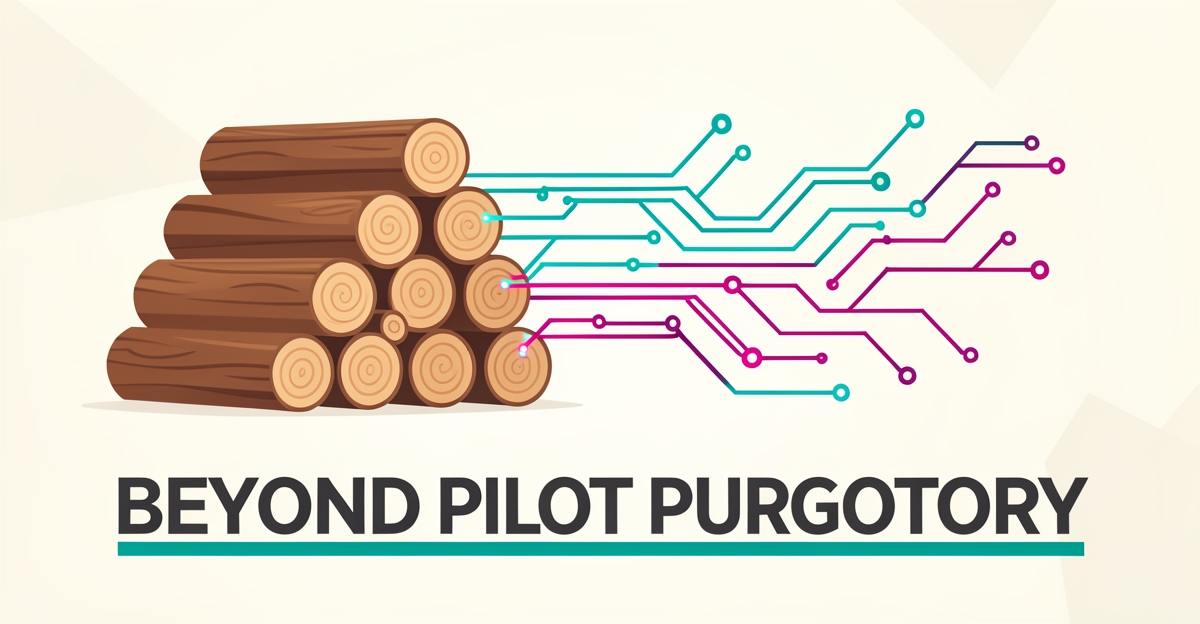
Why Most Firewood Suppliers Fail at AI Adoption (And How to Succeed)
Key Facts
- Case study analyses report that the large majority of AI projects stall before production — often cited as high as 95%
- One documented AI assurance implementation reported roughly 35% cost reduction per review
- Early adopters in that case reported ~14% efficiency gains and ~20% less review time
- Stora Enso reportedly reduced timber losses by around 30% using AI for forest monitoring
- Metsä Fibre reportedly gained ~20% uptime and ~15% maintenance savings through predictive maintenance
- A regional healthcare network reported an 89% pilot-to-production success rate after building a Center of Excellence first
- A global manufacturer scaled predictive maintenance across 23 plants, reportedly cutting downtime by 67% and saving $31M annually
Hire a team member that works 24/7 — for less than a part-time wage.
AI receptionists, SDRs, dispatchers and 99+ roles. Trained on your business, fully managed.
Not sure where to start? Ask our AI planner
The Pilot Trap: Why Most Firewood AI Projects Stall
Firewood suppliers are discovering that launching an AI chatbot or demand forecast is not the same as transforming operations. The industry-wide pattern is clear, and it starts long before the model is trained.
According to case study analysis, the large majority of organizations — some analyses put the figure as high as 95% — fail at AI adoption. The failure point is rarely the algorithm. It is pilot purgatory, where promising prototypes are built as side experiments and never become core workflow.
Companies launch chatbots, forecasting tools, and automation demos in isolation. Without shared data, governance, and executive ownership, those pilots remain disconnected from daily operations. Pilot purgatory persists because teams treat AI as an experiment rather than an operating system.
The stall pattern repeats across the sector:
- Fragmented data sources prevent models from learning a single source of truth
- No governance or change management leads to low adoption and trust gaps
- Prototypes are funded once and abandoned when initial results plateau
- Success metrics are demo-based, not tied to cost, speed, or revenue
The contrast is visible in documented project assurance work with FAST by Firewood. Traditional assurance methods are labour-intensive and fragmented, creating bottlenecks in oversight. FAST integrates the entire assurance process into a single application using AI and machine learning for risk identification and actionable recommendations.
Early adopters in that case reported a roughly 35% reduction per assurance review and a ~14% boost in assurance efficiency. Review time reportedly fell ~20% and productivity improved ~15% through gap analysis insights, with savings of up to £250,000 cited per major project assurance review. Treat these as reported results from one implementation, not guarantees — but the pattern behind them is what matters.
That outcome is not from a better prototype. It is from design choices that avoid common adoption mistakes like poor data quality, lack of training, and over-reliance on prototypes. The system was built as an integrated workflow with clear ownership, not a standalone demo.
For firewood suppliers, the lesson is readiness before rollout. AIQ Labs starts with an AI Readiness Assessment that maps data infrastructure, team capabilities, and high-value workflows, then builds sustainable systems rather than isolated pilots — ensuring models are integrated, governed, and scaled as core operations. That work happens through AI Workflow Builds and, for suppliers ready to go further, AI Operating Systems.
Three Fatal Mistakes: Bad Data, No Training, Prototype Dependency
Firewood suppliers often stumble on AI adoption not because the technology fails, but because they repeat three critical mistakes rooted in operational reality. First, poor data quality undermines any AI initiative from the start. Many still run on paper tickets, disconnected ERPs, and tribal knowledge passed between shifts—creating fragmented, inconsistent inputs that AI cannot reason over effectively. Organizations attempting AI without clean, integrated data foundations see models produce unreliable outputs, eroding trust before scaling even begins. Case study analyses suggest most AI adoption failures trace back to preventable issues like data chaos, where teams spend more time fixing inputs than gaining insights.
Second, lack of role-specific training leaves teams with tools but no clear path to use them. Simply deploying AI without enabling dispatchers, scalers, or yard managers to integrate it into daily workflows guarantees low adoption and frustration. Contrast this with a regional healthcare network that reported an 89% pilot-to-production success rate by building a Center of Excellence first—investing in people, processes, and role-based enablement before scaling tools. This approach shows that AI readiness isn't about technology alone; it's about preparing the humans who must work alongside it. Without tailored training, even the best system gathers dust.
Third, over-reliance on prototypes creates dependency and zero long-term value. Buying off-the-shelf SaaS or no-code bots might deliver quick demos, but it locks suppliers into vendor ecosystems with no ownership, no intellectual property, and no ability to customize for unique yard logistics or seasonal demand swings. When the prototype hits edge cases—like irregular wood sizes or multi-stop delivery routes—there's no path to fix it without vendor intervention. Sustainable AI requires owning the system, not renting a black box. Best practices stress that true transformation begins when businesses stop prototyping and start building—with full control over data, models, and outcomes. For suppliers ready to break this cycle, the path forward starts with assessing readiness—not chasing the next shiny tool. Start the 2-minute Fit Check to evaluate your current state and identify where AI can deliver real, owned value.
The FAST Blueprint: How Firewood Suppliers Actually Win with AI
Firewood suppliers don't need more AI experiments—they need a proven blueprint that connects AI directly to daily operations. The FAST framework, demonstrated in project assurance case studies, shows how integrated AI delivers measurable results: a reported ~20% reduction in review time and ~35% cost savings per workflow when AI is embedded in core processes, not layered on top according to industry research. This means turning messy real-world data—load tickets, weather logs, equipment maintenance records, and invoices—into actionable insights that prevent stockouts, optimize delivery routes, and reduce waste.
Successful adoption hinges on three non-negotiables: end-to-end integration across systems like inventory and accounting, AI that learns from imperfect field data, and clear ROI targets tied to specific workflows. Firewood businesses win when they treat AI as a core operational capability, not a standalone tool. In the broader wood industry, Stora Enso reportedly cut timber losses by ~30% using AI for forest monitoring, while Metsä Fibre gained ~20% uptime and ~15% maintenance savings through predictive maintenance—evidence that AI drives value when it's woven into existing processes per industry case studies.
- Integrate AI with CRM, accounting, and dispatch tools for unified data flow
- Train models on real-world inputs like weather patterns and load ticket anomalies
- Set measurable goals: e.g., faster invoice processing, lower cost per workflow
- Start with one high-impact workflow (e.g., delivery scheduling) before scaling
- Partner with experts who build owned systems, not prototypes
AIQ Labs helps firewood suppliers apply this blueprint by building custom AI employees for dispatch, intake, or invoicing, and integrating them into existing tools so the business owns the outcome. The result isn't just efficiency; it's a resilient operation that turns data into decisions, season after season.
From Pilot to Production: A 4-Phase Implementation Roadmap
The gap between a successful pilot and a scalable, production-grade AI system is where most initiatives die. Industry research suggests the large majority of organizations fail at AI adoption, often because they mistake a working prototype for a finished solution. To bridge that gap, you need a structured, four-phase roadmap that treats AI as an operational asset, not an experiment.
Phase 1: Discovery & Architecture begins with a rigorous audit of your data quality and a map of existing workflows. This is where you model the ROI before writing a single line of code. In the wood industry, where bark beetles have destroyed tens of millions of cubic meters of timber in a single year, understanding your data landscape is the difference between proactive intervention and catastrophic loss. This phase identifies which workflows—dispatch, inventory, or customer intake—will yield the fastest returns.
Phase 2: Development & Integration moves you from blueprint to build. Here, custom agents are constructed on proven frameworks, then connected to the systems that run your business: your CRM, accounting software, dispatch tools, and scale systems. This is not about layering a chatbot over broken processes; it is about deep, two-way API integration that creates a single source of truth. For context, enterprise supply chain platforms often require 12–18 months and $500K+ in consulting fees, making a focused, phased build a strategic advantage for SMBs.
Phase 3: Deployment & Training focuses on go-live with role-based training and human-in-the-loop guardrails. Technology fails when people are not prepared to use it. A regional healthcare network reported an 89% pilot-to-production success rate by investing in people before deploying tools. Your team needs to know not just how the system works, but when to override it.
Phase 4: Optimization & Scale (Ongoing) treats AI as a living capability. You monitor performance, retrain models, and expand across departments. The payoff for this discipline is substantial: a global manufacturer reportedly scaled predictive maintenance across 23 plants in 24 months, cutting downtime by 67% and saving $31M annually. Similarly, a multi-state utility reportedly reduced outage duration by 41% and saved $28M per year by moving from pilot to full production.
To navigate this journey, consider a structured approach:
- Audit data integrity before automating any workflow
- Build on production-ready frameworks, not prototypes
- Train every role that touches the system, not just power users
- Establish governance with human oversight for critical decisions
- Plan for cross-departmental scaling from day one
AIQ Labs structures every engagement around these four phases, ensuring that firewood suppliers and wood product businesses move from pilot purgatory to measurable, enterprise-wide impact.
Own Your AI Workforce: The Transformation Partner Difference
The difference between successful AI adoption and expensive failure often comes down to a fundamental choice: treating AI as a software purchase versus building it as a core business capability. While most organizations fail at AI adoption, those that succeed share a common trait—they stop renting temporary solutions and start owning permanent infrastructure.
Most firewood suppliers find themselves trapped in what industry analysts call "Stage 2" of the AI maturity curve: endless pilots and prototypes that never scale. They subscribe to generic tools that promise automation but deliver fragmentation, or they attempt DIY builds that collapse under real-world complexity. The result is a graveyard of half-implemented systems and subscription fatigue.
The alternative is a transformation partnership that delivers owned AI systems rather than rented access. This means working with builders who architect custom solutions using enterprise-grade frameworks—not consultants who hand you a roadmap and disappear, or vendors who lock you into proprietary platforms. A true partner delivers production-ready infrastructure: AI receptionists that handle customer calls 24/7, dispatchers that optimize delivery routes in real-time, and accounts receivable clerks that chase invoices while you sleep.
This capability-building approach requires flexible engagement models that match your risk tolerance and growth stage. Rather than forcing enterprise-scale commitments, AIQ Labs offers three entry points with matching payment models:
- Start Monthly: Deploy a managed AI employee — receptionist, SDR, dispatcher, or one of 99+ roles — at roughly 80% less cost than a human hire, including training, integrations, and ongoing optimization
- Build in Milestones: Rebuild the one workflow that costs you the most through AI Workflow Builds — fixed price, phased, paying only as each stage ships and keeping everything built if you pause
- Own It Outright: Commission a complete AI Operating System — one connected operating layer, built in phases, with full ownership of code, agents, and data transferred to your business upon completion
The stakes for getting this right are substantial. According to recent industry analysis, major project failures threaten £805 billion in UK government expenditure alone, with 37% of major projects failing and cost overruns averaging 42–45%. In the wood products sector specifically, companies implementing comprehensive AI strategies have reported timber loss reductions of up to 30%, while those relying on fragmented, reactive approaches continue to hemorrhage resources.
Success requires governance frameworks that ensure compliance and quality, plus the technical depth to move beyond prototypes. Look for partners who demonstrate production-proven capability—for instance, AIQ Labs has deployed 200+ multi-agent systems and runs 4 live SaaS products daily, proving their architectures handle real-world scale before applying them to client businesses. This isn't theoretical consulting; it's operational expertise applied to your specific workflows.
The path forward begins with honest assessment. Reviews of AI implementations suggest that organizations investing in capability building and governance frameworks see dramatically better returns than those chasing quick fixes. Before committing to another subscription or prototype, evaluate your readiness with a free Fit Check and strategy call. The goal isn't to buy AI—it's to build an AI workforce you own, control, and scale on your terms.
Still paying for 10+ subscriptions that don’t talk to each other?
We build custom AI systems you own outright. No vendor lock-in. Full control.
Not sure where to start? Ask our AI planner
Frequently Asked Questions
Why do most firewood suppliers fail at AI adoption?
What are the three fatal mistakes firewood suppliers make when adopting AI?
How does the FAST framework improve project assurance for firewood suppliers?
What is the success rate for organizations that invest in people before deploying AI tools?
How can firewood suppliers avoid prototype dependency in AI adoption?
What results have companies in the wood industry seen from AI implementation?
From Pilot Purgatory to Production Profit
Firewood suppliers aren't failing at AI because the models aren't good enough — they're failing because AI is treated as a demo, not an operating system. The pattern is consistent: fragmented data, no governance or role-specific training, and prototypes funded once then abandoned when results plateau. That's pilot purgatory, and it's why case study analysis suggests most organizations stall at adoption. The suppliers that win do the opposite. They start with readiness, integrate AI into core workflows like dispatch, inventory and invoicing, and build owned systems with clear ROI targets and human-in-the-loop guardrails. The FAST blueprint shows the payoff when AI is embedded, not layered on top. If you're ready to move from experiments to measurable operations, start with an honest assessment of data, capabilities and high-value workflows. AIQ Labs offers a free 2-minute Fit Check and a 30-minute strategy call to map your biggest bottleneck and identify where owned AI can deliver real, sustainable value. Start the Fit Check to see if there's a clear win — and if not, we'll tell you that too.
Make AI your competitive advantage — not just another tool.
Strategy, implementation and ongoing optimization. One partner, end to end.
Not sure where to start? Ask our AI planner