Why Most Food Halls Fail at AI Adoption (And How to Avoid It)
Key Facts
- Industry analyses have reported that roughly three-quarters of restaurant operators planned AI investment by 2026 while only about a quarter currently used it, a wide adoption gap according to industry analysis
- A majority of foodservice AI initiatives, commonly cited at 60-70%, stall before reaching production, often becoming expensive shelfware or unused dashboards per industry research
- A single failed AI project can consume $250K-$500K in investment and disrupt operations for 6-12 months, as reported in industry case studies of recent deployments
- AI-powered inventory tools have been reported to reduce food waste by 15-25% within the first few months based on operational data
- AI scheduling tools have been credited with cutting scheduling errors by 67% and reducing overtime spending by roughly $47K per year per implementation results
- Operators have reported repeat visits up 31% and average order value up $8.50 when applying AI personalization to ordering flows per customer-facing AI deployments
- Research widely cited in industry analysis (originally from MIT) found that 95% of corporate generative AI pilots failed to deliver measurable financial returns as cited in industry coverage
Hire a team member that works 24/7 — for less than a part-time wage.
AI receptionists, SDRs, dispatchers and 99+ roles. Trained on your business, fully managed.
Not sure where to start? Ask our AI planner
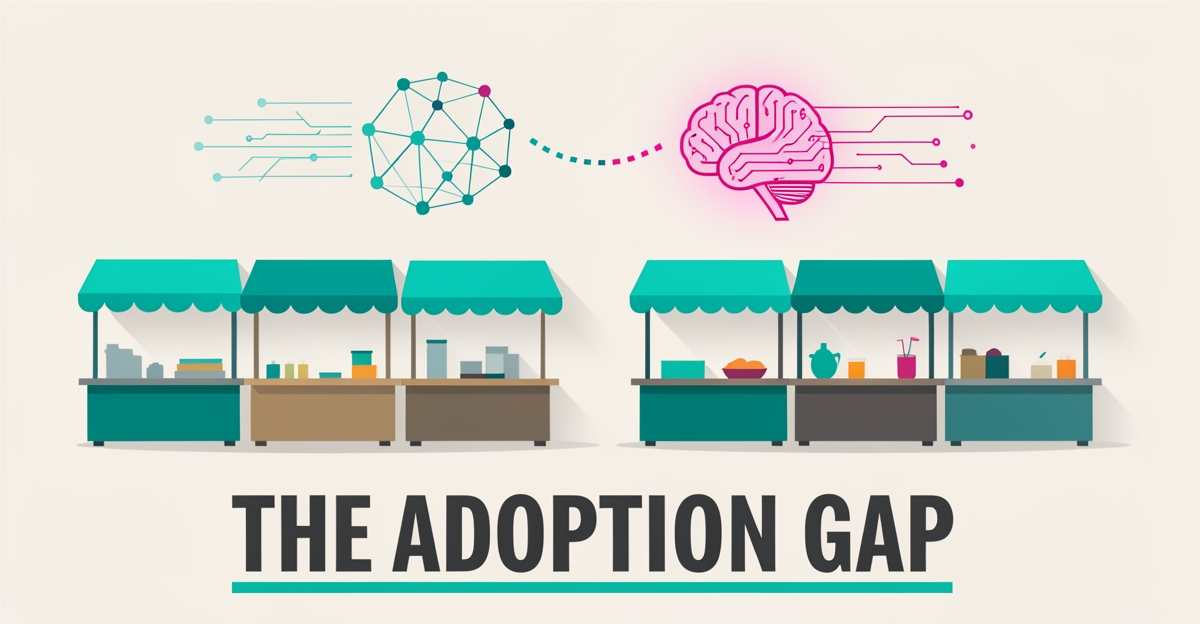
The Adoption Gap: Why Food Hall AI Ambitions Stall Before They Start
The gap between AI ambition and reality in food halls is stark: industry analyses have reported that roughly 73% of operators planned AI investment by 2026 while only about 26% currently used it. Even more concerning, a majority of foodservice AI initiatives, commonly cited at 60-70%, stall before reaching production, often becoming expensive shelfware or unused dashboards. These failures aren't due to flawed technology but stem from systemic implementation gaps that treat AI as an isolated tool rather than an operational necessity.
A single failed AI project can consume $250K-$500K in investment and disrupt operations for 6-12 months, burning through resources while eroding stakeholder confidence. This high cost of failure makes strategic preparation non-negotiable for food halls operating on thin margins. The most successful implementations recognize that AI does not optimize chaos, it executes structure, meaning foundational work must precede deployment.
Critical failure points consistently emerge across research: poor data quality where menu items are labeled differently across platforms, legacy systems that prevent real-time integration, change management gaps where staff aren't properly trained or involved, and security risks exposing sensitive operational data. These challenges compound when AI projects lack clear objectives, sufficient historical data, or executive and operational support from the outset.
For food halls seeking to avoid these pitfalls, the path forward requires treating AI adoption as a systemic transformation. This means starting with clean, structured data foundations, eliminating manual handoffs in operational flows, and building human-centric rollout strategies that include empathetic training and co-design with frontline teams. Success depends not on chasing novelty but on ensuring integration connects systems while frictionless flow allows execution, turning AI capability into tangible business impact. Start the 2-minute Fit Check to assess your food hall's AI readiness and identify high-ROI automation opportunities before investing in solutions that may stall before delivery.
The Four Failure Modes: Data Chaos, Legacy Architecture, and the Human Blind Spot
The gap between AI ambition and reality in food halls isn't a technology problem, it's a structural one. While industry analyses report most operators planned AI investment by 2026, only a fraction currently use AI tools, and 60-70% of initiatives stall before reaching production. These failures compound across four interconnected modes that most operators don't see until it's too late.
- Data chaos: Menu items labeled differently across POS, delivery apps, and loyalty platforms create a fragmented reality that AI cannot reconcile. Sales data split between systems means models train on noise, not signal.
- Legacy architecture: Bolting AI onto monolithic POS and batch-driven warehouses is, as one analysis puts it, "like trying to install a jet engine on a horse cart." The frame simply cannot handle the speed.
- Human blind spots: Line cooks and shift managers receive AI recommendations without context, training, or feedback loops. With high industry turnover, untrained staff treat new tools as disruptions rather than aids.
- Missing governance: Customer PII, payment histories, and employee scheduling data flow through AI systems without bias mitigation, consent tracking, or audit trails, exposing operators to compliance violations and reputational risk.
Integration, not novelty, determines whether AI becomes decoration or execution. The formula is simple: AI capability multiplied by system integration multiplied by frictionless flow. When any variable approaches zero, ROI collapses. A single failed project can consume $250K-$500K and disrupt operations for 6-12 months. AIQ Labs helps food hall operators diagnose these failure modes before investment, starting with a fixed-price workflow rebuild of the one process that costs you the most, or a broader AI operating system when the whole hall needs to connect, turning the adoption gap into a phased transformation roadmap.
Integration Over Novelty: The ROI Formula That Actually Works
Here's the uncomfortable math: the smartest AI model in the world delivers zero return if it's bolted onto fragmented systems. As QSR Magazine puts it, "AI layered on top of fragmented systems rarely changes performance. Integration, not novelty, determines whether AI becomes decoration or execution."
The publication offers a deceptively simple formula worth memorizing: Restaurant ROI = AI × Integration × Frictionless Flow. AI provides capability. Integration connects systems. Frictionless flow allows execution. Because it's multiplication, not addition, a zero in any single factor zeroes out the entire return. A dazzling forecasting engine that feeds on messy, siloed data produces nothing but unreliable outputs, and stakeholders lose trust before real impact is ever felt.
This is why food halls must treat menus differently than previous generations of operators did. Traditional menus were marketing artifacts, printed, reformatted, and manually updated. In the AI era, a menu must function as a structured, machine-readable data layer: standardized in naming and modifiers, synchronized with the POS, automatically updated across every platform, and accessible via API. When the same dish carries three different labels across delivery, loyalty, and POS systems, AI models are starved of the clean inputs they need to find meaningful patterns.
The same logic applies to operational flow. Every manual handoff in an ordering journey, from customer to menu to POS to kitchen, becomes a point where AI capability leaks out of the system. As QSR Magazine warns, "Any manual bottleneck becomes an AI bottleneck." The goal is a seamless customer-to-kitchen path with no redundant data entry between systems.
Then there's the build-versus-partner question, which is fundamentally a financial one. Building AI in-house demands high-priced data scientists, dedicated DevOps resources, and specialized infrastructure that can double or triple technology budgets. With thin margins and a single failed project capable of consuming $250K–$500K while disrupting operations for 6–12 months, most operators can't absorb that risk. Partner-built systems, by contrast, offer managed services and cloud-native architectures that materially reduce total cost.
This systems-first thinking shapes how we approach engagements at AIQ Labs. Before recommending any technology, we evaluate your data infrastructure, integration gaps, and operational flow, because AI doesn't optimize chaos, it executes structure. For most food halls, that starts with rebuilding the single workflow that costs the most, at a fixed price and in phases, so you only ever pay for what's already working.
The takeaway is counterintuitive but consistent across every successful implementation: AI success is a systems problem, not a tech problem. Fix the structure first, and the technology finally has something to work with.
The High-ROI Playbook: Where AI Actually Pays Off in Food Hall Operations
Food halls don't need more AI experiments. They need one use case that pays for itself fast, then compounds.
The highest-return opportunities cluster around waste, labor, and demand. Back-of-house inventory tools have been reported to cut food waste by 15-25% within the first few months, directly improving margin on perishable vendors.
Scheduling is the next quick win. AI scheduling tools have been credited with decreasing scheduling errors by 67% and reducing overtime spending by roughly $47K per year, while improving coverage during peak service windows.
Customer-facing AI drives revenue, not just efficiency. Operators have reported repeat visits up 31% and average order value up $8.50 when personalization and demand forecasting are applied to ordering flows.
These results are not from stacking tools. They come from picking one structured problem with clean data and a clear financial lever. A contrarian take shared in industry analysis is that AI does not optimize chaos. It executes structure.
A disciplined first-use-case selection filters out hype:
- High business impact with measurable P&L effect within 6-12 months
- Sufficient historical data availability to train and validate the model
- Clear ROI path and operational support from vendors and staff
That criteria mirrors the strategic planning framework most successful foodservice operators use. Assessing data foundations, integration points, and change management before building avoids the 60-70% stall rate seen across foodservice AI initiatives.
AIQ Labs approaches food hall transformation with this use-case-first discipline, grounding selection in data maturity and integration readiness rather than vendor demos. That can mean AI employees, managed AI receptionists, SDRs, and dispatchers handling roles like reservations, catering inquiries, and vendor coordination at a fraction of the cost of a human hire, or a deeper workflow rebuild. The goal is a production system that owns the workflow, not another dashboard.
Start with inventory or scheduling, prove the return, then expand to demand forecasting and guest personalization with the same rigor.
From Pilot to Production: A 90-Day Path That Doesn't End in Shelfware
The brutal reality is that a majority of AI initiatives in foodservice, commonly cited at 60-70%, stall before reaching production, leaving behind expensive dashboards nobody uses. Industry analysis shows these projects don't fail because the technology is immature, they fail because operators treat AI as a tool purchase rather than a systems transformation. Research widely cited in industry coverage (originally from MIT) found that 95% of corporate generative AI pilots fail to deliver measurable financial returns, often consuming $250K-$500K and 6-12 months of operational disruption before the plug gets pulled.
The path from pilot to production requires a disciplined sequence that starts long before model selection. First, assess your data infrastructure honestly, can your POS, inventory, and labor systems actually talk to each other in real time? QSR Magazine puts it bluntly: "AI does not optimize chaos. It executes structure." Define one measurable objective tied to a painful bottleneck, such as cutting waste 20% in 12 months or hitting 97% stock availability. Pilot with clean data from a single vendor or function where you control the inputs. Co-design the rollout with the shift leads and line cooks who will live with the new workflow daily, their buy-in determines whether the system survives first contact with a Friday night rush. Then scale with governance baked in: model monitoring, data drift alerts, and clear escalation paths when the AI gets it wrong.
- Audit data sources and standardize formats across POS, delivery, and loyalty platforms
- Pick one high-impact use case with sufficient historical data and clear 6-12 month ROI
- Run a controlled pilot with a single vendor or location before expanding
- Train staff as change champions, not passive users of a new dashboard
- Establish governance frameworks for bias, privacy, and model auditability from day one
This is exactly the sequence AIQ Labs builds into every engagement, starting with a 2-minute Fit Check, then a free 30-minute strategy call to map your biggest bottleneck, and telling you straight if there's no clear win. Work is delivered in milestones at a fixed price, so you're never betting the whole budget on a promise. The goal isn't more pilots. It's production systems that pay for themselves.
Still paying for 10+ subscriptions that don’t talk to each other?
We build custom AI systems you own outright. No vendor lock-in. Full control.
Not sure where to start? Ask our AI planner
Frequently Asked Questions
Why do so many food hall AI initiatives fail to move beyond pilot stages?
What is the biggest technical barrier preventing AI from working effectively in food halls?
How much can a single failed AI project cost a food hall, and what operational impact does it have?
What are the highest-ROI AI use cases for food halls to start with?
How can food halls avoid treating AI as just another dashboard that no one uses?
Is building AI in-house a viable option for most food halls?
Structure First, AI Second, Your Roadmap Out of the Adoption Gap
The gap between AI ambition and reality isn't a technology problem, it's a systems problem. With most operators planning investment but only a fraction using AI, and 60-70% of initiatives stalling before production, food halls are burning $250K-$500K on dashboards and shelfware because AI is being bolted onto data chaos, legacy architecture, and change management blind spots. The math is clear: Restaurant ROI = AI × Integration × Frictionless Flow. Capability means nothing without clean, structured data, real-time system connections, and workflows designed for execution. Success starts with one high-impact, data-ready use case, inventory or scheduling, built on a foundation of standardized menus, eliminated manual handoffs, and staff co-design. AIQ Labs helps operators diagnose those failure modes before spending, mapping data foundations, integration gaps, and operational flow into a phased transformation roadmap, whether that's AI employees covering front-of-house roles, a fixed-price workflow rebuild, or a full AI operating system you own outright. Start the Fit Check at https://aiqlabs.ai/apply, then book a free 30-minute strategy call to identify your highest-ROI automation opportunity and see if there's a clear win before you invest.
Make AI your competitive advantage — not just another tool.
Strategy, implementation and ongoing optimization. One partner, end to end.
Not sure where to start? Ask our AI planner