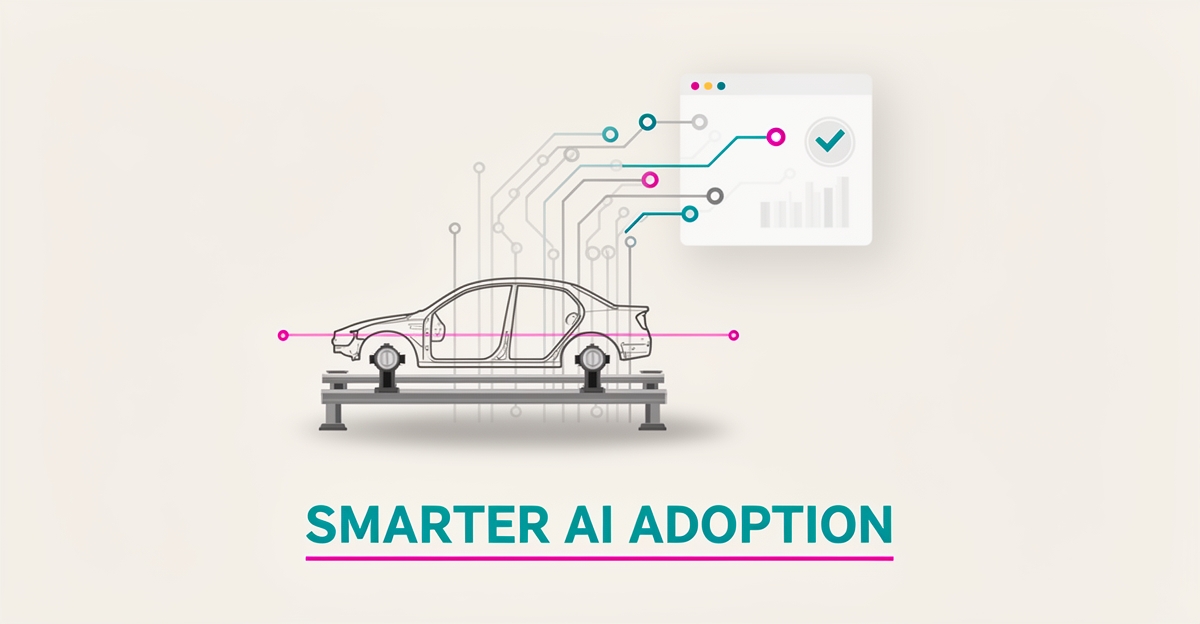
Why Most Frame Straightening Shops Fail at AI Adoption — And How to Avoid It
Key Facts
- Industry analyses report that single-location auto repair shops have recovered amounts in the tens of thousands of dollars in their first year using AI-powered accounts payable reconciliation according to industry data
- Industry analysis projects that a majority of auto repair shops will use some form of AI technology by late 2026, up from roughly a quarter in early 2025 per industry analysis
- Manual straightening remains optimal for high-mix, low-volume operations where part geometries vary significantly per manufacturing research
- Automated frame straighteners only deliver ROI when production volume scales to the point where human variability creates unacceptable scrap rates per industry analysis
- Multi-location operators have reported finding five-figure sums in missing vendor credits within hours of using AI for accounts payable reconciliation per industry data
- AI-powered diagnostic tools like Mastertech.ai draw on a community database of over 2 million verified repairs to generate estimate support per industry analysis
- Shops investing in automated frame straighteners for low weekly volumes face extended payback periods due to mismatched investment per manufacturing research
Hire a team member that works 24/7 — for less than a part-time wage.
AI receptionists, SDRs, dispatchers and 99+ roles. Trained on your business, fully managed.
Not sure where to start? Ask our AI planner
The AI Adoption Trap: Why Most Frame Shops Invest in the Wrong Technology
The most expensive mistake a frame shop owner can make isn't buying the wrong equipment—it's buying the right equipment for the wrong reasons. As industry analysis suggests, AI adoption in auto repair is climbing sharply through 2026, yet many shops are investing in technology that mismatches their operational reality.
The core failure pattern is predictable: owners see competitors adopting AI or automated machinery and assume they need the same capability. They purchase high-cost automated straightening systems or generic AI tools without first assessing their production volume, part geometry, or data readiness. The result is capital tied up in equipment that doesn't scale with their business.
Consider the manual versus automated straightening decision. According to manufacturing research, manual systems remain the optimal choice for high-mix, low-volume operations where part geometries vary significantly. Automated systems only deliver ROI when production volume reaches levels where human variability creates unacceptable scrap rates and throughput bottlenecks.
The financial impact of mismatched investment is severe. Shops investing in automated frame straighteners for low-volume work face extended payback periods, while those ignoring high-impact back-office AI applications miss immediate profit recovery opportunities. Industry data reports single-location shops recovering tens of thousands of dollars in their first year using AI-powered accounts payable reconciliation.
The problem extends beyond equipment selection. Many shops adopt generic business AI tools that cannot handle industry-specific workflows like parts-to-RO matching, core return tracking, or vendor statement reconciliation. These tools fail to integrate with existing shop management systems, forcing expensive "rip and replace" scenarios that disrupt operations without delivering value.
The most common mismatched investments include:
- High-capacity automated straighteners for shops processing low weekly volumes
- Generic AI chatbots that cannot interpret repair orders or parts invoices
- Diagnostic AI tools that duplicate existing technician expertise without adding value
- Shop management platforms requiring complete workflow redesign rather than integration
Successful AI adoption starts with operational assessment, not technology selection. Shops must calculate their true cost per part under current methods, model how volume changes affect these costs, and identify specific bottlenecks where technology can deliver measurable ROI. This analysis often reveals that back-office automation—particularly accounts payable reconciliation—delivers faster returns than physical equipment upgrades.
At AIQ Labs, we help frame shops avoid these capital traps by mapping technology investments to actual operational constraints. Our AI Workflow Builds rebuild the one workflow that costs you the most—fixed price, delivered in phases—so you're never betting the shop on a moonshot. When a shop needs ongoing capacity first, AI Employees handle back-office roles like dispatching and reception at a fraction of the cost of a human hire.
The shops succeeding with AI aren't those with the most advanced equipment—they're the ones that matched technology investment to their specific production reality and financial constraints.
Where AI Actually Delivers ROI in Frame Repair: Beyond the Straightening Bay
Here's an uncomfortable truth for frame shop owners: the AI delivering real money right now isn't anywhere near the straightening bay. It's in the back office, quietly finding profit leaks that manual processes miss every single day.
Consider the reported results. According to industry analysis of AI tools for auto repair, single-location shops have recovered tens of thousands of dollars per year using AI-powered accounts payable reconciliation, and multi-location operators have reported finding five-figure sums in missing vendor credits within hours of focused use. Few physical automation investments pay back that fast.
Why does financial AI outperform so dramatically? Because manual reconciliation is time-consuming, and most shops audit only a fraction of their transactions. Purpose-built AI tools work around the clock, cross-referencing every invoice against repair orders and vendor statements to flag missed credits, duplicate charges, and billing errors the moment they happen. For a modest monthly investment, the math is hard to argue with.
Diagnostic AI is the second proven winner. Platforms like Mastertech.ai draw on a community database of more than 2 million verified repairs to generate diagnostic and estimate support, while Mitchell 1's SureTrack delivers AI-enhanced repair data from decades of verified fixes. These tools accelerate decisions technicians already make — they don't attempt to replace the tactile skill that straightening work demands.
The pattern across successful deployments is consistent. The tools that deliver ROI share three traits:
- Industry-specific design — they handle parts-to-RO matching, core return tracking, and unique vendor workflows that generic business AI simply cannot process
- Integration with existing shop management systems and accounting platforms, rather than forcing a rip-and-replace of your entire tech stack
- Measurable ROI metrics — recovered dollars, hours saved, faster estimates — instead of vague efficiency promises
That last point deserves emphasis. A tool your advisors and technicians won't actually use is worthless, no matter how sophisticated. Ease of adoption, mobile access, and low training requirements separate the tools that stick from the subscriptions that quietly die.
The lesson for frame shop owners is straightforward: before investing in physical automation, audit where money is already leaking. The same research projects that a majority of auto repair shops will use some form of AI by late 2026, up from roughly a quarter in early 2025 — and the shops winning that race are starting with back-office wins, not bay-floor moonshots. This is precisely why a readiness-first approach matters: it identifies where your shop's specific bottlenecks and profit leaks actually live before you spend a dollar, ensuring your first AI investment targets a proven use case rather than a mismatched one.
How to Avoid Failure: A Readiness-First Approach to AI Investment
The gap between AI hype and shop-floor reality is where most frame straightening investments go to die. Shops pour capital into automated pullers or generic chatbots without first quantifying what their current process actually costs per repair. Industry analysis shows that manual straightening remains the superior choice for high-mix, low-volume work where tactile feedback and operator judgment drive quality, while automation only pays off when volume scales to the point that human variability creates unacceptable scrap rates and throughput bottlenecks.
Before signing a purchase order, calculate your true cost per part under current manual methods. Factor in labor hours, scrap rates, rework time, and the delivery delays caused by throughput bottlenecks. Then model how those metrics shift if production volume doubles or triples. Research from MAE confirms that the ROI for automated systems is straightforward only for operations running high volumes of similar parts with consistent geometries; for everyone else, a manual machine remains the smart, cost-effective choice.
The same rigor applies to software. A majority of auto repair shops are expected to use some form of AI technology by late 2026, up from roughly a quarter in early 2025, yet many will adopt generic tools that cannot handle parts-to-RO matching, core return tracking, or unique vendor workflows. Purpose-built back-office AI has repeatedly delivered faster, higher-ROI returns than bay-floor equipment for shops that start there.
Use this readiness checklist before investing:
- Calculate true cost per part including labor, scrap, rework, and throughput delays
- Model volume scenarios at 2x and 3x current output to test automation break-even
- Verify the tool is built for auto repair — not generic business AI — to handle your vendor workflows
- Confirm integration with your existing shop management system without a rip-and-replace
- Define measurable ROI metrics: recovered dollars, hours saved, or faster cycle times
AIQ Labs helps frame shops run this exact assessment, mapping your production reality to the right technology instead of the loudest marketing. If the numbers don't add up, we'll tell you that too. Start with the two-minute Fit Check at https://aiqlabs.ai/apply, then book your free 30-minute strategy call at https://aiqlabs.ai/book. The right answer is always the one that fits your production reality.
Still paying for 10+ subscriptions that don’t talk to each other?
We build custom AI systems you own outright. No vendor lock-in. Full control.
Not sure where to start? Ask our AI planner
Frequently Asked Questions
Should I invest in an automated frame straightening system if I only fix 10 vehicles a week?
Where can AI actually save me money fastest in my frame shop?
Why do generic AI tools fail in auto repair shops?
How do I know if AI is right for my shop before making a big investment?
What percentage of auto repair shops are expected to use AI by late 2026?
Is diagnostic AI worth investing in for my frame shop?
Start Where the Money Actually Is
The difference between frame shops that thrive with AI and those that stall isn't technical sophistication—it's strategic patience. While competitors rush to automate the straightening bay or deploy generic chatbots, the winners are quietly plugging profit leaks in the back office, where industry data shows accounts payable reconciliation alone can recover tens of thousands of dollars annually for a single location. Before you invest in equipment that demands volume you don't have, calculate your true cost per part and audit where your current processes are bleeding cash. AIQ Labs helps shops run this exact analysis—whether that means an AI Employee for the back office, a fixed-price Workflow Build for your costliest process, or a phased AI Operating System once the basics are working. Start with the two-minute Fit Check at https://aiqlabs.ai/apply, then book your free 30-minute strategy call at https://aiqlabs.ai/book to identify your highest-ROI opportunity—no sales pitch, just a working session with an AI engineer. If the numbers don't add up, we'll tell you that too.
Make AI your competitive advantage — not just another tool.
Strategy, implementation and ongoing optimization. One partner, end to end.
Not sure where to start? Ask our AI planner