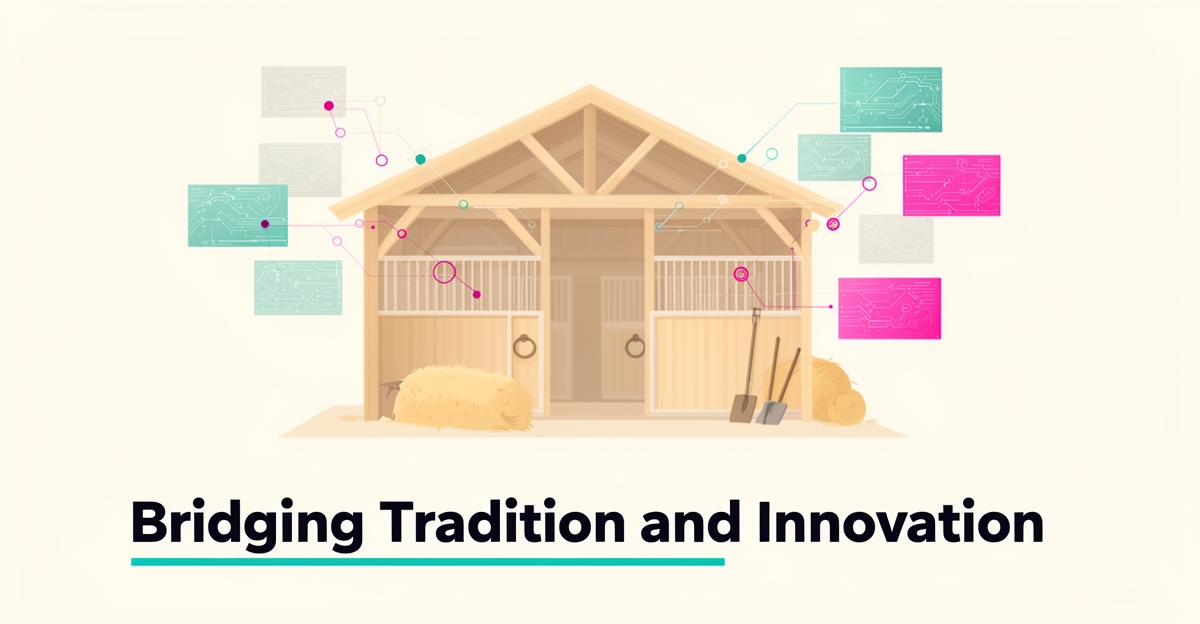
Why Most Horse Stables Fail at AI Adoption — And How to Avoid It
Hire a team member that works 24/7 — for less than a part-time wage.
AI receptionists, SDRs, dispatchers and 99+ roles. Trained on your business, fully managed.
Not sure where to start? Ask our AI planner
The Stable AI Gap: Buying Tools Before Building Foundations
Equine operations run on tight margins and thin staffing. When AI vendors come calling with apps for health monitoring, scheduling, or breeding analysis, the temptation is to buy the tool and hope it fixes the workflow. That's the pattern behind most failed adoptions: the technology gets purchased before anyone has defined the problem, checked the data, or prepared the team.
The result is predictable. A subscription gets paid for a year, staff ignore it, and the stable concludes that "AI doesn't work for our industry." The technology usually wasn't the problem. The rollout was.
Pitfall #1 — Fragmented Data and No Governance
Most stables run on a mix of paper records, disconnected spreadsheets, and whatever the barn whiteboard says. AI tools need structured, consistent data to do anything useful — whether that's flagging health trends, tracking training loads, or handling intake and billing. Feed a system fragmented records and you get fragmented answers.
Governance matters just as much. Someone has to decide what the AI is allowed to do, who reviews its output, and what happens when it gets something wrong. Autonomous agents amplify whatever process they're dropped into — good or bad. Without human oversight and clear guardrails, small errors compound quietly until they surface as missed appointments, billing mistakes, or worse.
Before spending a dollar on software, map where your data lives, who owns it, and which decisions a human must always sign off on.
Pitfall #2 — Black-Box AI and Staff Who Don't Trust It
Barn managers and trainers are practical people. If a tool spits out a recommendation and nobody can explain where it came from, it gets ignored — and rightly so. Explainability is one of the most commonly cited barriers to trusting AI in business settings, and it's especially acute in operations where a bad call affects animal welfare.
The fix isn't more dashboards. It's choosing systems that show their reasoning, keeping humans in the loop on consequential decisions, and training staff on what the AI does and doesn't handle. Adoption sticks when the team understands the tool, not when they're told to trust it.
The Readiness Check: Assessing Your Stable Before Spending a Dollar
A useful readiness check asks four questions:
- Data: Are health, scheduling, and billing records structured and accessible, or scattered across paper and inboxes?
- Workflows: Which single process costs you the most time or money each month? That's your first candidate, not the flashiest app.
- People: Does your team have the capacity and buy-in to change how they work, or will new tools bounce off?
- Oversight: Who reviews AI output, and what's the escalation path when it's wrong?
If you can't answer these confidently, you're not ready to buy — you're ready to assess. AIQ Labs' free 30-minute strategy call walks through exactly these questions for your operation, with no obligation.
From Assessment to Action: A Roadmap That Actually Sticks
Once readiness is clear, the roadmap is deliberately boring: fix one high-impact workflow first, prove it works, then expand. Most organizations stall at the pilot stage because they try to transform everything at once with no governance underneath. A phased approach avoids that.
There are three practical ways to move forward, depending on your capacity:
- Managed AI Employees — trained AI staff covering roles like receptionist, intake coordinator, or scheduling agent, available around the clock at a fraction of a human hire's cost. Good when staffing is the bottleneck.
- AI Workflow Builds — rebuild the one workflow that costs you the most, at a fixed price, delivered in phases. Good when one broken process is dragging the whole operation.
- AI Operating Systems — one connected operating layer built in phases and owned outright. Good when you're ready to stop patching tools together.
Whichever path fits, the system should be yours — no vendor lock-in, no renting your own operations back from a software company. Payment models like Start Monthly, Build in Milestones, and Own It Outright exist so the structure matches your risk tolerance, not the vendor's.
Still paying for 10+ subscriptions that don’t talk to each other?
We build custom AI systems you own outright. No vendor lock-in. Full control.
Not sure where to start? Ask our AI planner
Frequently Asked Questions
Why do most horse stables struggle when trying to adopt AI technology?
What are the biggest hidden costs or risks of implementing AI in a stable operation?
How do I know if my stable's data is good enough for AI tools to actually work?
My staff isn't technical — can we still use AI without hiring a data scientist?
What does a realistic AI adoption roadmap look like for a mid-sized stable?
How does AIQ Labs help stables avoid the common failure points in AI adoption?
From Stalls to Strategy: Your AI Readiness Checklist
Most horse stables stumble on AI adoption not because the technology isn't ready, but because foundational gaps in data, training, and governance go unaddressed. Success hinges on assessing readiness — data quality, staff capability, and integration points — before investing in anything. AIQ Labs helps equine operations avoid these pitfalls through structured readiness checks, custom systems you own outright, and managed AI employees that work alongside your team. The path forward starts with clarity: identify your highest-impact workflow, validate your data foundations, and pick a delivery model that matches your risk tolerance. Take the first step with our free Fit Check — two minutes, no obligation, and a clear view of where AI can genuinely move the needle for your operation. Questions first? Email [[email protected]](mailto:[email protected]).
Make AI your competitive advantage — not just another tool.
Strategy, implementation and ongoing optimization. One partner, end to end.
Not sure where to start? Ask our AI planner