# Why Most Ice Management Companies Fail at AI Adoption, And How to Avoid It
**Quick Answer:** Most ice management AI fails not because of bad technology, but because of broken foundations. Here's how to avoid the common traps and deploy AI that actually scales.
## Key Facts
- AI amplifies existing operational weaknesses rather than fixing them
- Data governance and consent failures are the leading source of AI-related regulatory penalties, so they must be addressed before scaling
- AI creates value only when the underlying workflow is fixed first, automation layered on a broken process just produces faster mistakes
- Quality should be prioritized over speed of implementation in AI deployment
- AI works best as the intelligence layer while your existing systems serve as the execution layer
- The organizations that succeed with AI build it on operational foundations designed for scale and governance
## Table of Contents
- [The Real Reason AI Projects Fail: Broken Foundations, Not Bad Technology](#the-real-reason-ai-projects-fail-broken-foundations-not-bad-technology)
- [The Workflow Trap: Why Bolting AI Onto Broken Processes Accelerates Failure](#the-workflow-trap-why-bolting-ai-onto-broken-processes-accelerates-failure)
- [The Hidden Risks: Data Governance and Compliance](#the-hidden-risks-data-governance-and-compliance)
- [The Phased Approach: How to Deploy AI Without the Chaos](#the-phased-approach-how-to-deploy-ai-without-the-chaos)
- [Building AI That Lasts: Ownership, Training, and the Right Delivery Model](#building-ai-that-lasts-ownership-training-and-the-right-delivery-model)
## The Real Reason AI Projects Fail: Broken Foundations, Not Bad Technology
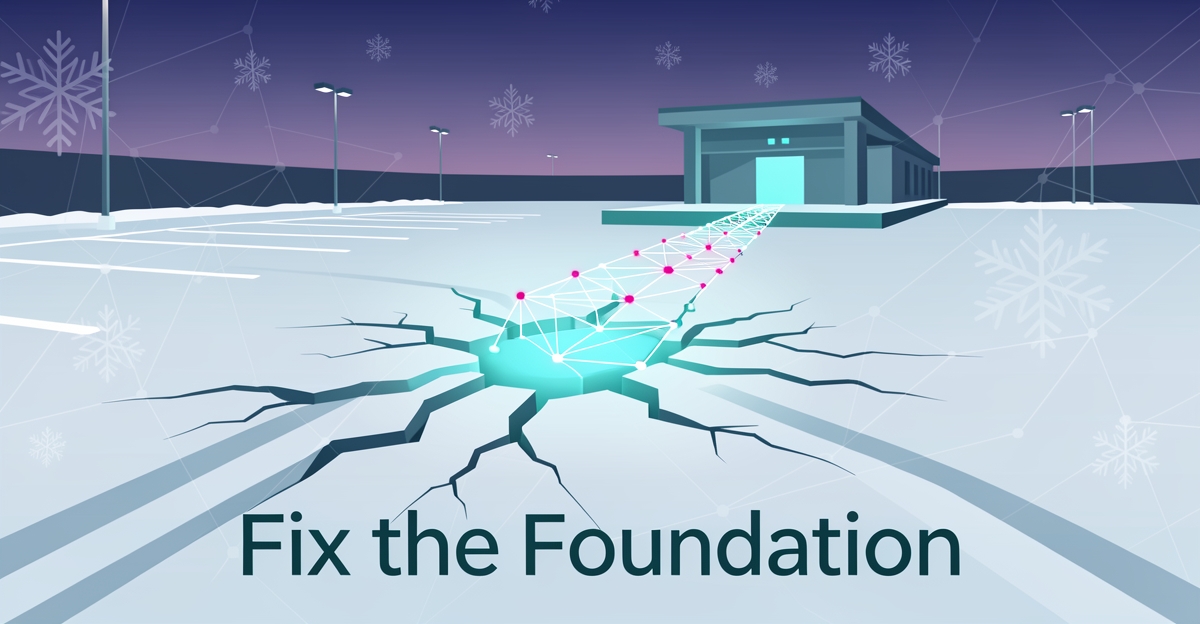
When an ice management company invests in AI-powered route optimization or automated dispatch, the assumption is that the technology itself drives results. The reality is far less forgiving: AI acts as a multiplier, not a repair kit. If your underlying operations are fractured, AI simply helps you fail faster and at greater scale.
Industry research consistently finds that the issue is rarely the AI itself. More often, it is the lack of a strong operational foundation underneath it. When organizations move from promising pilots to enterprise-scale deployment, they encounter hidden constraints that were always there but previously invisible.
These constraints typically include:
- Fragmented data scattered across disconnected systems and spreadsheets
- Inconsistent processes that vary by crew, shift, or region
- Unclear ownership of data and decision-making authority
- Governance gaps that leave compliance and accountability exposed
The pattern is predictable. A dispatch system might work beautifully in a controlled pilot with your most organized team, then collapse when rolled out to crews who record service times differently or skip data entry entirely. **AI amplifies existing operational weaknesses** rather than fixing them. It cannot compensate for conflicting sources of truth or fragmented operating models; it simply exposes these flaws at machine speed.
This is why workflow redesign must precede automation. Organizations lose money not because they lack AI tools, but because critical steps still move through disconnected systems, inboxes, and document versions. In ice management, this might mean your expensive new AI scheduling tool fails because job completion data lives in three different apps that never sync.
The companies succeeding with AI are not necessarily those with the biggest budgets or the most advanced models. They are the ones that build on **operational foundations designed to support scale**, governance, and continuous execution. They establish clear data ownership and standardized processes before layering intelligence on top.
This is where structured change management becomes critical. At AIQ Labs, we approach AI transformation by first stabilizing the operational core, ensuring data flows cleanly between systems and teams follow consistent workflows, then introducing AI as an intelligence layer that enhances rather than disrupts. Without this foundation, even the most sophisticated AI becomes an expensive lesson in why preparation beats deployment speed.
## The Workflow Trap: Why Bolting AI Onto Broken Processes Accelerates Failure
Many organizations treat AI as a quick fix, layering intelligent tools onto processes that were never designed for scale or clarity. This approach doesn't just waste investment, it actively worsens outcomes by accelerating confusion at scale. When workflows are poorly defined, AI doesn't solve problems; it amplifies them, turning minor inefficiencies into systemic breakdowns.
The root issue isn't the technology, it's the foundation. Without clear, consistent processes, AI systems inherit and magnify existing flaws: fragmented data, unclear ownership, and governance gaps that become impossible to manage as automation spreads.
This is especially evident in agreement- and coordination-heavy workflows, where poor design creates compounding friction. Small, repetitive tasks, chasing approvals, checking standard clauses, triaging routine requests, pull skilled employees away from high-value work, trapping them in cycles of low-impact tasks that erode morale and productivity. Analysts have estimated these frictions cost the global economy enormous sums in lost value, though the precise figures vary by study; the direction is what matters.
The principle is simple: if the process is unclear, AI can accelerate confusion at scale. Bolting AI onto broken processes doesn't create efficiency, it creates faster, more expensive mistakes. The real opportunity lies not in automation for its own sake, but in using AI to eliminate the routine work that shouldn't require human judgment in the first place.
The most successful AI transformations begin with a simple but critical question: where do existing workflows force skilled people to do routine, low-val
AI Employees
Hire a team member that works 24/7 — for less than a part-time wage.
AI receptionists, SDRs, dispatchers and 99+ roles. Trained on your business, fully managed.
See If You’re a Fit — AI Employees from $700/mo
Not sure where to start? Ask our AI planner
ue work? Answering this reveals the true leverage points for AI, not as a replacement for judgment, but as a tool to free people from the tasks that drain their expertise. AIQ Labs helps organizations answer this question through structured workflow analysis, typically starting with a single [AI Workflow Build](/workflow-builds) targeting the one workflow that costs you the most, ensuring AI is applied where it creates real value, not just the illusion of progress.
## The Hidden Risks: Data Governance and Compliance
The regulatory bill for rushing AI is already being paid at scale, and ice management companies are not immune. Regulators have imposed billions of dollars in AI-related fines on major technology firms in recent years, and the pattern is clear: accountability is catching up with innovation. A large majority of those penalties have related to using personal data without proper consent or legal authorization.
For operational firms handling customer data, route information, and operational records, that risk translates directly to daily workflows. High-profile enforcement actions have targeted unauthorized data use, copyright infringement in training data, and deceptive marketing of AI capabilities, all areas where a service business can stumble without realizing it.
Ice management companies collect highly sensitive operational data: property addresses, service schedules, payment details, and crew locations. Deploying AI without clear data lineage and consent creates exposure. Regulators are increasingly focused on how companies build AI and how they market it, and small and mid-sized businesses are not exempt from the same principles.
Governance gaps also amplify operational risk. AI can accelerate decision-making, but it cannot compensate for fragmented operating models or conflicting sources of truth. In many cases, AI simply exposes weaknesses that already existed within the business.
That is why governance frameworks must be built before scaling AI, not after. A phased approach that prioritizes workflow redesign, operational readiness, and change management prevents the hidden constraints that stall pilots.
For ice management, the highest-risk data practices to govern early include:
- Using customer property data, route logs, or crew records to train models without explicit consent
- Merging data from disconnected systems like dispatch, billing, and CRM into a single AI input without audit trails
- Deploying voice or chat agents, such as an [AI receptionist](/ai-employees), that capture personal information without documented retention and deletion policies
- Marketing AI capabilities that overstate automation benefits or compliance posture
Building trust and ethics guidelines, data security and privacy protection, and regulatory alignment into the foundation is a core part of any serious AI deployment. AIQ Labs works with SMBs to establish AI governance frameworks for compliance, ethics, and risk management before scaling.
Organizations that succeed with AI will not necessarily be the ones that deploy the most models first. They will be the ones that build AI on top of operational foundations designed to support scale, governance, and continuous execution.
## The Phased Approach: How to Deploy AI Without the Chaos
The difference between AI success and expensive failure often comes down to one strategic choice: whether you sprint toward full automation or build deliberately through incremental wins. For ice management companies, where seasonal windows are tight and operational errors carry immediate costs, the phased approach isn't just safer, it's the only sustainable path forward.
Successful deployment starts with **agile methodologies** that break complex AI projects into manageable phases. Rather than attempting to automate your entire dispatch and routing operation overnight, effective leaders define clear business value deliverables for each phase. Connecting these deliverables to specific use cases, such as reducing salt usage per route or predicting equipment maintenance, generates essential stakeholder buy-in. When your team sees tangible improvements in one workflow before moving to the next, resistance gives way to momentum.
Cloud platforms offer another critical accelerator, allowing you to leverage enterprise-grade infrastructure without massive capital investment. By utilizing services from AWS, Azure, or Google Cloud, ice management companies can access sophisticated AI capabilities quickly, focusing resources on data quality and process integration rather than server maintenance.
Pre-trained models provide a similar shortcut for specific functions. Instead of training algorithms from scratch, you can fine-tune existing models for tasks like weather pattern analysis or route optimization. However, speed should never compromise reliability. **Quality should be considered, rather than speed of implementation.** Before any AI system touches live operations, whether it's automated customer communications or dynamic pricing for de-icing services, rigorous testing frameworks must validate performance against real-world scenarios.
The testing phase protects against the operational chaos that plagues rushed implementations. Early pilots often deliver promising results, but the challenge emerges when scaling across functions without proper validation. For ice management, this means running parallel systems during a storm event, comparing AI recommendations against human decisions, and establishing clear escalation protocols before full automation takes hold.
At AIQ Labs, we structure engagements around these exact principles. Our [Build in Milestones](/pricing) payment model means you approve and pay for each phase as it ships, so you maintain control while building toward comprehensive automation, and if you'd rather start small, a monthly [AI Employee](/ai-employees) can prove value in one role before you commit to anyt
AI Development
Still paying for 10+ subscriptions that don’t talk to each other?
We build custom AI systems you own outright. No vendor lock-in. Full control.
See If You’re a Fit — AI Employees from $700/mo
Not sure where to start? Ask our AI planner
hing bigger.
The path to AI maturity isn't a sprint; it's a series of validated steps that compound into competitive advantage. By adopting phased methods, leveraging cloud infrastructure, utilizing pre-trained models, and enforcing rigorous testing, ice management companies can avoid the pilot purgatory that claims most AI initiatives.
## Building AI That Lasts: Ownership, Training, and the Right Delivery Model
Building sustainable AI adoption requires more than just technology, it demands clear ownership, role-specific training, and ongoing change management. Many organizations underestimate the human and operational shifts needed, leading to stalled pilots or fragmented implementations that fail to scale. Without a dedicated owner accountable for outcomes, AI initiatives often lack direction and momentum. Similarly, generic training overlooks the nuances of how different roles interact with AI, reducing effectiveness and user confidence. True transformation happens when organizations treat AI adoption as a continuous journey, not a one-time deployment.
The right delivery model addresses these gaps by embedding ownership, tailored training, and change management into every phase of implementation. Unlike DIY approaches that leave teams to figure things out, or disconnected vendors who hand off solutions without support, a partnership model ensures long-term success. AIQ Labs acts as a lifecycle partner, guiding businesses from strategy through execution and optimization, and when the engagement ends, you own what was built outright, with no licensing hostage-taking.
Our delivery follows a clear progression. First, an assessment identifies high-value opportunities and readiness gaps. Then we build production-ready systems you truly own, connecting AI seamlessly with existing tools like your CRM and accounting platforms. Governance establishes ethical, compliant frameworks for responsible use. Adoption drives organization-wide uptake through role-specific training and feedback loops, and ongoing iteration ensures AI evolves with the business, uncovering new use cases and scaling impact over time. This progression can start with a single AI Employee, expand into a rebuilt workflow, and eventually grow into a full [AI Operating System](/ai-operating-systems): one connected operating layer for the whole business, built in phases and owned outright. Research and field experience both point the same way: organizations that focus on workflow redesign over technology hype see significantly better outcomes, because AI accelerates confusion when bolted onto broken processes. To start building AI that lasts, [take the free Fit Check](/apply) and schedule a 30-minute strategy call to map your highest-impact opportunities.
## Frequently Asked Questions
**Why do AI projects fail even when the technology works?**
The issue is rarely the AI itself, it's the weak operational foundation underneath it: fragmented data, inconsistent processes, and governance gaps. AI cannot compensate for fragmented operating models or conflicting sources of truth; it simply exposes weaknesses that already existed.
**Can I just bolt AI onto my existing dispatch and scheduling processes?**
That's the fastest way to fail. If the process is unclear, AI can accelerate confusion at scale, workflow redesign must come before automation, or you'll just create faster, more expensive mistakes.
**What are the biggest data compliance risks when using AI?**
Unauthorized data use is the top risk. Regulators have levied billions in AI-related fines in recent years, most tied to personal data used without consent. For service businesses, that means governing how you use customer addresses, route logs, and crew records before scaling AI.
**Should we automate everything at once or roll out AI gradually?**
Go phased. Break projects into sprints with clear business value deliverables, like reducing salt usage per route, to build stakeholder buy-in, and remember that quality should be considered rather than speed of implementation. Run parallel systems and validate performance against real-world scenarios before full automation.
**Where should we start with AI in our operations?**
Start by asking where existing workflows force skilled people to do routine, low-value work, not where you can deploy AI. That question reveals the true leverage points, since poor workflow design quietly drains productivity through small, repetitive frictions.
**How do we make sure our team actually adopts the AI we invest in?**
Sustainable adoption requires clear ownership, role-specific training, and ongoing change management, not a one-time deployment. AIQ Labs embeds these into every phase, and you can start with the free Fit Check at aiqlabs.ai/apply and a 30-minute strategy call to map your highest-impact opportunities.
## The Foundation First Approach: Your Next Move
The path to AI success in ice management isn't paved with the latest models or the fastest deployment schedules. It's built on operational foundations that support scale, governance, and continuous execution. Companies that rush to automate broken workflows don't just waste investment, they accelerate confusion and expose themselves to compliance risks that can cost millions. The winners in this space aren't necessarily those with the biggest budgets, but those who recognize that AI amplifies what already exists. Before layering intelligence onto your operations, ensure your data flows cleanly, your processes are standardized, and your governance frameworks are solid. AIQ Labs helps ice management companies build these foundations through phased rollouts that prioritize stability over speed, whether that's a single AI Employee, one rebuilt workflow, or a full operating system you own outright. Ready to assess your operational readiness? [Take the free Fit Check](/apply) and schedule a 30-minute strategy call to map your highest-impact opportunities.
AI Transformation Partner
Make AI your competitive advantage — not just another tool.
Strategy, implementation and ongoing optimization. One partner, end to end.
See If You’re a Fit — AI Employees from $700/mo
Not sure where to start? Ask our AI planner