# Why Most Interior Design Firms Still Rely on Manual Client Onboarding (And How to Fix It)
**Quick Answer:** AI can meaningfully reduce the admin side of client onboarding—intake forms, documentation, and project setup—so designers spend more hours on creative work and client relationships. Here's how to fix the manual bottleneck without adding another subscription.
## Key Facts
- Industry reviews of AI tools for interior designers consistently report significant time savings on the design process, with many workflows seeing reductions in the 50–70% range.
- The U.S. interior design industry continues to project thousands of job openings annually through 2034, per industry research.
- Designers now face a crowded field of AI tools competing for their workflow attention—well over a dozen distinct options as of late 2026.
- Popular design platforms typically run anywhere from roughly $25 to several hundred dollars per month depending on tier.
- Concerns about job replacement remain a major barrier to AI adoption among designers.
- Firms often juggle five or more disconnected platforms just to move a client from inquiry to signed contract.
## Table of Contents
- [The Manual Onboarding Bottleneck Holding Firms Back](#the-manual-onboarding-bottleneck-holding-firms-back)
- [What AI Actually Automates in Client Onboarding](#what-ai-actually-automates-in-client-onboarding)
- [From Tool Chaos to Owned AI Workflows](#from-tool-chaos-to-owned-ai-workflows)
- [A Practical Path to Automated Onboarding](#a-practical-path-to-automated-onboarding)
## The Manual Onboarding Bottleneck Holding Firms Back
The interior design field faces a persistent talent gap, with thousands of U.S. job openings projected annually through 2034, yet many firms cling to manual onboarding that slows growth and frustrates teams. This disconnect persists despite clear evidence that automating repetitive tasks like form completion, project intake, and documentation directly addresses the industry's most pressing inefficiencies.
Designers waste significant time on administrative drag—manually entering client details, chasing signatures, and organizing project files—time that could instead be spent on creative work or client relationships. Industry reviews of AI tools for interior designers report substantial time reductions on the design process, highlighting how much potential is lost when firms rely on paper-heavy workflows. Every hour spent on manual data entry is an hour not spent designing spaces that delight clients.
Error risk compounds the problem. Manual data entry inevitably leads to typos, missing information, or version control issues—mistakes that delay timelines, increase costs, and damage client trust. When a designer must redo measurements or resend contracts due to avoidable errors, the cumulative toll erodes both profitability and morale. These avoidable mistakes are especially costly in an industry where precision directly impacts project outcomes and client satisfaction.
Adding to the challenge, many designers stay focused on external conditions—material availability, supply chains, market demand—rather than fixing broken internal processes. The belief that outside circumstances will improve often overshadows the urgent need to streamline foundational operations like onboarding. This misplaced focus leaves firms vulnerable to inefficiencies that persist regardless of market conditions.
The result is a bottleneck where talent acquisition struggles meet operational stagnation. Firms can't hire fast enough to keep up with demand, yet their existing teams are bogged down by tasks that AI could handle in seconds. Until interior design businesses confront the true cost of manual onboarding—measured in lost time, avoidable errors, and delayed projects—they'll continue to underutilize their creative potential, even as opportunity knocks.
## What AI Actually Automates in Client Onboarding
Manual intake packets still eat hours that should go to design. Interior firms are discovering that AI does not replace creative judgment—it removes the repetitive scaffolding around it.
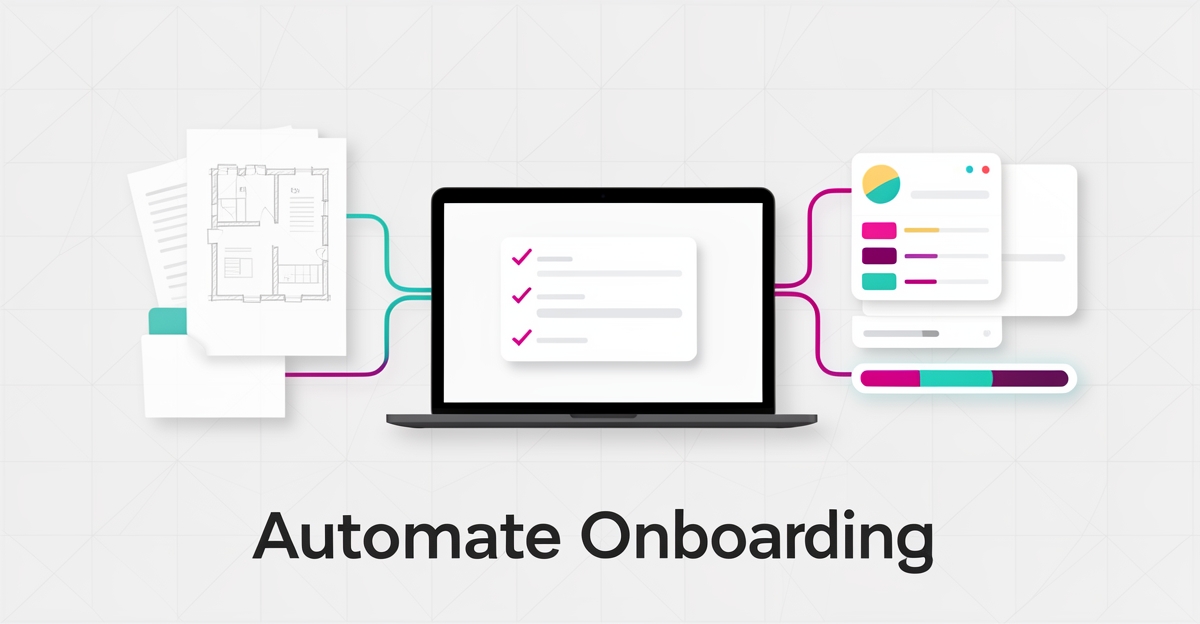
AI is transforming the interior design industry by automating form completion, project intake, and documentation, freeing designers to focus on creativity and client relationships. These workflows shift from copy-paste admin to structured capture and reuse.
The most measurable impact is speed. Industry reviews of AI tools for interior designers consistently report significant time reductions on the design process—often in the 50–70% range. That reduction comes from automating the front end of a project, not the design decisions themselves.
In practice, automation shows up in three repeatable areas:
- **Automated form completion and intake** that pulls client preferences, room dimensions, budget ranges, and style references into a structured brief without back-and-forth emails.
- **Project documentation** that generates timelines, material lists, and revision logs from conversations and uploads, improving accuracy and auditability.
- **Faster
AI Employees
Hire a team member that works 24/7 — for less than a part-time wage.
AI receptionists, SDRs, dispatchers and 99+ roles. Trained on your business, fully managed.
See If You’re a Fit — AI Employees from $700/mo
Not sure where to start? Ask our AI planner
client options** where AI drafts initial mood boards and layout variations for review, shortening the first presentation cycle.
Accuracy improves alongside speed. AI can reduce errors in data entry and keep briefs consistent across team members. Clients receive clearer proposals sooner, and designers spend less time chasing missing information.
Adoption is still uneven. Concerns about job replacement are a major barrier to AI adoption, with designers fearing that AI will replace their creative judgment. That fear is compounded by a lack of understanding about AI and its capabilities, with many designers unsure how to integrate it into their workflows.
The hesitation is understandable in a field built on taste and relationships. AI in this context handles intake and documentation—the parts firms already describe as administrative drag. The creative direction, curation, and client trust remain human.
For firms exploring change, the logic mirrors what AIQ Labs applies in [AI Workflow Builds](/workflow-builds): identify a manual bottleneck, automate the data capture and handoff, and keep the human in the creative loop. The result is less admin, more design time, and a smoother onboarding experience without outsourcing the relationship.
With thousands of U.S. interior design job openings projected annually through 2034, efficiency gains are not optional for growth. Firms that automate onboarding can serve more clients with the same team while protecting the creative work that differentiates them.
## From Tool Chaos to Owned AI Workflows
The modern interior design firm is drowning in tabs. A designer might start their morning in a mood board generator, jump to a floor planner after lunch, and finish the day manually copying client details from email into a project tracker. As of late 2026, well over a dozen distinct AI tools compete for an interior designer's attention, each promising to solve one slice of the workflow puzzle.
Yet this abundance creates its own chaos. Most firms cobble together subscriptions that never talk to each other: individual rendering tools typically run around $25–30 per month, mid-tier platforms start higher, and full practice-management suites like Houzz Pro can run from roughly $65 to several hundred dollars per month depending on the tier. Add in visualization tools, floor planners, and client portals, and firms often juggle five or more disconnected platforms just to move a client from inquiry to contract.
This fragmentation creates three compounding problems:
- **Integration gaps** force designers to manually transfer client data between systems, re-entering the same square footage, style preferences, and budget constraints into multiple platforms.
- **Data quality degrades** as information scatters across siloed tools, making it difficult to maintain the clean, structured data that effective AI requires.
- **Subscription costs stack quickly**, turning what seemed like affordable point solutions into significant monthly overhead that still leaves intake and documentation largely manual.
The alternative isn't another subscription—it's ownership. Custom AI workflows replace the patchwork with a unified system that handles intake, documentation, and project setup automatically. Rather than forcing designers to adapt to rigid software templates, these owned systems adapt to the firm's specific processes, integrating directly with existing CRMs and communication tools.
Industry research suggests AI can substantially reduce design process time, but those gains only materialize when the technology handles the administrative burden end-to-end. When AI manages form completion, client intake, and documentation generation, designers reclaim those hours for creative work and relationship building—the aspects of the job that actually require human judgment.
AIQ Labs builds these owned systems specifically for firms tired of tool chaos. Instead of renting access to generic platforms, firms invest in **custom AI infrastructure they control outright**—no vendor lock-in, no integration headaches, and no scattered data. The result is a single intelligent workflow that moves clients from first contact to signed contract while designers focus on what they do best: designing.
## A Practical Path to Automated Onboarding
Manual onboarding is quietly draining the hours interior designers actually want to spend designing. With thousands of U.S. interior design job openings projected annually through 2034, firms can't afford to waste talent on repetitive intake.
A practical path starts with clarity, not tool sprawl. AI can automate form completion, project intake, and documentation, freeing designers to focus on creativity and client relationships—and the time savings reported across industry workflows are substantial.
Begin by mapping the highest-friction intake tasks. Identify the repetitive steps that slow project kickoff, create errors, and frustrate clients. Prioritize forms, preference gathering, mood-board requests, and documentation that repeats on every new client.
Choo
AI Development
Still paying for 10+ subscriptions that don’t talk to each other?
We build custom AI systems you own outright. No vendor lock-in. Full control.
See If You’re a Fit — AI Employees from $700/mo
Not sure where to start? Ask our AI planner
se an integration-first approach over adding another standalone tool. Industry data highlights integration challenges as a core barrier to adoption, and point solutions often create more manual copying. A unified system that connects CRM, project management, and scheduling reduces operational errors and keeps a single source of truth.
Train the team on data quality and best practices before scaling. AI requires high-quality data to produce accurate results, and as intake data grows more valuable, clear naming conventions, required fields, and review checkpoints prevent garbage-in, garbage-out.
Monitor time reduction and client satisfaction as leading indicators. Track intake-to-kickoff time, revision rounds, and post-onboarding feedback. Those metrics show whether automation is improving the overall client experience.
Implementation can be staged for low risk:
- Audit current onboarding and log every manual touchpoint
- Select one high-value intake workflow to automate first
- Integrate the workflow with existing CRM and project tools
- Train staff on data entry standards and exception handling
- Measure time saved and client satisfaction, then expand
For firms ready to move beyond off-the-shelf tools, AIQ Labs offers two entry points: [AI Workflow Builds](/workflow-builds) rebuild the one workflow that costs you the most, at a fixed price and in phases, while [AI Employees](/ai-employees) provide managed AI staff—like an **AI Onboarding Agent** or Intake Specialist—that work around the clock to qualify leads, collect preferences, and prep project briefs, typically at a fraction of the cost of a human hire. For firms that want everything connected, [AI Operating Systems](/ai-operating-systems) build one operating layer across the whole practice, owned outright.
The goal is not to replace creative judgment. It is to remove the manual work that delays it, so designers spend more time where they add the most value.
## Frequently Asked Questions
**Why do most interior design firms still use manual client onboarding despite knowing it's inefficient?**
Many firms stay focused on external factors like material availability and market conditions while overlooking internal process fixes, which leaves them vulnerable to inefficiencies regardless of what the market does.
**How much time can AI actually save in the interior design process?**
Industry reviews of AI tools for interior designers consistently report significant time reductions on the design process—often in the 50–70% range—primarily by automating repetitive tasks like form completion, project intake, and documentation.
**Will using AI in client onboarding replace my role as an interior designer?**
No—AI handles administrative tasks like data entry and documentation, not creative judgment. Your role in curation, client relationships, and design decisions remains essential. AI removes the scaffolding around creativity, not the creativity itself.
**What specific parts of client onboarding can AI automate for interior design firms?**
AI automates form completion and intake (pulling client preferences, room dimensions, budget, and style into a structured brief), project documentation (generating timelines, material lists, and revision logs), and faster client options like initial mood boards and layout variations for review.
**I'm overwhelmed by the number of AI tools available—how do I avoid tool chaos in my firm?**
Instead of juggling multiple disconnected platforms, consider a custom AI workflow that unifies intake, documentation, and project setup, integrating directly with your existing CRM and tools to eliminate manual data transfer and integration gaps.
**What's a low-risk way to start automating client onboarding without overhauling our entire system?**
Begin by auditing your current onboarding to log every manual touchpoint, then select one high-value workflow (like form intake) to automate first, integrate it with your CRM, train your team, measure results, and expand from there.
## Designing the Future: Where Automation Meets Creativity
The interior design industry stands at a pivotal moment: thousands of U.S. job openings are projected annually through 2034, yet many firms remain stuck in manual onboarding cycles that drain creative time and amplify avoidable errors. AI doesn't replace the designer's eye—it eliminates the administrative drag of form completion, preference gathering, and documentation, freeing teams to focus on what truly moves the needle: crafting spaces that delight clients and building lasting relationships. The path forward isn't about chasing another standalone tool but owning a unified workflow that integrates with existing systems, ensures data quality, and scales with growth. For firms ready to reclaim hours lost to repetitive tasks, the next step is clarity: take the [2-minute Fit Check](/apply) and then book a free 30-minute strategy call to map your biggest onboarding bottleneck and see where AI can deliver measurable time savings without compromising the human touch that defines your work.
AI Transformation Partner
Make AI your competitive advantage — not just another tool.
Strategy, implementation and ongoing optimization. One partner, end to end.
See If You’re a Fit — AI Employees from $700/mo
Not sure where to start? Ask our AI planner