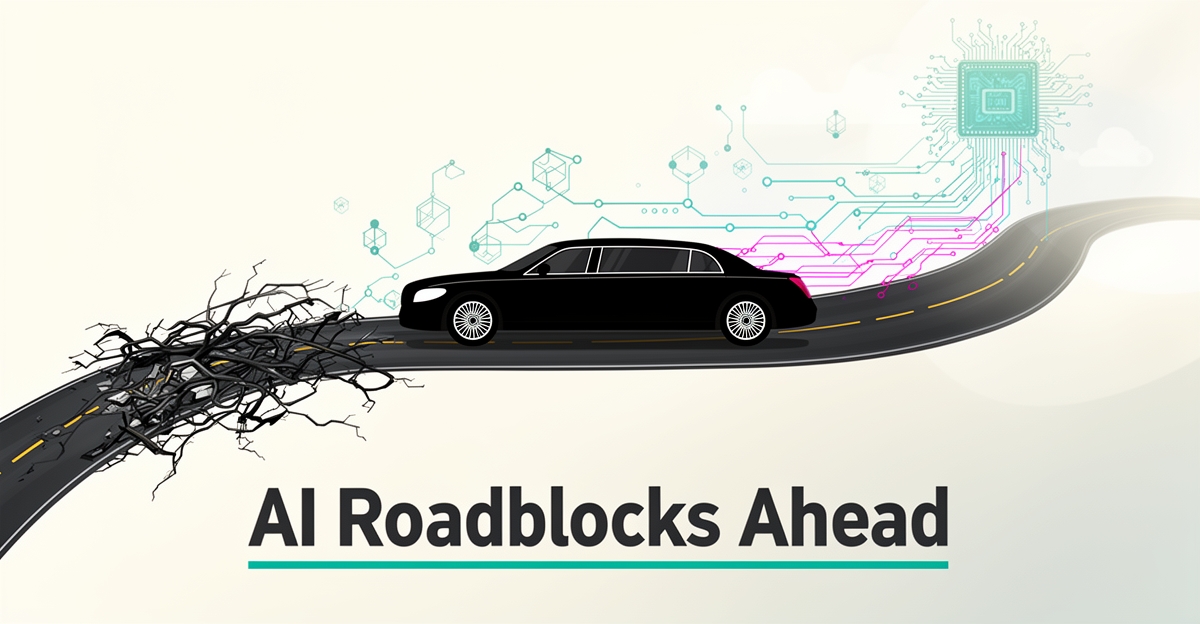
Why Most Limousine Businesses Fail at AI Implementation (And How to Avoid It)
Key Facts
- Industry comparisons typically show AI-driven processes cutting operational costs by roughly 20% with error rates well below manual baselines according to industry research
- Fleet ROI analyses commonly report five-figure annual savings for mid-sized fleets, with break-even in the first few months per fleet ROI analysis
- AI-optimized routes can save roughly 10–15% on fuel costs and let one dispatcher manage far more vehicles than the typical manual ratio fleet management data shows
- A majority of workers feel their organizations aren't investing enough in AI skills development, stalling adoption industry research reveals
- Drivers and dispatchers typically need 1–2 weeks to adapt to new AI-driven workflows for successful implementation fleet management research indicates
- AI can reduce daily route planning from 1–2 hours to minutes and mid-day rerouting from 15–45 minutes to seconds fleet management comparison shows
Hire a team member that works 24/7 — for less than a part-time wage.
AI receptionists, SDRs, dispatchers and 99+ roles. Trained on your business, fully managed.
Not sure where to start? Ask our AI planner
The Pilot Trap: Why Limousine AI Projects Stall Before Scaling
Limousine operators love a quick win, and AI chatbots for email drafting feel like one. That's exactly how projects get stuck in pilot mode: running isolated experiments that never touch dispatch, routing, or fleet operations.
The pattern is predictable: a team adopts fragmented, unstructured AI usage for low-risk tasks while core workflows stay manual. Industry analysis shows this fragmented prompting model is expensive and difficult to measure, with hidden token spend that erodes any perceived savings. Ad-hoc AI use without governance tends to rack up costs that no one tracks, a pattern that repeats in operations teams running scattered prompts across disconnected tools.
Pilots stall because they lack connective infrastructure. AI stays a tool that answers questions instead of performing work. Research on enterprise adoption notes the most critical shift is from tools that answer questions to systems that perform work, yet limousine businesses rarely integrate AI with telematics, CRM, dispatch boards, or driver apps.
Without integration, ROI never materializes. The competitive battleground has moved from model access to orchestration layers, retrieval systems, and connective infrastructure that embed AI into daily operations. Analysis of AI interoperability emphasizes that organizations do not deploy a model but workflows integrating models with proprietary data, existing software, human review, and operational monitoring.
Stalled pilots typically exhibit:
- Isolated chatbots for email or proposal drafting with no data connection to bookings
- Generic tools used manually instead of automated multi-step dispatch and routing
- No orchestration layer to route tasks to the right model or system
- Missing retrieval and integration, so AI cannot see live fleet status or customer history
The result is pilot fatigue and hidden costs, while competitors build central intelligence that reuses the same data and logic across workflows. AIQ Labs sees this repeatedly when scoping Workflow Builds: poor data integration, lack of staff training, and over-reliance on chatbots prevent scaling.
Moving beyond the pilot trap requires designing AI as operational capacity, not an experiment. That means embedding AI into dispatch, routing, and fleet workflows with proper infrastructure, governance, and human-AI integration before deployment.
The Infrastructure Gap: Missing Data Integration and Orchestration
Most limousine businesses fail at AI implementation not because the technology is flawed, but because their data remains trapped in silos. A CRM system might know client preferences, telematics tracks vehicle location, and accounting software records invoices—yet these systems rarely communicate. When AI cannot access unified, real-time context, it generates generic responses instead of actionable insights, starving optimization efforts of the fuel they need to deliver results. Fleet management data shows that AI-optimized routes can cut fuel costs by roughly 10–15% and let one dispatcher manage far more vehicles—but only when AI pulls live data from all operational sources.
Without a retrieval-augmented generation (RAG) layer, AI lacks the grounding to reference current policies, client histories, or route constraints. Similarly, the absence of an orchestration layer means tasks aren't routed to the right model—simple queries waste expensive LLMs while complex workflows stall on underpowered tools. This forces reliance on brittle, custom integrations that break with every software update, creating technical debt that strangles scalability. As noted in research on AI interoperability, the true competitive advantage now lies in the "connective tissue" that binds models to data and workflows, not in the models themselves. Standards like Model Context Protocol (MCP) address this by providing a universal interface for connecting AI to CRM, telematics, and accounting systems—eliminating the need for fragile, point-to-point code.
AIQ Labs addresses this gap by evaluating data infrastructure and workflow design before any model is deployed—first through a Workflow Build on the one workflow that costs you the most, and eventually through a full AI Operating System that connects dispatch, fleet, and billing into one layer you own outright. By ensuring systems speak the same language via open protocols and layered intelligence, limousine businesses can finally unlock AI's potential to reduce fuel waste, optimize dispatch ratios, and turn fragmented data into a coordinated operational advantage.
The Human Factor: Undertrained Staff and Broken Change Management
The promise of AI in limousine operations often stalls not because of the technology itself, but because of the people expected to use it. A majority of workers—around 53% in industry surveys—report that their organizations underinvest in AI skills development, leaving teams unprepared for the shift from manual to intelligent workflows. This gap isn't just about technical know-how; it's about confidence, role clarity, and trust in how AI will change daily responsibilities. Without targeted training and clear communication, even the most sophisticated AI system becomes a source of frustration rather than efficiency.
Drivers and dispatchers, in particular, typically need 1–2 weeks to adapt to new AI-driven workflows, according to fleet management research. This adaptation period isn't optional—it's a critical phase where habits are reshaped and new routines are built. During this time, staff must learn to interpret AI-generated route suggestions, trust real-time tracking alerts, and know when to override automated decisions. Skipping or rushing this phase guarantees resistance, errors, and underutilization of the technology's potential.
The most successful implementations reject the myth that AI replaces humans and instead embrace a hybrid model where each side does what it does best. AI excels at route optimization, compliance automation, and continuous vehicle tracking—tasks that are repetitive, data-intensive, and prone to human error. Meanwhile, experienced staff shift their focus to exception handling, driver coaching, and managing customer escalations—areas where judgment, empathy, and experience are irreplaceable. This division of labor doesn't eliminate jobs; it elevates them, turning dispatchers into fleet coaches and drivers into more autonomous, informed operators.
For this model to work, organizations must invest in role-specific training, establish feedback loops where staff can report pain points and suggest improvements, and implement clear governance frameworks that define when AI acts autonomously and when human oversight is required. Without these elements, AI deployment risks becoming a top-down mandate that ignores the realities of frontline work—precisely where the value of AI in limousine services is either realized or lost. AIQ Labs builds these human factors into every deployment through change management planning and tailored training as part of each engagement.
The Readiness Framework: How AIQ Labs Prevents Failure Before Deployment
Most limousine businesses rush into AI deployment without assessing whether their systems, data, and teams are prepared to support it—leading to stalled pilots, wasted investment, and fragmented tool usage that fails to deliver measurable ROI. AIQ Labs prevents this failure by starting with a 2-minute Fit Check and a free 30-minute strategy call that maps high-ROI workflows like dispatch automation and booking intake before any build begins. This approach directly addresses the pitfalls of poor data integration, lack of staff training, and over-reliance on chatbots by establishing the connective tissue—MCP, RAG, and orchestration layers—that turns AI from a novelty into reliable operational capacity.
From there, the work follows three entry points designed to eliminate common failure points. First, AI Employees deploy managed AI staff—receptionists, SDRs, dispatchers, and 99+ other roles—at roughly 80% less cost than a human hire, proving value in weeks instead of months. Second, Workflow Builds rebuild the single workflow that costs your business the most—dispatch, billing, bookings—at a fixed price and in phases, so you see results at each milestone before going deeper. Third, AI Operating Systems connect everything into one operating layer, built in phases and owned outright, so the intelligence and data belong to you, not to a vendor.
Payment follows the same no-surprises logic: Start Monthly for a low-risk beginning, Build in Milestones for phased projects, or Own It Outright for systems you keep. No fake prices, no invented case-study numbers—just clear scope and clear ownership. With 200+ multi-agent systems deployed and four live SaaS products AIQ Labs runs daily, the approach is grounded in operational reality, not slideware.
By grounding every deployment in readiness and phased planning, AIQ Labs ensures limousine businesses avoid the trap of treating AI as a simple technology add-on. Instead, they build capabilities that scale with their operations—without the fragmentation that derails most AI initiatives.
From Assessment to Owned AI Workforce: A Limousine Operator's Path
Most limousine operators don't fail at AI because the models are weak. They fail because they skip readiness and try to bolt a chatbot onto broken workflows.
A low-risk path starts with clarity, not code. The free Fit Check takes two minutes, and a free 30-minute strategy call maps current bottlenecks—dispatch, bookings, billing—before any build begins. That assessment mirrors the approach research recommends: identify key automation areas first, then integrate data sources and design for workflow, not just answers.
From there, deploy a single AI Employee on the Start Monthly model. A flat monthly fee—typically far less than a part-time hire—includes build, training on your business, tool integrations, monitoring, and improvements. You keep ownership of the agent and data, with the ability to pause or adjust anytime.
This proves the concept in weeks, not months. Fleet ROI analyses commonly report five-figure annual savings for mid-sized fleets with break-even in the first few months, according to fleet ROI analysis. The same pattern applies to limousine dispatch: route planning drops from hours to minutes, and one dispatcher can manage far more vehicles than the typical manual ratio allows.
Once the first agent is stable, scale deliberately:
- AI Dispatcher or AI Receptionist for 24/7 bookings, call routing, and real-time updates
- A Workflow Build linking dispatch + fleet + billing into one owned system
- A complete AI Operating System with a central intelligence hub for operations
AIQ Labs applies this progression with real dispatch automation experience—200+ multi-agent systems deployed—moving clients from pilot to owned operational capacity. The focus is on human-AI integration, not replacement.
The payoff is measurable. Industry research typically shows AI-driven processes cutting costs by roughly 20% with error rates well below manual baselines. Yet a majority of workers feel organizations aren't investing enough in skills development, a gap that stalls adoption.
Success requires readiness, proper infrastructure, and workflow redesign before deployment. That is why a single owned AI Employee is the safest first step toward a fully automated limousine operation.
Still paying for 10+ subscriptions that don’t talk to each other?
We build custom AI systems you own outright. No vendor lock-in. Full control.
Not sure where to start? Ask our AI planner
Frequently Asked Questions
Why do most limousine AI projects get stuck in pilot mode?
How expensive is unstructured AI prompting really?
What's the infrastructure gap that kills limousine AI ROI?
Do drivers and dispatchers need training to use AI?
Can AI actually save money for a limousine fleet?
What's the first safe step instead of bolting on a chatbot?
Your AI Workforce Starts with Readiness, Not Code
Most limousine businesses don't fail at AI because the technology is flawed—they fail by skipping readiness and bolting chatbots onto broken workflows. The real advantage comes not from chasing models, but from building connective infrastructure: integrating data through MCP and RAG layers, orchestrating workflows that perform work instead of just answering questions, and preparing teams through targeted training and change management. When AI is embedded into dispatch, routing, and fleet operations as operational capacity—not an experiment—it delivers measurable ROI: lower costs, route planning in minutes instead of hours, and dispatchers managing far more vehicles. The path forward starts with clarity, not code. Take the free Fit Check and book a free 30-minute strategy call to map your biggest bottlenecks in dispatch, bookings, or billing—no obligation, just a real working session to identify high-ROI automation opportunities before any build begins.
Make AI your competitive advantage — not just another tool.
Strategy, implementation and ongoing optimization. One partner, end to end.
Not sure where to start? Ask our AI planner