Why Most Livestock Feed Suppliers Underestimate the Cost of Manual Order Tracking
Key Facts
- Feed is typically one of the largest cost components in livestock and poultry operations, so tracking errors compound financially
- Manual order tracking commonly leads to missed deliveries, duplicate entries, and billing mismatches
- Reliable data collection is essential for any AI-based optimization—incomplete or inconsistent data reduces system accuracy and decision quality
- AIQ Labs has deployed 200+ multi-agent systems and runs 4 live SaaS products daily
- AIQ Labs builds owned order-tracking and financial-control systems across three entry points: AI Employees, Workflow Builds, and AI Operating Systems
Hire a team member that works 24/7 — for less than a part-time wage.
AI receptionists, SDRs, dispatchers and 99+ roles. Trained on your business, fully managed.
Not sure where to start? Ask our AI planner
The Hidden Cost of Paper-Based Order Tracking in Feed Supply
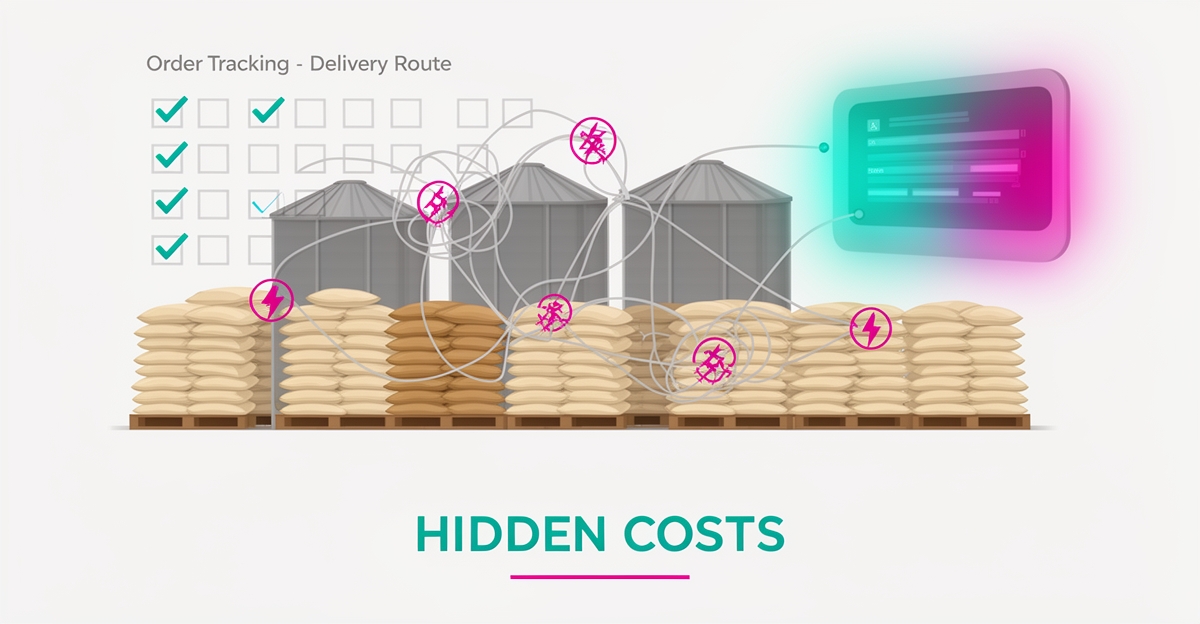
The hidden cost of paper-based order tracking in feed supply isn't always visible on the balance sheet—it lives in the gaps between what was promised and what was delivered. Manual spreadsheets, phone notes, and paper logs create operational drag that accumulates silently, masking true delivery failures and billing leakage. Since feed is typically one of the largest cost components in livestock operations, even small inaccuracies in tracking can compound into significant financial waste over time.
These manual systems are prone to human error, delayed updates, and version confusion, especially when multiple team members handle orders across shifts or locations. A single misplaced decimal or overlooked delivery confirmation can trigger a chain reaction: incorrect invoices, strained customer relationships, and revenue that vanishes without clear accountability. Without real-time visibility, suppliers often remain unaware of these losses until they surface as disputes or unexplained shortfalls.
- Feed is typically one of the largest cost components in livestock and poultry operations, making accurate tracking essential for financial control.
- Manual order tracking commonly leads to missed deliveries and billing errors, directly impacting profitability.
- Reliable data collection is essential for AI-based optimization, and incomplete or inconsistent data from manual processes reduces system accuracy and decision quality.
AIQ Labs helps feed suppliers replace these fragile, error-prone systems with AI-powered order tracking that automatically captures, validates, and synchronizes data across teams. By eliminating manual entry and providing real-time delivery insights, suppliers gain the clarity needed to prevent leakage, improve billing accuracy, and protect margins in a cost-sensitive industry. For operations that want managed capacity without hiring, AI Employees can handle order processing and follow-ups around the clock.
How Manual Tracking Drives Missed Deliveries and Billing Errors
Manual order tracking feels manageable until the first missed delivery costs a customer. For livestock feed suppliers, that moment arrives faster than expected because orders move through spreadsheets, phone notes, and memory instead of a single source of truth.
Delayed updates create the first failure point. A driver leaves with yesterday's sheet while the office logs a change this morning. The farm receives the wrong tonnage or the wrong formulation, and the supplier absorbs the re-delivery cost.
Duplicate entries compound the problem. The same PO gets typed into an invoice log and a dispatch log by different staff. One version ships, the other bills, and reconciliation becomes a manual hunt. Customers question invoices, payment cycles stretch, and margins erode on a product line where feed is typically one of the largest cost components in livestock and poultry operations.
Lost confirmations finish the cycle. Verbal approvals and paper sign-offs disappear, so the supplier cannot prove delivery windows were met. Trust drops, reorder frequency falls, and sales teams spend hours chasing clarification instead of selling.
The failure points show up repeatedly in day-to-day operations:
- Delayed updates between sales, warehouse, and drivers
- Duplicate entries across spreadsheets and paper logs
- Lost or missing delivery confirmations
- Billing mismatches from unreconciled order changes
These errors are not just operational. They undermine financial control because incomplete or inconsistent data reduces system accuracy and decision quality. Reliable data collection is essential for any optimization effort, and manual tracking makes consistent data impossible to guarantee.
Modern AI systems are now capable enough to close that gap. As of late 2026, multi-agent systems can reliably handle order capture, delivery timeline management, and real-time reporting across the disconnected tools most suppliers already use. AIQ Labs has deployed 200+ such systems and runs 4 live SaaS products on its own stack daily—this is production technology, not experimentation.
For feed suppliers, that capability translates into automatic order tracking, delivery timeline management, and real-time reporting. AIQ Labs helps suppliers deploy AI systems that automatically track orders, manage delivery timelines, and generate real-time reports for better financial control, replacing the spreadsheet handoffs that create missed deliveries and billing errors.
Why Data Quality Determines AI Success in Feed Operations
The quality of data flowing into AI systems directly determines their effectiveness in feed operations. When order tracking relies on manual processes, errors and delays contaminate the data foundation, undermining any predictive analytics or automation efforts. The principle is simple: garbage in, garbage out. It is especially critical when managing complex feed supply chains where timing and accuracy impact both animal nutrition and financial outcomes.
AI-driven feed optimization depends on consistent, real-time inputs to function properly. Incomplete or inconsistent data reduces system accuracy and decision quality. Without accurate order and delivery timestamps, AI cannot predict demand patterns, optimize routing, or trigger timely replenishment alerts. This data gap forces operators to rely on reactive fixes rather than proactive planning, increasing the risk of stockouts or overstocking that directly affects feed conversion efficiency and waste levels.
Poor data quality also sabotages financial control mechanisms essential for feed suppliers. Manual tracking introduces discrepancies between recorded orders and actual deliveries, leading to billing errors and revenue leakage that accumulate over time. When AI systems attempt to automate invoicing or payment scheduling based on flawed data, they amplify these mistakes rather than correct them. The result is a cascade of inefficiencies: missed deliveries disrupt farm operations, incorrect invoices strain customer relationships, and finance teams spend excessive time reconciling preventable errors instead of focusing on strategic analysis.
For AI to deliver meaningful value in feed operations, suppliers must first establish clean, automated data pipelines from order placement through delivery confirmation. This foundation enables predictive analytics to forecast feed needs with precision, automation to execute routine tasks without intervention, and real-time reporting to provide accurate financial control. Only when the data is trustworthy can AI systems truly optimize livestock nutrition, reduce waste, and improve overall farm efficiency as intended—turning a potential liability into a competitive advantage. AIQ Labs helps feed suppliers build this critical data infrastructure through custom AI workflow automation that eliminates manual tracking errors and creates the reliable foundation needed for predictive analytics and financial control systems to function effectively. For suppliers who want to start by fixing the single most expensive workflow, a fixed-price Workflow Build rebuilds the order-to-cash process in phases.
- Automated order capture from multiple channels eliminates transcription errors
- Real-time delivery tracking provides accurate timestamps for predictive modeling
- Integrated financial automation ensures billing aligns with actual deliveries
- Continuous data validation maintains data integrity over time
- Unified data sources create a single source of truth for analytics
Building Owned AI Systems for Automated Order Tracking and Financial Control
Building an owned AI system for automated order tracking begins with recognizing that manual processes in livestock feed supply chains are prone to errors that cascade into financial and operational losses. Without real-time synchronization between order entry, inventory levels, and delivery schedules, suppliers face avoidable delays and invoicing discrepancies that erode margins. AIQ Labs addresses this by developing custom AI systems that unify order data across CRM, accounting, and logistics platforms into a single source of truth, eliminating the manual reconciliation that consumes staff time and introduces risk. These systems are engineered for production use, not prototypes, ensuring they handle real operational demands while remaining fully owned by the client—no vendor lock-in, no platform dependencies.
The automation extends beyond simple tracking to proactive financial control. AI-powered workflows monitor delivery timelines in real time, flagging deviations before they become missed shipments and triggering alerts for corrective action. Simultaneously, the system validates invoice data against purchase orders and delivery confirmations, reducing billing errors that lead to delayed payments or disputed charges. This level of precision supports accurate revenue recognition and strengthens cash flow predictability—critical for suppliers operating on thin margins. By deploying AI Employees trained specifically for order processing and accounts receivable tasks, businesses gain 24/7/365 capacity to manage exceptions, follow up on overdue invoices, and maintain audit-ready records—typically at a fraction of the cost of an equivalent human hire.
- Custom AI workflow integration that connects order entry, inventory, and delivery systems to eliminate hours of manual data entry every week
- AI-powered invoice and AP automation that typically cuts processing time dramatically and accelerates month-end close
- Real-time financial and KPI dashboards consolidating all business systems for data-driven decisions with predictive analytics
Ownership is central to the model. Clients choose how to invest—Start Monthly for managed AI Employees handling order tracking and invoicing, Build in Milestones to deploy phased automation of the order-to-cash cycle, or Own It Outright for full control of the code, agents, and data. This flexibility ensures suppliers can scale AI adoption at their pace while retaining long-term value. Unlike subscription-based tools that create ongoing costs and dependency, AIQ Labs builds assets that appreciate with use, turning order tracking from a cost center into a source of operational resilience and financial clarity. The result is not just automation, but a self-owned system that evolves with the business—delivering sustained ROI without the hidden costs of manual oversight. For operations ready to connect everything into one layer, an AI Operating System unifies order, inventory, and finance in phases you own outright.
Still paying for 10+ subscriptions that don’t talk to each other?
We build custom AI systems you own outright. No vendor lock-in. Full control.
Not sure where to start? Ask our AI planner
Frequently Asked Questions
How does manual order tracking in livestock feed supply actually lead to billing errors and missed deliveries?
Why is reliable data collection so important for AI-based feed optimization in livestock operations?
Can AI really help feed suppliers reduce manual work and improve financial control?
What does 'garbage in, garbage out' mean for AI in feed supply chains, and why does it matter?
Is it true that feed represents one of the largest cost components in livestock operations, making tracking accuracy critical?
What are the risks of relying on manual spreadsheets and paper logs for feed order tracking?
Turning Order Tracking Into a Strategic Advantage
Manual order tracking in livestock feed supply chains isn't just an inconvenience—it's a silent drain on profitability, accuracy, and trust. As we've seen, paper logs, spreadsheets, and fragmented processes lead to missed deliveries, billing errors, and unreliable data that undermines both operational efficiency and AI-driven optimization efforts. The good news is that these challenges are solvable. By replacing manual workflows with owned, AI-powered systems that unify order tracking, delivery confirmation, and financial control, feed suppliers can eliminate costly errors, gain real-time visibility, and protect margins in an industry where feed costs are among the largest line items. AIQ Labs helps businesses make this shift—not with off-the-shelf tools, but with custom-built systems that clients own and control, designed to scale with their operations. The path forward starts with understanding where the biggest leaks exist and how automation can seal them. To explore how this applies to your business, start with the 2-minute Fit Check, then book a free 30-minute strategy call to map your highest-impact opportunities.
Make AI your competitive advantage — not just another tool.
Strategy, implementation and ongoing optimization. One partner, end to end.
Not sure where to start? Ask our AI planner