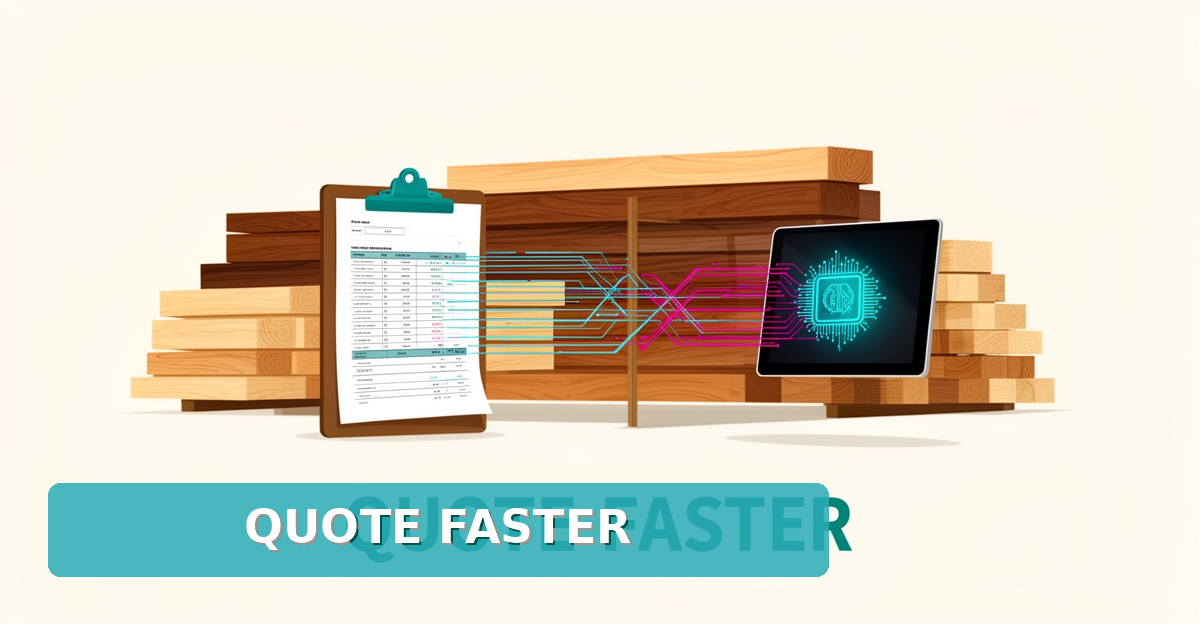
Why Most Lumber Suppliers Still Use Manual Quoting (And How to Fix It)
Key Facts
- The bulk of vendor quote comparison time is typically consumed by data extraction and normalization before sourcing decisions even begin
- A five-supplier RFQ commonly takes several hours manually — locating unit prices in differently formatted PDFs and retyping them into spreadsheets
- Manual quoting accumulates hundreds of hours of repetitive work annually per organization
- Manual entry error rates in the 5–10% range can erode tens of thousands in margin on a mid-size project
- AI-assisted extraction typically reduces quote turnaround dramatically and cuts error rates to low single digits
- Skills gaps and data security concerns remain the top barriers to digital transformation in the lumber industry as of late 2026
- Most enterprises already run ERP systems, creating a natural integration point for AI quoting
Hire a team member that works 24/7 — for less than a part-time wage.
AI receptionists, SDRs, dispatchers and 99+ roles. Trained on your business, fully managed.
Not sure where to start? Ask our AI planner
The Hidden Cost of Manual Quoting in Lumber Supply
Imagine spending most of your workday just gathering numbers before you can even start comparing them. That's the reality for many lumber procurement teams, where manual quoting eats up valuable time. In a typical vendor quote comparison, the majority of the time vanishes on tasks like locating unit prices in differently formatted PDFs and retyping data into spreadsheets — before any actual sourcing decision happens.
This inefficiency adds up quickly. A five-supplier RFQ commonly takes several hours of manual work — reading each document, normalizing units, and building the comparison sheet. Over a year, these repetitive tasks can accumulate to hundreds of hours of manual work per organization, time that produces no new revenue and no better pricing.
The financial toll is starker still. Manual processes tend to carry error rates in the 5–10% range, and on a $500,000 project that can mean $25,000–$50,000 in eroded margin — lost before the first delivery is scheduled. Estimators often spend the majority of their time on manual takeoffs rather than judgment calls, which is the part of the job that actually earns its keep.
Lumber-specific challenges make manual quoting particularly painful. Suppliers deal with varied document formats like PDFs, scans, and emails, plus complex unit conversions for board feet or cubic meters. Key issues include:
- Handling multiple document layouts from different suppliers
- Converting units across measurement systems
- Managing product grades and seasonal demand variations
- Reducing errors in data extraction and normalization
AIQ Labs addresses these pains with [AI Workflow Builds](/workflow-builds) — we rebuild the one workflow that costs you the most, at a fixed price, in phases. For quoting, that means AI handles extraction and normalization while your team keeps control of pricing decisions.
As of late 2026, skills gaps and security concerns remain the most commonly cited barriers to digital transformation in the lumber industry — yet adopting AI doesn't require a massive overhaul. It requires fixing one workflow at a time.
Why Lumber Suppliers Are Stuck in Manual Mode
Manual quoting feels familiar, so lumber suppliers keep doing it. The reality is the process is quietly eroding margin, speed, and scalability every week.
The skills gap is a structural block. Industry surveys consistently find that a majority of lumber industry leaders cite lack of digital skills as a top barrier to transformation. Teams that have mastered board feet calculations and grade inspections for decades are being asked to normalize PDFs, scanned forms, and handwritten notes into ERP-ready data. That mismatch keeps workflows paper-based.
Data security worries reinforce the hesitation. A large share of organizations flag data security as a key concern with digital transformation. Pricing sheets, customer specs, and supplier terms are commercially sensitive, and fragmented email and file sharing make leaders reluctant to centralize quoting data without clear governance.
Lumber quoting is also uniquely messy for generic tools. A five-supplier RFQ takes hours manually because most of that time is consumed before sourcing even starts — locating unit prices across differently formatted PDFs, retyping values into Excel, and normalizing units when one supplier quotes per case and another per unit.
The industry-specific friction points that stall automation include:
- Complex unit conversions across board feet, linear feet, cubic meters and bundles
- Product grades, dimensions and treatments that require expert interpretation
- Seasonal demand patterns that change inventory needs and pricing windows
- Document variability from ERP PDFs to scanned handwritten forms
These factors create a manual quoting trap: roughly 15 minutes per supplier document just to locate fields, hours to build each full quote, and significant rework on every revision. Errors compound quickly — a 5–10% manual error rate on a $500,000 project can erase $25,000–$50,000 in margin.
AIQ Labs sees this pattern across SMBs in building materials, where quoting is slow, error-prone, and limits scalability. The barrier is rarely willingness; it is the combination of skills gaps, security concerns, and lumber-specific complexity that generic solutions fail to handle.
How AI-Powered Quoting Transforms the Process
The shift from manual to AI-powered quoting isn't just an upgrade — it removes the bottleneck that consumes most procurement time before any actual comparison begins.
Modern AI quoting systems excel at handling the complex, lumber-specific challenges that make manual processes so time-consuming. They automatically process diverse document formats — from structured PDFs to scanned handwritten forms — while understanding industry-specific requirements like board feet, linear feet, cubic meters, and bundle conversions. Systems built for lumber distribution can comprehend dimensions, grades, and packaging units, generating accurate comparisons regardless of how suppliers format their information.
The transformation typically delivers:
- Dramatically faster turnaround — from hours to minutes per quote
- Error rates dropping from 5–10% to low single digits
- More bids processed per month with the same headcount
- Weeks of estimator time recovered annually
The workflow itself becomes remarkably streamlined. AI systems with OCR capabilities read supplier documents automatically, extract relevant data, and validate it against predefined requirements. Human oversight remains crucial but focuses only on flagged inconsistencies or missing information. Once validated, the system generates customer-ready quotes that integrate directly with existing ERP systems — and most enterprises already run one, so the foundation is usually in place.
This is exactly the kind of workflow AIQ Labs rebuilds. With 200+ multi-agent systems deployed and four live SaaS products we run daily, we build quoting systems that don't just extract data — they understand context, handle unit conversions automatically, and maintain accuracy through seasonal demand swings and grade variations. The result is a quoting process that operates around the clock instead of around one estimator's calendar.
Implementing AI Quoting: A Practical Path Forward
Implementing AI quoting requires a structured approach that addresses technical, organizational, and financial considerations. The process begins with document extraction, where AI systems automatically read supplier quotes in various formats — PDFs, scanned forms, or Excel files — and extract key data like dimensions, grades, and pricing. This eliminates the 30–60 minutes per document typically spent locating fields manually. With manual methods, supplier document processing commonly averages around 15 minutes per document; AI typically reduces this to under two minutes.
Once extracted, the system validates data against predefined requirements — correct units, product specifications, pricing rules — flagging inconsistencies for human review only when necessary. This targeted oversight ensures estimators focus on exceptions rather than routine data entry, the very work that consumes most of the comparison timeline today. After validation, AI generates customer-ready quotes instantly, incorporating lumber-specific logic like board feet conversions and seasonal pricing adjustments.
Successful implementation depends on three practical steps. First, assess integration needs with existing ERP or inventory systems — most enterprises already run ERP platforms, which can serve as the backbone for automated quoting workflows. Second, invest in change management to address the digital skills gap; phased training and pilot programs build confidence without disrupting operations. Third, choose the right engagement model. AIQ Labs offers three: [AI Workflow Builds](/workflow-builds) to rebuild the one workflow that costs the most, [AI Employees](/ai-employees) for managed AI staff such as quoting and dispatch roles at roughly 80% less than a human hire, and [AI Operating Systems](/ai-operating-systems) for a fully connected operating layer you own outright. Payment models are straightforward — Start Monthly, Build in Milestones, or Own It Outright — with no lock-in games. For teams ready to begin, [take the two-minute Fit Check](/apply) and book a [free 30-minute strategy call](/book) to map workflow bottlenecks and model ROI from time savings and error reduction.
Still paying for 10+ subscriptions that don’t talk to each other?
We build custom AI systems you own outright. No vendor lock-in. Full control.
Not sure where to start? Ask our AI planner
Frequently Asked Questions
Why do most lumber suppliers still rely on manual quoting instead of switching to AI?
How much time can AI-powered quoting actually save compared to manual processes?
What financial risks come from errors in manual lumber quoting?
Can AI handle the complex document formats and unit conversions used in lumber quoting?
Is it necessary to replace our existing ERP system to implement AI quoting?
How does AI quoting improve accuracy compared to manual takeoffs?
The Quote That Changes Everything
Manual quoting isn't just slow — it's a structural ceiling on growth. Most procurement time vanishes before real comparison begins, error rates of 5–10% quietly erode margins, and the industry's digital skills gap keeps teams locked in spreadsheets while demand accelerates. AI-powered quoting flips this equation: turnaround drops from hours to minutes, accuracy climbs, and estimators focus on judgment instead of data entry. The technology already understands board feet conversions, grade variations, and seasonal pricing — it just needs to be wired into your workflow. AIQ Labs has deployed 200+ multi-agent systems and builds quoting automation you own outright, not rent. Ready to see what your quoting process could look like? Take the two-minute Fit Check, then book a free 30-minute strategy call to map the bottleneck and model the ROI. Questions first? Reach us at [email protected].
Make AI your competitive advantage — not just another tool.
Strategy, implementation and ongoing optimization. One partner, end to end.
Not sure where to start? Ask our AI planner