Why Most Mobile Tire Service Businesses Fail at AI Adoption
Key Facts
- Fast-answering AI voice agents can recover a meaningful share of missed inbound calls—industry analyses commonly cite 20-40%—with each recovered call worth hundreds to thousands of dollars according to DispatchNode
- AI-driven inventory systems are typically credited with reducing carrying costs by 15-25% for tire dealers per HumanAI
- AI-powered predictive maintenance is reported to increase fleet customer lifetime value by 30-40% per HumanAI
- AI agents analyzing purchase history are credited with lifting repeat sales by 20-30% per HumanAI
- Dynamic pricing with AI is reported to improve gross margins by 5-10% for tire dealers per HumanAI
- AI chatbots are reported to reduce incoming phone volume by 40-50% for routine inquiries per HumanAI
- A majority of automotive businesses are expected to integrate AI into core operations by the late 2020s per Reelmind
Hire a team member that works 24/7 — for less than a part-time wage.
AI receptionists, SDRs, dispatchers and 99+ roles. Trained on your business, fully managed.
Not sure where to start? Ask our AI planner
The Bounded Assistance Trap: Why AI Autonomy Fails in Mobile Tire Operations
The promise of AI in mobile tire service often collides with reality when businesses deploy autonomous systems without safeguards. Many operators assume AI can independently verify tire fitment, authorize dispatches, or make final service recommendations—leading to dangerous errors and financial loss. This misconception ignores a fundamental principle: in safety-critical workflows like tire service, AI must function as bounded assistance, not an independent decision-maker.
Treating AI-generated outputs as authoritative without human verification risks selling incorrect tires, creating safety hazards, and making unfulfillable commitments. The "operator's rule" requires businesses to define the source of truth, human authority, measurable workflow stage, and stop condition before adopting any AI tool. Without these boundaries, AI systems relying on mixed data timestamps—such as current vehicle details paired with yesterday's inventory—generate plausible but wrong answers that can dispatch a technician without the correct tire in stock.
For mobile operations specifically, this gap is amplified by dynamic van inventory and route constraints. AI must instruct callers to read sidewall markings and cross-reference against live van inventory before confirming fitment; it cannot guess trim levels or assume availability. If the correct tire isn't physically present, the system must block dispatch to prevent wasted trips and customer frustration. Human oversight remains essential for technical verification, with AI limited to drafting estimates, organizing intake data, and suggesting capacity—never deciding repairability, pricing, or vehicle release.
Successful implementation means integrating AI with authoritative data sources like live inventory and repair-order systems, and establishing clear human-in-the-loop controls for critical decisions. AIQ Labs builds these boundaries into every engagement—whether that's an AI receptionist or dispatcher handling intake, or a workflow rebuild that fixes one costly process at a time. By treating AI as bounded assistance—handling intake triage and draft communications while deferring final authority to qualified technicians—mobile tire businesses avoid the pitfalls of autonomous action and build trustworthy, scalable automation.
Closing the Data Gap: Integrating AI with Live Inventory and Vehicle Truth
Mobile tire AI fails the moment it answers from memory instead of from the van. When an agent quotes stock, fitment or ETA from a stale catalog, the business creates a safety liability and a wasted dispatch. Real-time data integration turns AI from a liability into a revenue protector.
The core failure is the source-of-truth gap. AI models that rely on model memory rather than authoritative, real-time data produce plausible but wrong answers. In mobile operations, that means mixing current vehicle details with yesterday's stock and an unverified catalog result. The operator's rule demands you can name the source of truth, human authority, measurable stage and stop condition before buying any AI category.
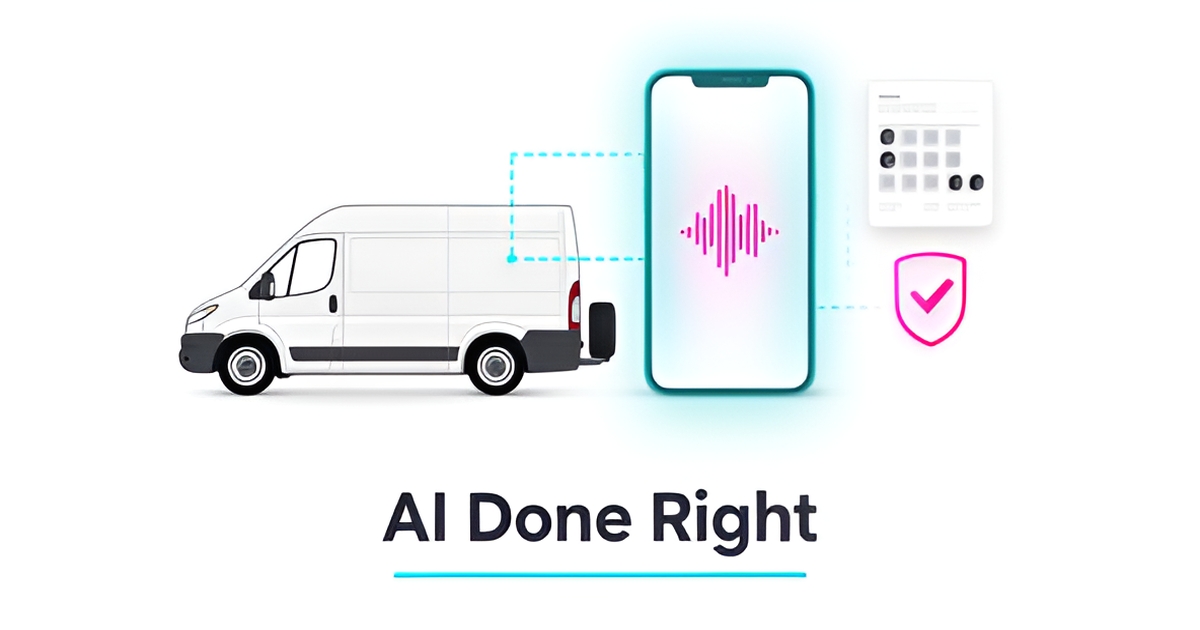
Successful implementations connect AI directly to live van inventory and vehicle identity. The system instructs callers to read sidewall markings — width, aspect ratio, rim diameter — and parses the string against the van's live inventory database. If the specific tire is not physically present, dispatch is blocked. That single control prevents the wasted trips that erode margin in route-based work.
Fitment verification must be bounded assistance, not autonomous decision-making. AI can collect VIN, location and urgency, but it cannot verify tire condition or authorize vehicle release without qualified human intervention. Provenance stays visible: technician finding, image reference and adviser approval remain distinct from AI-generated drafts.
Integration also closes revenue leakage on the phone. Mobile operators commonly miss a significant share of inbound calls—industry analyses often cite 20-40%—because technicians are on the road, with each missed call representing hundreds to thousands of dollars in lost revenue. An AI voice agent that answers in under 3 seconds, 24/7, captures that demand and creates a structured enquiry awaiting confirmation rather than a false booking.
Data integration delivers measurable financial upside when done correctly. Tire dealers implementing AI-driven inventory systems are typically credited with a 15-25% reduction in inventory carrying costs, while AI-powered predictive maintenance can increase fleet customer lifetime value by 30-40%. Those gains depend on clean, connected data.
A robust mobile tire data layer typically includes:
- Live van inventory sync with last-updated time, location and reservation status for every truth card
- VIN and sidewall input capture with automatic cross-reference to fitment database and stock
- Dispatch blocking rules that stop actions when stock is unavailable or fitment is uncertain
- Human-in-the-loop handoffs for technical findings, repairability and vehicle release decisions
This is where readiness work matters. A readiness-first engagement maps your current technology stack, data infrastructure and team capabilities to identify gaps before tools are selected. AIQ Labs uses that groundwork to design a realistic implementation roadmap that defines authoritative records, stop conditions and bounded workflows for mobile tire operations—whether the end state is a single rebuilt workflow or a full AI operating system you own outright.
When AI is wired to real inventory and vehicle truth, it stops guessing and starts protecting revenue, safety and reputation.
From Missed Calls to Measurable ROI: Practical AI Use Cases That Work for Mobile Tire
Mobile tire service businesses lose significant revenue daily to missed calls—industry analyses commonly cite 20-40% of inbound calls going unanswered because technicians are on the road. Each missed call can represent hundreds to thousands of dollars in potential revenue, from emergency flat repairs to fleet maintenance opportunities. AI voice agents that answer in under three seconds, 24/7, capture this lost income by qualifying leads, scheduling appointments, and even processing deposits. These systems integrate directly with live inventory and scheduling tools, ensuring every interaction is bounded by real-time data and human oversight—turning a chronic revenue leak into a predictable stream.
Beyond call capture, AI delivers measurable ROI through predictive maintenance and inventory optimization. By analyzing tire wear patterns, mileage, and service history, AI predicts optimal replacement timing for fleet vehicles, with reported gains of 30-40% in customer lifetime value through proactive service contracts and reduced downtime. Simultaneously, AI-driven inventory systems analyze local demand patterns, weather, and registration trends to optimize stock levels, with reported reductions of 15-25% in carrying costs while minimizing stockouts. These use cases require tight integration with authoritative data sources—like live van inventory and CRM systems—to ensure AI acts as bounded assistance, not an autonomous decision-maker.
- Deploy AI voice agents to answer calls in under 3 seconds, 24/7, recovering missed calls worth hundreds to thousands of dollars each
- Implement predictive maintenance for fleets using AI to analyze wear patterns and mileage, with reported lifetime-value gains of 30-40%
- Optimize inventory with AI-driven demand forecasting to reduce carrying costs by a reported 15-25% while improving stock availability
Success hinges on defining clear workflow boundaries: AI handles intake and data collection, but human technicians verify fitment, authorize service, and approve final commitments. By measuring KPIs like missed call recovery rate, inventory-confirmation accuracy, and correction rate, mobile tire businesses can scale AI adoption with confidence—starting small, proving value, and expanding only when data integrity and human oversight are assured. This practical, low-risk path transforms AI from a theoretical investment into a measurable competitive advantage.
Still paying for 10+ subscriptions that don’t talk to each other?
We build custom AI systems you own outright. No vendor lock-in. Full control.
Not sure where to start? Ask our AI planner
Frequently Asked Questions
Why do most mobile tire service businesses fail when they try to use AI on their own?
How can AI help mobile tire businesses recover revenue from missed calls?
What specific data must AI use to avoid giving wrong tire fitment advice in mobile operations?
Can AI decide if a tire is repairable or authorize a vehicle to go back on the road?
What ROI can mobile tire businesses expect from using AI for inventory and predictive maintenance?
What's the first step a mobile tire business should take before buying any AI tool?
Turning AI Pitfalls into Your Competitive Edge
The path to successful AI adoption in mobile tire service isn't about chasing autonomy—it's about building smart boundaries. The real wins come when AI acts as bounded assistance: capturing missed calls worth hundreds to thousands of dollars each, optimizing inventory to cut carrying costs by a reported 15-25%, and boosting fleet customer lifetime value by a reported 30-40% through predictive maintenance—all while keeping human technicians in control of critical safety decisions like fitment verification and vehicle release. The businesses pulling ahead aren't those with the flashiest tools, but the ones that start with clean data integration, define clear human-in-the-loop workflows, and measure what matters—like inventory-confirmation accuracy and missed call recovery rate. If you're ready to move beyond AI hype and into measurable, safe automation that protects your revenue and reputation, the first step is understanding where your operation stands today. Take the 2-minute Fit Check to map your biggest bottleneck, then book a free 30-minute strategy call to uncover where AI can deliver real, bounded value for your mobile tire business.
Make AI your competitive advantage — not just another tool.
Strategy, implementation and ongoing optimization. One partner, end to end.
Not sure where to start? Ask our AI planner