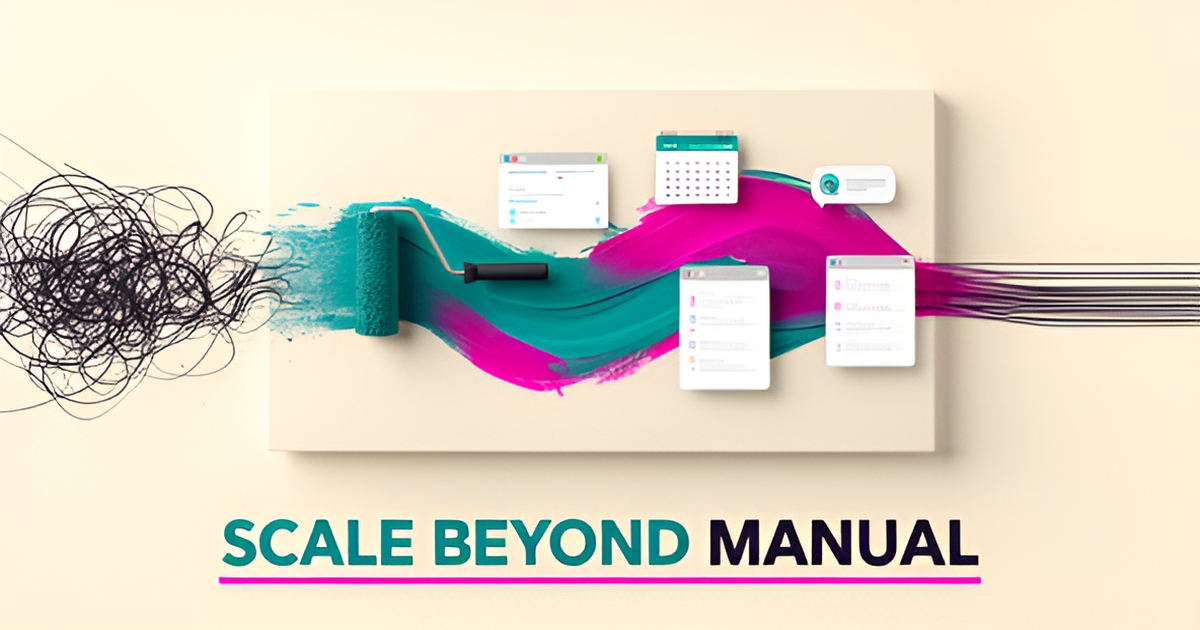
Why Most Mural Painting Businesses Fail to Scale with Manual Project Management
Key Facts
- Most mural painting businesses hit an invisible ceiling where the founder becomes the bottleneck for every decision and client interaction
- Manual estimating typically produces inconsistent quotes that either lose jobs through overpricing or erode margins through underpricing
- Missed calls translate directly to missed revenue, especially when clients contact multiple contractors and hire the first responder
- Administrative tasks—scheduling, invoicing, follow-ups—commonly consume 20+ hours per week for owner-operated trades businesses
- AIQ Labs has deployed 200+ multi-agent systems and runs 4 live SaaS products daily, so its automation patterns are tested in real operations per company information
- AI employees typically cost around 80% less than an equivalent human hire while operating 24/7 per AIQ Labs pricing analysis
Hire a team member that works 24/7 — for less than a part-time wage.
AI receptionists, SDRs, dispatchers and 99+ roles. Trained on your business, fully managed.
Not sure where to start? Ask our AI planner
The Hidden Cost of Manual Operations in Mural Painting
Most mural painting businesses hit an invisible ceiling where the founder becomes the bottleneck for every decision, estimate, and client interaction. Owner-operators relying on manual methods often work long weeks just to maintain operations, while competitors using AI-powered systems reclaim their time and scale beyond personal capacity.
The problem starts with inconsistent pricing and estimation. Without standardized systems, contractors rely on guesswork and memory, leading to quotes that either lose jobs through overpricing or erode margins through underpricing. Manual estimating processes consume hours that could be spent on actual painting or business development.
Communication breakdowns create additional friction. When customer interactions scatter across phone calls, text messages, and email threads, critical details slip through the cracks. Missed calls translate directly to missed revenue, particularly when potential clients contact multiple contractors simultaneously and hire the first responder.
Operational bottlenecks multiply as project volume increases. Tasks that should take minutes—scheduling adjustments, invoice generation, follow-up reminders—consume entire afternoons. Businesses that automate these workflows with integrated AI systems pull ahead, while manual operators drown in administrative overhead.
These inefficiencies compound into three critical scaling barriers:
- Founder dependency for all pricing and client decisions
- Inability to respond to leads outside business hours
- Zero visibility into project pipelines and cash flow
- Administrative tasks consuming 20+ hours weekly
The contrast between manual and automated operations becomes stark during growth phases. While traditional methods require linear increases in administrative time, businesses leveraging AI can implement systems that handle estimation, scheduling, and customer communication without proportional increases in overhead. Teams using structured AI workflows commonly report reclaiming a day or more per week previously lost to manual coordination.
AIQ Labs works with mural painting businesses to assess these operational gaps through a structured fit check. By mapping current workflows and identifying high-value automation targets, we help contractors transition from founder-dependent operations to scalable systems. This strategic approach ensures that technology investments address actual bottlenecks rather than creating additional complexity.
The businesses that successfully scale recognize that manual project management isn't just inefficient—it's a growth ceiling. Breaking through requires replacing tribal knowledge and scattered spreadsheets with intelligent systems that operate consistently regardless of founder availability.
How AI Workflow Builds Identify High-Value Automation Targets
Most mural painting businesses don't ignore automation because they doubt its value — they stall because they can't pinpoint where to start. A structured assessment cuts through that paralysis by mapping every workflow, tool, and team capability against measurable ROI potential.
The process begins with an audit of current operations: estimating methods, scheduling systems, invoicing cadence, and customer communication channels. Contractors that move from experience-based guesswork to consistent, data-informed pricing typically see the fastest gains, because quote consistency directly affects both close rates and margins. That gap between manual inconsistency and repeatable accuracy is often the highest-leverage starting point.
- Estimating workflows evaluated for photo-based analysis and location-specific pricing integration
- Scheduling systems assessed for weather-triggered mass rescheduling and calendar synchronization
- Invoicing processes reviewed for end-of-week automation and payment reminder sequences
- Communication channels mapped for 24/7 lead capture and AI-generated follow-up sequences
- Team capabilities measured against conversational AI interfaces that require no technical training
This is exactly what AIQ Labs' AI Workflow Builds are designed for: we rebuild the one workflow that costs you the most, at a fixed price, in phases. When we run the assessment, we trace each administrative hour to its automation equivalent, revealing exactly which high-value automation targets will reclaim the most capacity.
The assessment doesn't produce a wish list — it delivers a prioritized roadmap with clear milestones, regular check-ins, and adaptability built in. Treating automation as a living, evolving capability rather than a linear project is what separates scalable implementations from stalled pilots.
Integrated AI Systems vs. Fragmented Tool Stacks: The Scaling Difference
The difference between mural businesses that scale smoothly and those that stall often comes down to one decision: fragmented subscriptions versus a unified AI system.
Many growing contractors assemble their tech stack piecemeal—one tool for estimates, another for scheduling, a third for customer communication. This approach quickly becomes expensive and chaotic. Modern integrated platforms consolidate estimating, scheduling, invoicing, and communication into a single interface, eliminating the need to juggle multiple subscriptions.
A consolidated AI setup functions as a 24/7 virtual business manager: it creates estimates, reschedules jobs after weather delays, sends invoices, and launches follow-up campaigns—all through simple text or voice commands. Photo-based estimators can generate market-calibrated quotes in minutes, and visual mockups show clients before-and-after transformations to improve close rates.
The contrast with fragmented systems is stark:
- Manual stacks require switching between apps, re-entering data, and managing separate logins
- Integrated systems centralize estimates, scheduling, invoicing, and communication in one place
- Fragmented approaches multiply subscription costs and integration headaches
- Scattered tools create data silos; integrated platforms maintain a single source of truth
This is where strategic guidance matters. AIQ Labs helps businesses assess whether their current tool stack supports growth or creates bottlenecks. Through structured assessments, we identify which workflows benefit most from consolidation—whether that means deploying AI employees to handle reception, follow-ups, and dispatch, or building a connected AI operating system you own outright.
The competitive advantage no longer comes from having AI tools, but from having them work together seamlessly. Businesses still toggling between five different apps to manage one project face an uphill battle against competitors who simply tell their system what needs to happen.
From Linear Projects to Living AI Systems: A New Operating Model
The mural painting businesses that break through the scaling ceiling don't just manage projects differently — they stop treating AI initiatives as finite projects altogether. Many practitioners now argue that the term "project" undersells AI work, which behaves more like a living, evolving system that delivers continuous value rather than following rigid, linear timelines.
This shift demands a new operating model built on three pillars: milestone-based delivery that replaces waterfall phases, continuous monitoring that catches drift before it compounds, and cross-team collaboration that turns alignment into an ongoing practice. Teams that move from static documentation to dynamic, shared workspaces consistently report faster onboarding and fewer coordination losses.
- Define the AI system's outcomes upfront — not the project plan — with measurable results that evolve
- Adopt iterative delivery cycles instead of fixed endpoints
- Embed monitoring into every review, not as a separate governance layer
- Use shared dashboards that make strategy-to-execution gaps visible in real time
- Treat stakeholder communication as a continuous loop, not milestone-based reporting
AIQ Labs applies this same philosophy across its service lineup: workflow builds ship in phases with clear milestones, and AI operating systems are built as one connected layer, owned outright by the business. The distinction matters: a project ends, but a living AI system compounds — learning from every interaction, refining its outputs, and expanding its scope as the organization's maturity grows.
Implementation Roadmap: Assessing Readiness and Deploying Your First AI Workflow
Assessing your current workflows is the critical first step toward scaling your mural painting business beyond manual limitations. Many contractors still rely on spreadsheets for estimating, phone calls for scheduling, and scattered messaging apps for customer communication, creating inefficiencies that compound as workload increases. Manual methods lead to inconsistent pricing and missed opportunities due to delayed responses. Begin by mapping each core process—from initial inquiry to final payment—and identifying where time is lost to repetitive tasks or communication gaps.
Next, decide between augmenting your existing stack and consolidating into one connected system. A unified approach reduces cognitive load and ensures data consistency across estimating, scheduling, invoicing, and marketing—key pain points for mural businesses aiming to scale. Prioritize capabilities that address the challenges unique to your market: location-specific pricing accuracy, weather-driven rescheduling, and 24/7 lead capture.
Deploying conversational AI for core operations transforms daily management from a time sink into a streamlined workflow. Start with the highest-cost workflow—often end-of-week invoicing, mass rescheduling after weather delays, or after-hours lead response. Then add photo-based estimating to generate consistent quotes in minutes, replacing experience-based guessing. Finally, automate professional communication—including payment reminders and complaint responses—so responsiveness doesn't depend on your mental bandwidth. Establish regular review cycles to assess time saved, close rate improvements, and workflow adjustments, ensuring your AI system evolves with your business rather than becoming another rigid process. AIQ Labs' Start Monthly, Build in Milestones, and Own It Outright payment models let you begin small and expand as results come in—see pricing details for how each model works.
Still paying for 10+ subscriptions that don’t talk to each other?
We build custom AI systems you own outright. No vendor lock-in. Full control.
Not sure where to start? Ask our AI planner
Frequently Asked Questions
Why do mural painting businesses hit a scaling ceiling with manual project management?
How much time can I actually get back by automating mural painting workflows?
What can AI employees do for a painting business?
Is AI too expensive for a small mural painting business?
Where should I start with AI without getting overwhelmed?
Will AI replace my team or change how we work with clients?
Your Path to Scaling Without the Burnout
Most mural painting businesses hit a growth ceiling not because of market demand, but because manual project management turns the founder into a bottleneck—long weeks spent on estimating, scheduling, and administrative tasks that could be automated. Fragmented tools create data silos and missed opportunities, while integrated AI systems consolidate estimating, scheduling, invoicing, and communication into one connected layer. AIQ Labs helps mural contractors move beyond guesswork: start with AI employees for 24/7 lead handling, rebuild your costliest workflow with an AI Workflow Build, or connect everything with an AI Operating System you own outright. The businesses that scale successfully treat AI not as a one-time project but as a living system that evolves with every interaction. If you're ready to replace tribal knowledge with scalable systems, start with a free two-minute Fit Check to see where your biggest opportunity lies—then schedule a no-obligation 30-minute strategy call to map your path forward. Start the Fit Check to begin.
Make AI your competitive advantage — not just another tool.
Strategy, implementation and ongoing optimization. One partner, end to end.
Not sure where to start? Ask our AI planner