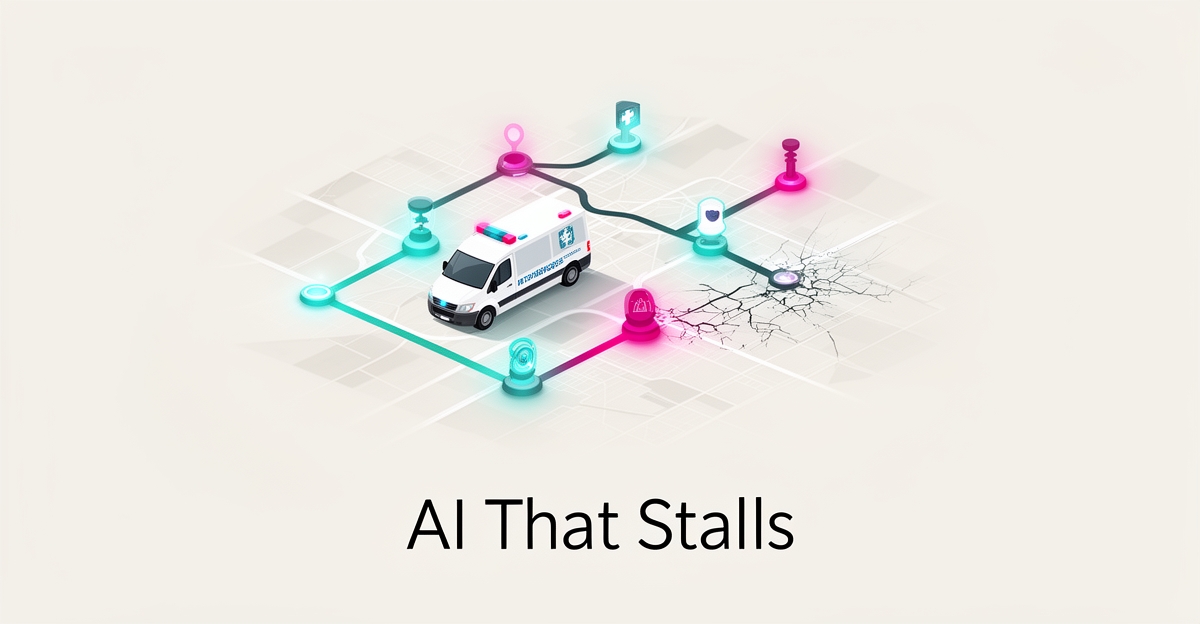
Why Most Non-Emergency Medical Transport Companies Fail at AI Integration
Key Facts
- Industry analyses suggest AI-driven dispatch can meaningfully reduce missed trips and cut fuel costs—often cited in the 25–30% range—when deeply integrated into daily operations
- Predictive scheduling tools are reported to forecast demand with high accuracy and reduce no-shows, though results depend heavily on data quality and staff adoption
- The NEMT market has been projected to grow from roughly $16 billion in the mid-2020s toward $24 billion by 2030, per widely cited market trend analyses
- Upfront costs for AI-driven dispatch implementations are typically reported in the tens to low hundreds of thousands of dollars, varying widely by scope
- AI-powered route optimization is credited with lowering fuel and maintenance costs—again, only when systems share real-time data
- Role-specific training consistently increases AI adoption and reduces resistance in NEMT operations
Hire a team member that works 24/7 — for less than a part-time wage.
AI receptionists, SDRs, dispatchers and 99+ roles. Trained on your business, fully managed.
Not sure where to start? Ask our AI planner
The Growing-Market Problem: Why NEMT AI Projects Stall Before They Scale
The Non-Emergency Medical Transportation (NEMT) market has been projected to grow from roughly $16 billion in the mid-2020s to around $24 billion by 2030, representing a significant opportunity for providers who can harness AI effectively. Yet despite this promise, most NEMT companies fail to scale their AI investments beyond pilot projects. The core issue isn't a lack of technology—it's a failure to treat AI as an operational transformation rather than a software purchase. Many providers acquire dispatch or scheduling tools expecting immediate returns, only to find these systems sit unused or underutilized because they weren't designed around real workflows, staff capabilities, or existing infrastructure.
This disconnect between AI's theoretical potential and practical outcomes is especially pronounced in NEMT, where fragmented legacy systems, high regulatory scrutiny, and labor-intensive processes create unique barriers to adoption. AI-driven dispatch systems are widely credited with reducing missed trips and cutting fuel costs—figures in the 25–30% range appear across industry analyses—but only when integrated deeply into daily operations, not layered on top as a standalone feature. Predictive analytics can forecast demand and reduce no-shows, yet these benefits vanish if dispatchers don't trust the outputs or lack training to act on them. Similarly, AI-powered route optimization lowers fuel and maintenance costs, but gains erode when data feeds from GPS, EHRs, and billing systems remain siloed.
The most common pitfalls stem from treating AI implementation as an IT project rather than a change management initiative. Providers often overlook three critical factors: poor data integration across legacy platforms, insufficient staff training that leaves teams reverting to manual processes, and a failure to redesign workflows around AI's capabilities. Without addressing these, even the most advanced AI tools become expensive shelfware—capable of transformation in theory but delivering none in practice. Scaling AI in NEMT requires not just technology, but a fundamental shift in how trips are planned, dispatched, and monitored—one that aligns people, processes, and platforms from the start.
The Three Failure Modes: Broken Integrations, Untrained Staff, Ignored Workflows
The promise of AI in non-emergency medical transport often collides with harsh realities when implementation overlooks critical operational foundations. Many companies invest heavily in technology only to see minimal returns because they treat AI as a standalone tool rather than a catalyst for systemic change. This misalignment turns potential efficiency gains into sunk costs, especially when upfront investments run into the tens or hundreds of thousands of dollars. Integration challenges, staff readiness, and workflow misalignment are consistently cited as the primary reasons these investments fail to deliver expected value.
The first failure mode stems from treating AI as an add-on instead of integrating it deeply with existing infrastructure. When dispatch systems cannot communicate with scheduling software, billing platforms, or electronic health records, data silos persist and manual workarounds multiply. Seamless integration is what enables AI-driven dispatch to deliver on its promised reductions in missed trips and fuel costs—benefits that vanish when systems operate in isolation. Without bidirectional data flow, AI lacks the real-time inputs needed for intelligent decision-making, forcing staff to duplicate efforts across platforms.
The second critical pitfall is underestimating the human element in technological transformation. Even the most sophisticated AI will falter if dispatchers, drivers, and administrative staff are not adequately trained to interpret its outputs, override its recommendations when necessary, and provide feedback for improvement. Predictive analytics can forecast demand with high accuracy, but only when users trust and actively engage with the technology. Skipping role-specific training or change management leads to resistance, workarounds, and underutilization—turning AI into an expensive ornament rather than an operational asset.
The third and perhaps most fundamental error is implementing AI without redesigning the workflows it is meant to enhance. Automating a broken process simply accelerates inefficiency. For example, deploying AI-powered route optimization without revisiting driver shift patterns, vehicle maintenance schedules, or patient appointment buffers can create new bottlenecks. AI's cost-saving potential is only realizable when operational workflows are reengineered around the technology's capabilities. AIQ Labs addresses this by embedding workflow redesign into every implementation phase—its Workflow Builds service rebuilds the one workflow that costs the most, at a fixed price and in phases—ensuring that technology adoption is paired with process evolution rather than layered onto outdated practices. This holistic approach prevents the common scenario where upfront investment yields no measurable return because the underlying operations remain unchanged.
What Working AI Looks Like: Dispatch, Prediction, and Patient Communication Done Right
The gap between AI hype and operational reality closes the moment an NEMT provider sees the first fully optimized dispatch board in action. Industry analyses widely credit AI-driven dispatch with reducing missed trips by roughly a quarter while cutting fuel costs by around 30%. That is not incremental improvement. That is a fundamental shift in unit economics.
The mechanism is straightforward. AI dispatch processes real-time variables—driver locations, traffic conditions, patient priorities—and makes assignment decisions in seconds rather than minutes. This transforms the dispatcher from a reactive problem-solver into a strategic manager. The human sets policy. The system executes at machine speed.
Predictive analytics delivers a second layer of advantage. These tools forecast demand and flag likely no-shows before they happen. For an NEMT operator running tight margins, knowing tomorrow's trip volume today means staffing vehicles correctly and eliminating deadhead miles.
Patient communication completes the picture. AI receptionist systems—like the managed AI Employees AIQ Labs deploys, at roughly 80% less cost than a human hire—handle routine inquiries, automate scheduling, and provide real-time updates without adding headcount. The patient experience improves while administrative burden drops.
However, these results depend entirely on end-to-end integration. A dispatch algorithm that cannot see updated patient contact information will optimize routes to empty addresses. A predictive model trained on incomplete trip history will forecast demand that does not exist. The technology works when the data flows.
AIQ Labs approaches NEMT transformation through this lens. Rather than deploying isolated tools, the focus is on building unified systems where dispatch, prediction, and communication share a single source of truth. The operational workflow determines the architecture, not the reverse.
The providers seeing fewer missed trips and lower fuel costs are not using better AI. They are using AI that actually connects.
A Failure-Proof Implementation Roadmap for NEMT Operators
Most NEMT operators fail at AI because they chase features instead of fixing foundations. The market is expanding, but growth rewards operators who sequence implementation correctly, not those who deploy the fastest.
Start with readiness and data infrastructure before any model goes live. AI-driven dispatch can reduce missed trips and cut fuel costs, yet those gains depend on clean, connected trip, driver, and patient data. Assess current systems, data quality, and integration points first. Without this, automation amplifies errors instead of removing them.
Fix one critical workflow before scaling. Dispatch or scheduling is the highest-leverage starting point for NEMT. Automating trip assignments and route optimization delivers immediate cost and reliability impact while building trust. Proving value on a single workflow limits risk and funds the next phase—which is exactly how AIQ Labs' Workflow Builds are structured: fixed price, phased delivery, one workflow at a time.
Integrate with existing systems rather than replacing them. NEMT operations run on scheduling, billing, and compliance tools that cannot be disrupted. Deep two-way API integration creates a single source of truth and avoids manual re-entry. This is where operational continuity is preserved while AI adds intelligence.
Train staff per role, not in generic sessions. Dispatchers shift from reactive problem-solvers to strategic managers when AI handles instant adjustments. Drivers need clear mobile updates. Admins need to understand exception handling. Role-specific training reduces resistance and adoption failure.
Establish compliance and monitoring from day one. NEMT data is sensitive and regulated. Build audit trails, human-in-the-loop controls, and performance dashboards before scaling. Predictive analytics only delivers when models are monitored for drift and bias.
A failure-proof roadmap moves from pilot to transformation in deliberate steps:
- Assess readiness, data infrastructure, and integration gaps
- Pilot AI on one workflow: dispatch or scheduling
- Integrate with existing CRM, scheduling, and billing systems
- Deliver role-based training and change management
- Implement governance, compliance monitoring, and KPI tracking
This sequence avoids the common pitfalls of poor data integration, lack of staff training, and ignoring operational workflows. For operators ready to go further, AIQ Labs' AI Operating Systems build one connected operating layer across the business—in phases, owned outright by the operator—so AI stops being a pilot that stalls and becomes embedded capability that scales.
From Pilot to Competitive Advantage: Getting AI Right the First Time
Most NEMT companies begin their AI journey with a pilot—only to watch it stall before delivering real value. This pattern repeats across the industry: promising trials that never scale, fragmented tools that don't talk to each other, and teams left managing more complexity than before. The result isn't just wasted investment—it's a growing gap between those who use AI as a checkbox and those who turn it into a competitive advantage.
The root cause isn't lack of ambition—it's lack of cohesion. Too many operators piece together AI solutions from multiple vendors: one for dispatch, another for scheduling, a third for patient communication. Each system works in isolation, creating data silos, integration headaches, and workflow friction. Upfront costs and integration issues are consistently cited among the top barriers to AI adoption in NEMT, and vendor fragmentation makes both problems worse. Without seamless integration, even a well-funded dispatch investment often fails to deliver the missed-trip reductions and fuel savings it promised.
AIQ Labs prevents this outcome by acting as a single transformation partner—handling strategy, build, integration, adoption, and optimization under one roof. With 200+ multi-agent systems deployed and four live SaaS products the company runs daily, the team builds systems that don't just automate tasks—they adapt to real-world NEMT workflows, from trip assignment to no-show prediction. Payment models are straightforward: start monthly, build in milestones, or own it outright—no fake prices, no invented case-study numbers. Predictive analytics only pays off when trained on clean, integrated data and deployed within a system staff actually use.
The difference lies in treating AI not as a project, but as a capability. The maturity curve moves beyond stalled pilots into scaling, optimization, and ultimately transformation, where AI drives strategic advantage. By owning the full lifecycle, finger-pointing disappears, adoption accelerates, and performance is continuously optimized as your business evolves.
Ready to move past the pilot trap? Start with the 2-minute Fit Check to see whether AI can create real, measurable impact in your NEMT operations—no obligation, just clarity. From there, schedule your free 30-minute strategy call to map your biggest bottleneck and identify high-ROI automation opportunities. If there isn't a clear win, we'll tell you that too.
Still paying for 10+ subscriptions that don’t talk to each other?
We build custom AI systems you own outright. No vendor lock-in. Full control.
Not sure where to start? Ask our AI planner
Frequently Asked Questions
Why do most NEMT AI projects stall after the pilot?
How much does it actually cost to implement AI dispatch in NEMT?
Can AI really reduce missed trips and fuel costs?
Do we have to rip out our current scheduling and billing systems?
What's the first workflow we should automate?
Will my dispatchers and drivers actually use the AI?
Turning AI Investment Into Operational Reality
The path to AI success in NEMT isn't about buying the latest tools—it's about building AI into the fabric of daily operations. Fragmented systems, undertrained staff, and unchanged workflows turn even the most promising pilots into costly shelfware. But when AI is implemented with clean data integration, role-specific training, and redesigned processes, the results speak for themselves: fewer missed trips, lower fuel costs, and dispatchers who operate as strategic managers instead of reactive troubleshooters. These aren't hypothetical gains—they're achievable outcomes for providers who treat AI as an operational transformation, not a software purchase. If you're ready to move beyond stalled pilots and start seeing real, measurable impact in your NEMT operations, the first step is clarity. Take the 2-minute Fit Check, then schedule your free 30-minute strategy call to map your biggest bottleneck and identify high-ROI automation opportunities—no obligation, just a real working session to see if there's a clear win for your business.
Make AI your competitive advantage — not just another tool.
Strategy, implementation and ongoing optimization. One partner, end to end.
Not sure where to start? Ask our AI planner