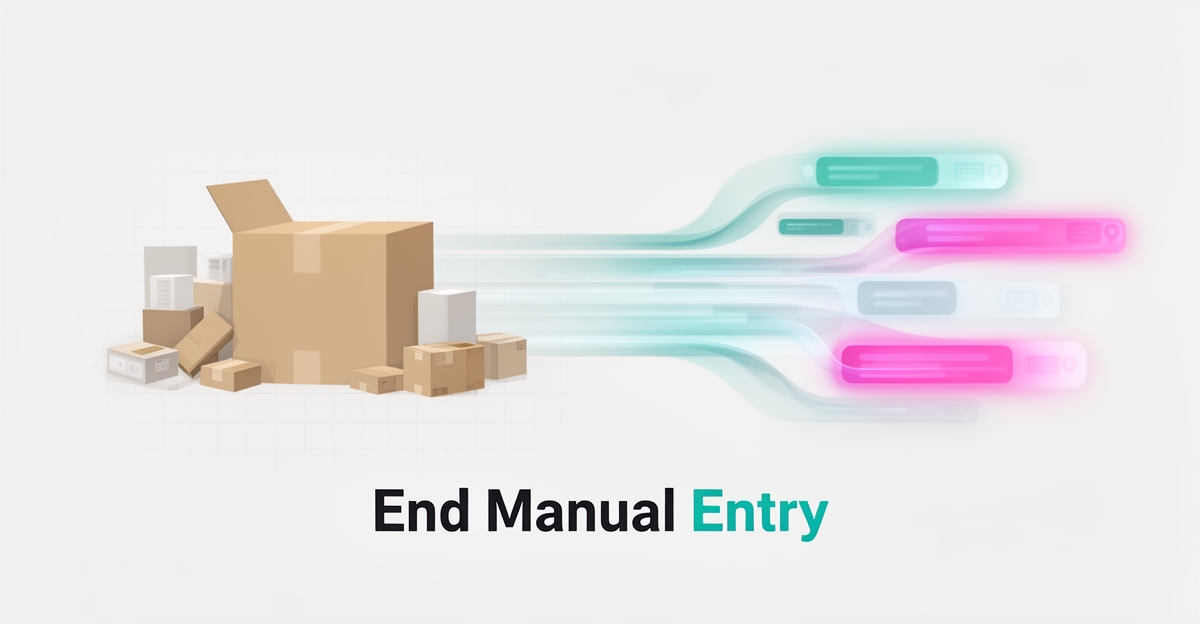
Why Most Packaging Distributors Still Use Manual Data Entry (And How to Fix It)
Key Facts
- Product data inconsistencies remain one of the most commonly cited operational challenges for industrial distributors
- A significant share of product information errors typically traces back to manual data entry
- Bad data carries a measurable annual cost for organizations—often in the millions when rework, expedites, and lost accounts are counted
- Data-error-driven service failures are a leading reason customers quietly take their business elsewhere
- AI order entry can typically cut manual entry time dramatically while catching errors before orders release
Hire a team member that works 24/7 — for less than a part-time wage.
AI receptionists, SDRs, dispatchers and 99+ roles. Trained on your business, fully managed.
Not sure where to start? Ask our AI planner
The Hidden Cost of Manual Order Entry in Packaging Distribution
Despite significant investments in ERP systems, customer portals, and EDI infrastructure, most packaging distributors still process the majority of their orders manually through email. Email-based orders persist because they require no behavior change from customers—who continue sending purchase orders as PDF attachments, embedded images, or plain text in whatever format suits them.
The challenge intensifies when these unstructured orders meet inconsistent product data. Product data inconsistencies are among the most commonly reported operational challenges for industrial distributors, alongside the difficulty of managing rapidly changing product information. When your CSR team manually keys line items from an email into your ERP, they're translating between two worlds—the customer's informal language and your system's structured requirements.
This manual translation carries a steep price tag. Industry analyses of data quality consistently find that bad data costs organizations millions annually, and a substantial share of product information errors traces directly to manual entry. Each mistyped SKU, incorrect quantity, or wrong ship-to address triggers a cascade of downstream costs: expedited shipping to correct mistakes, credit memos, return processing, and the labor hours spent investigating what went wrong.
The damage extends beyond operational metrics. When data errors lead to wrong shipments or delayed orders, a meaningful share of customers will quietly take their business elsewhere. In packaging distribution—where switching costs are relatively low and competitors are plentiful—a single data entry mistake can permanently cost you an account.
AI-powered order entry eliminates this bottleneck by reading purchase orders directly from emails, extracting line items and quantities, validating them against your ERP's business rules, and flagging exceptions for human review. Unlike rigid OCR templates or brittle RPA scripts, modern AI document processing adapts to format variations without constant reconfiguration. AIQ Labs builds these systems to integrate directly with your existing accounting and CRM infrastructure, cutting manual entry time dramatically while virtually eliminating transcription errors.
The technology handles the repetitive translation work, freeing your team to focus on exception handling and customer relationships—the areas where human judgment actually adds value.
How AI-Powered Order Entry Eliminates Manual Bottlenecks
Email orders still land in inboxes with different layouts, handwritten notes, and customer-specific codes. Packaging distributors keep copying that data by hand because the alternatives feel just as brittle.
Manual data entry gives human oversight but remains time-consuming, error-prone, and expensive. A significant share of product information errors typically stems from manual data entry, and product data inconsistencies remain a widely reported challenge across distribution. Bad data carries a real price tag—rework, expedites, credit memos, and eventually lost accounts.
Optical Character Recognition reads text but does not understand meaning. It breaks when layouts change and requires constant reconfiguration. Robotic Process Automation relies on rigid rules and screen positions, so it is fragile when systems or formats change and maintenance climbs over time. Customer portals require customers to change behavior and often see low adoption, so email orders persist.
AI-powered order entry changes the equation by extracting and validating data from unstructured PDFs and emails with context. Modern systems can reduce manual data entry time dramatically—often by the majority—while catching errors before orders release. Machine learning models learn the variations in how customers send orders and map them to ERP fields without hard-coded templates.
Validation happens against ERP rules in real time. The system checks customer-specific product codes, pricing tiers, minimum order quantities, and inventory availability before the order is released. Rush orders are flagged automatically and routed for expedited approval, while exceptions are surfaced with clear explanations for human review.
AIQ Labs approaches this through AI Workflow Builds—rebuilding the one workflow that costs the most, at a fixed price and in phases. For distributors who want a managed option instead, an AI Employee can handle order and invoice intake end to end, with setup, integrations, and ongoing optimization included. The result is automated, fast, and accurate processing that still allows human oversight where it matters.
Key capabilities that separate AI from legacy tools:
- Contextual extraction from unstructured PDFs and emails, not just text recognition
- Real-time validation against ERP rules, customer-specific codes, and pricing
- Adaptive handling of rush orders and layout changes without reconfiguration
- Seamless integration with existing ERP systems and workflows
When AI augments the order entry process, teams stop rekeying and start managing exceptions. That shift protects revenue, improves customer experience, and frees staff for higher-value work.
A Structured Roadmap to Automate Data Entry Without Disruption
Manual data entry is still the default because it feels controllable, even as it quietly erodes margins. Packaging distributors live with the trade-off: human oversight versus speed, accuracy, and scale.
A structured rollout reduces disruption by treating automation as an operational upgrade, not a rip-and-replace project. The path starts with clarity on why automation matters to the business, then moves to workflow mapping, data readiness, integration, and adoption.
Define the strategic purpose before touching software. The most successful adopters begin by identifying one or two business-critical areas—often the most time-consuming manual processes—and applying AI functionality there first. For distributors, order and invoice intake from email and PDFs is typically the highest-ROI starting point.
Map the current workflow end-to-end and quantify pain. Document where orders arrive, who touches them, and where errors compound. Product data inconsistencies and manual-entry errors drive rework, late shipments, and customer friction—quantify them so the business case is grounded in your own numbers, not industry averages.
Build a data foundation that lets AI learn fast. Establish a single source of truth, clear ownership, and consistent formats for SKUs, pricing, and customer codes. A strong foundation enables AI to learn faster and make more accurate predictions, which is essential before scaling beyond a pilot.
Integrate AI with ERP/CRM rather than alongside it. The system should extract, validate, and route data from PDFs and emails, then write directly into existing accounting and CRM tools with human-in-the-loop checks for exceptions. This is the core of how AIQ Labs builds order entry automation—production-grade systems that connect to the tools you already run.
Train teams for trust and feedback. AI adoption succeeds when it enhances human performance, not undermines it. Roles shift from typing to verifying and exception handling. Continuous feedback loops improve accuracy and build confidence.
A practical first-phase roadmap looks like this:
- Define strategic purpose and pick one critical intake workflow to automate first
- Map the workflow, audit data quality, and create a single source of truth
- Deploy AI document processing for extraction and validation with ERP/CRM integration
- Train staff on verification, exceptions, and feedback to drive iterative improvement
With production-grade AI systems that integrate directly with accounting and CRM tools, AIQ Labs helps distributors automate extraction and validation without forcing customers to change behavior. The result is faster order-to-cash, fewer errors, and a foundation for scaling automation across the business without disruption.
From Manual to Managed: What Packaging Distributors Should Do Next
The path forward begins with recognizing that manual data entry isn't just inefficient—it's actively undermining operational performance. For packaging distributors, product data inconsistencies and manual-entry errors create avoidable delays, rework, and customer friction. Continuing down this path means accepting higher costs, slower response times, and eroded customer trust in an industry where accuracy and speed are non-negotiable.
To transition from manual to managed, distributors must start with data governance and establish a single source of truth for order and invoice information. This foundation ensures AI systems have reliable inputs to learn from and accurate outputs to act upon. Rather than attempting a full-scale overhaul, the most effective strategy is to pilot AI in one critical workflow—such as processing emailed purchase orders—where the pain is acute and the ROI is measurable. AI-powered order entry delivers its biggest gains when built on clean, governed data and integrated with existing ERP and CRM systems.
AIQ Labs supports this pragmatic progression through three payment models designed for SMBs. Start Monthly lets distributors deploy a managed AI employee focused solely on order or invoice processing, with setup, training, integrations, and ongoing optimization included—typically at a fraction of the cost of a human hire. Build in Milestones breaks the initiative into phases—like automating email order extraction first, then ERP validation—so teams can approve and pay for each step as it delivers value, retaining all work completed even if paused. Own It Outright provides a path to full ownership of a custom AI system that becomes a permanent, controllable asset, eliminating vendor lock-in while ensuring long-term scalability.
The goal isn't perfection on day one—it's proven progress. By beginning with a single, high-impact workflow, grounding the effort in data governance, and choosing a flexible implementation model, packaging distributors can turn a persistent liability into a strategic advantage. This approach minimizes risk, builds internal confidence, and creates a repeatable framework for expanding AI across other operations—from inventory forecasting to customer service—without disrupting core business functions. The shift from manual to managed isn't about replacing people; it's about freeing them to focus on higher-value work while AI handles the repetitive, error-prone tasks that have held the industry back for too long.
Still paying for 10+ subscriptions that don’t talk to each other?
We build custom AI systems you own outright. No vendor lock-in. Full control.
Not sure where to start? Ask our AI planner
Frequently Asked Questions
Why do packaging distributors still rely on manual data entry despite having ERP systems?
How much does bad data cost organizations annually due to manual data entry errors?
Can AI-powered order entry really reduce manual data entry time significantly?
What happens if a data entry error leads to a wrong shipment in packaging distribution?
How do AI order entry systems handle different customer order formats without constant reconfiguration?
What's the first step in implementing AI-powered order entry without disrupting current operations?
From Manual Entry to Managed Growth
Manual order entry persists because it feels controllable, but for packaging distributors it quietly erodes margin, slows order-to-cash, and risks customer trust. Product data inconsistencies and manual-entry errors compound into rework, expedites, and lost accounts. AI-powered order entry changes the equation by extracting and validating data from unstructured emails and PDFs against ERP rules—cutting manual entry time dramatically without forcing customers to change behavior. The shift starts with data governance and a single source of truth, then a focused pilot on the highest-pain intake workflow. AIQ Labs helps distributors automate extraction and validation with production-grade AI systems that integrate directly with accounting and CRM tools, freeing teams to manage exceptions and relationships instead of rekeying. Every week you keep rekeying orders is a week of margin and goodwill you don't get back. Start the 2-minute Fit Check at https://aiqlabs.ai/apply, then book a free 30-minute strategy call at https://aiqlabs.ai/book to identify your highest-ROI automation opportunity. Questions first? Reach the team at [email protected].
Make AI your competitive advantage — not just another tool.
Strategy, implementation and ongoing optimization. One partner, end to end.
Not sure where to start? Ask our AI planner