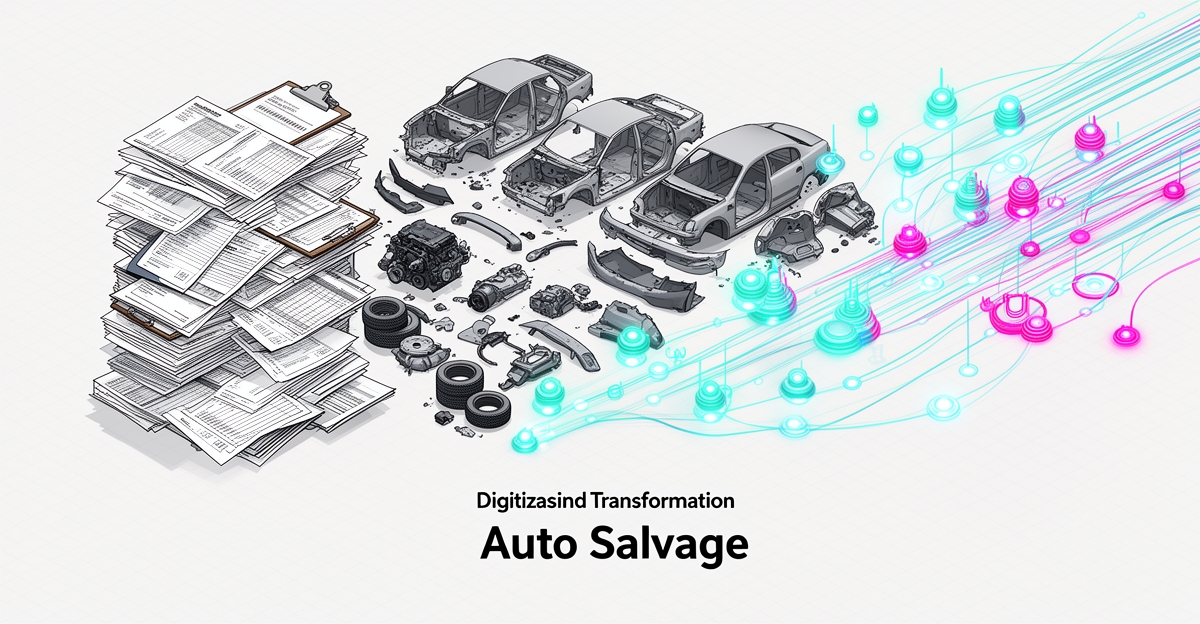
Why Most Salvage Yards Still Use Paper Records (And How AI Fixes It)
Key Facts
- Traditional scrap yards remain laden with manual processes, unpredictable pricing, material theft, and compliance gaps, according to industry analysis from TDC Ventures.
- Workflow mapping at one Canadian scrap yard reportedly uncovered roughly 40% redundancy in manual data entry — the kind of waste that justifies digitization investment.
- Industry analyses suggest AI-powered systems can meaningfully reduce operating costs in recycling facilities within the first year, with some reporting reductions of up to 20%.
- AI models trained on large scrap-material image datasets have been reported to outperform manual graders on uncommon alloys, though results depend heavily on training data that matches the yard's actual materials.
- Tech-enabled scrap yards typically report lower labor costs through automated sorting and inventory tracking, with some operations citing 20-30% reductions.
- Predictive maintenance platforms are commonly credited with reducing equipment downtime in AI-enabled facilities.
- Smart wearables and hazard-detection systems are associated with fewer workplace incidents in modern yards, though reported figures vary widely by operation.
Hire a team member that works 24/7 — for less than a part-time wage.
AI receptionists, SDRs, dispatchers and 99+ roles. Trained on your business, fully managed.
Not sure where to start? Ask our AI planner
The Hidden Cost of Paper in Auto Recycling
Paper records feel safe until a yard realizes how much value they're quietly leaking. In auto recycling, manual logs create blind spots that show up as lost inventory, mispriced material, and compliance exposure.
Traditional scrap yards remain "laden with manual processes, unpredictable pricing systems, material theft, and compliance gaps" according to industry research. Without real-time data access, managers cannot effectively track material flow, optimize inventory, or ensure regulatory compliance.
Manual data entry compounds the problem. One Canadian scrap yard used workflow mapping to uncover roughly 40% redundancy in manual data entry — duplicated entries, lost forms, and conflicting versions of the same vehicle record. That redundancy is not just wasted time; it is a standing invitation for errors.
Misclassification is a direct financial hit. Human-dependent sorting creates variable quality and pricing errors when lower-grade materials are sold at higher-grade prices, or valuable components are overlooked during processing. Paper systems also enable material theft and slow reconciliations because chain-of-custody is hard to prove after the fact.
Operational blind spots prevent real-time visibility. Yard managers rely on incomplete historical data for decisions, while material quantities, revenue losses, and safety risks remain hidden until month-end. The lack of digital infrastructure hampers the industry's ability to adapt to market dynamics.
The hidden cost of paper shows up across the operation:
- Misclassification and pricing errors that erode margin on every vehicle processed
- Lost or damaged records that create compliance gaps and audit risk
- Material theft and untraceable inventory movements with no automated gate logging
- Redundant manual entry that consumes labor without adding value
AI document processing changes the record-keeping foundation. When records are captured, classified, and linked automatically, yards gain a single source of truth for parts, materials, and vehicles. Decisions move from guesswork to data, and compliance becomes a continuous process rather than a scramble at audit time.
The shift is already showing results. Tech-enabled analysis suggests AI-powered systems can reduce operating costs in recycling facilities by up to 20% within the first year of implementation. That reduction comes from fewer errors, faster workflows, and real-time visibility that paper cannot provide.
AIQ Labs builds these systems for auto recycling operations — either as a single AI Workflow Build targeting the one record-keeping process that costs the most, or as a fuller AI Operating System that connects intake, inventory, and sales in one layer the yard owns outright.
How AI Digitizes Vehicle Records From Yard to Sale
The shift from paper to digital records begins the moment a vehicle enters the yard, where AI-powered systems replace manual logging with real-time data capture. Computer vision technology identifies and catalogs vehicle components as they are processed, using models trained on large image datasets to recognize parts with precision that industry reports suggest can surpass manual methods several times over. This eliminates the misclassification errors that commonly occur with paper-based tracking, where human oversight leads to lost data and inaccurate inventory counts.
Smart scales, RFID tags, and IoT sensors work in tandem to automate weight logging, material tracking, and location monitoring without manual entry. These devices sync data instantly to centralized platforms, creating a single source of truth that cuts the redundant data entry documented in workflow-mapping studies. Predictive analytics then layer onto this foundation, forecasting demand for specific parts based on historical sales, seasonality, and market trends — enabling yards to optimize stock levels and reduce waste. The result is a seamless flow of information that supports faster decision-making and minimizes the guesswork inherent in paper systems.
This integrated approach delivers measurable operational improvements. Tech-enabled facilities typically report lower labor costs through automated sorting and inventory tracking, with some citing 20-30% reductions. Downtime tends to fall as predictive maintenance platforms monitor equipment health and schedule repairs before failures occur. Workplace safety also improves, with smart wearables and hazard-detection systems associated with fewer incidents. Together, these technologies transform salvage yards from reactive, paper-dependent operations into proactive, data-driven enterprises where every vehicle's journey is tracked, analyzed, and optimized for maximum value recovery.
- Real-time vehicle and parts tracking via AI cameras and sensors
- Automated inventory logging using RFID and smart scales
- Demand forecasting to reduce overstock and stockouts
- Predictive maintenance to minimize equipment downtime
- Enhanced compliance through automated data logging
By replacing manual logs with intelligent automation, yards gain the visibility needed to price parts accurately, meet regulatory requirements, and respond quickly to market shifts — turning what was once a liability into a strategic advantage. For yards that want the data-entry and reconciliation work handled without adding headcount, AIQ Labs also offers AI Employees that handle record capture, classification, and reconciliation around the clock at a fraction of the cost of a human hire.
From Paper to Production: A Phased Tech-Enabled Rollout
Many salvage yards remain stuck in paper-based workflows not because they resist change, but because they lack a clear path forward. Manual record-keeping creates blind spots that inflate labor costs and increase error rates, and industry research confirms that transitioning to digital systems is no longer optional for yards aiming to stay competitive in a data-driven market.
A successful rollout begins with a thorough infrastructure audit to map existing workflows and identify high-impact automation targets. This step often reveals significant inefficiencies — one Canadian facility uncovered roughly 40% redundancy in manual data entry just by mapping its processes, providing a strong business case for investment. TDC Ventures notes that setting measurable KPIs early, such as targeting a specific reduction in downtime, helps align technology choices with operational goals and justifies phased implementation.
Technology selection should prioritize ROI-driven tools that deliver quick wins while building toward long-term integration. Starting with IoT sensors and smart scales enables real-time tracking of material flow and equipment performance, laying the foundation for AI classification and predictive maintenance. Pilot testing — such as deploying AI cameras on a single conveyor line — allows yards to validate performance before scaling, reducing risk and ensuring compatibility with legacy systems. Implementation guides recommend partnering with vendors offering modular, scalable solutions that can grow with the yard's needs.
The phased rollout typically unfolds in three stages: first deploying IoT sensors and smart scales for real-time monitoring; second integrating AI classification engines and predictive maintenance platforms; and third launching advanced analytics dashboards for site-wide visibility. Throughout this process, system integration via APIs unifies data streams from devices, ERP, and CRM platforms, while cloud migration ensures scalability and secure storage. Workforce training focuses on upskilling teams through hands-on workshops and addressing resistance by highlighting efficiency gains. Continuous optimization — including regular AI model updates and KPI tracking — sustains improvements in material yield, equipment uptime, and safety over time. AIQ Labs structures this work in fixed-price milestones, so a yard always knows what it is paying for and what it gets before the next phase begins.
Why Custom AI Beats Off-the-Shelf for Salvage Operations
Here's the uncomfortable truth about salvage yard digitization: the software most vendors sell doesn't actually fit the yard. Off-the-shelf inventory tools assume clean, structured data — not a grease-stained ledger, a wall of handwritten tags, and three decades of institutional knowledge living in someone's head.
That mismatch is why so many digitization projects stall. A Canadian scrap yard that mapped its workflows discovered roughly 40% redundancy in manual data entry — the kind of inefficiency generic software can't untangle because it was never designed for how auto recycling actually works. Salvage operations need systems built around their reality: VIN-level part tracking, grading accuracy, chain-of-custody documentation, and environmental reporting.
Custom AI development flips the equation. Instead of forcing a yard to adapt to a product, the system is architected around the yard's existing workflows, then connected directly to scales, inventory tools, and accounting software through deep API integrations. The accuracy gains are real: AI models trained on large scrap-material image datasets have been reported to outperform manual graders on uncommon alloys — a capability that only works when the model is trained on the specific materials a yard actually handles.
Ownership matters just as much as accuracy. When a yard depends on a subscription platform, its data lives in someone else's cloud, and every improvement requires paying the vendor again. A purpose-built system the yard owns outright eliminates that dependency — no vendor lock-in, no per-seat fees stacking up, no losing access to years of operational records if a contract ends.
This is the approach AIQ Labs takes with auto recycling operations: custom-built AI systems that digitize vehicle and parts records with accuracy and compliance built in, backed by managed AI employees that handle data entry, classification, and record reconciliation around the clock. Because the yard owns the code, agents, and data, the system grows with the business instead of billing against it.
The results across the industry show why this shift is worth making. Tech-enabled facilities commonly report lower labor costs through automated sorting and inventory tracking, and AI-powered inventory systems can predict which parts are likely to be in demand, helping yards optimize stock and reduce waste. Paper records can't do any of that — and neither can rented software that was never built for the yard in the first place.
The difference between a digitization project that sticks and one that fades comes down to fit and ownership. Salvage yards that solve both end up with a digital asset they control permanently, not another line item on a software invoice.
Still paying for 10+ subscriptions that don’t talk to each other?
We build custom AI systems you own outright. No vendor lock-in. Full control.
Not sure where to start? Ask our AI planner
Frequently Asked Questions
Why do salvage yards still rely on paper records despite the risks?
How much can AI-powered systems reduce operating costs in auto recycling facilities?
What specific inefficiency did a Canadian scrap yard uncover by mapping its manual workflows?
Can AI improve the accuracy of material grading in salvage yards, especially for uncommon alloys?
What are the key benefits of using IoT sensors and smart scales in a tech-enabled salvage yard?
Is it better to build a custom AI system or use off-the-shelf software for salvage yard operations?
From Paper Lag to Data Lead: Your Next Step in Salvage Yard Intelligence
The evidence is clear: paper records in salvage yards aren't just inefficient — they're actively eroding profit through misclassification, lost inventory, redundant labor, and compliance risk. AI-powered digitization fixes these leaks and turns yards into proactive, data-driven operations with real-time visibility and automated compliance. AIQ Labs helps salvage operations make this shift not with generic software, but with custom-built systems that fit your workflows, integrate with your tools, and give you full ownership — no vendor lock-in, no per-seat fees. The first step isn't a big investment; it's clarity. Take the 2-minute Fit Check, then book a free 30-minute strategy call to map your biggest bottleneck and see where AI delivers the highest ROI for your yard — no obligation, just a real working session. Prefer email? Reach the team at [email protected].
Make AI your competitive advantage — not just another tool.
Strategy, implementation and ongoing optimization. One partner, end to end.
Not sure where to start? Ask our AI planner