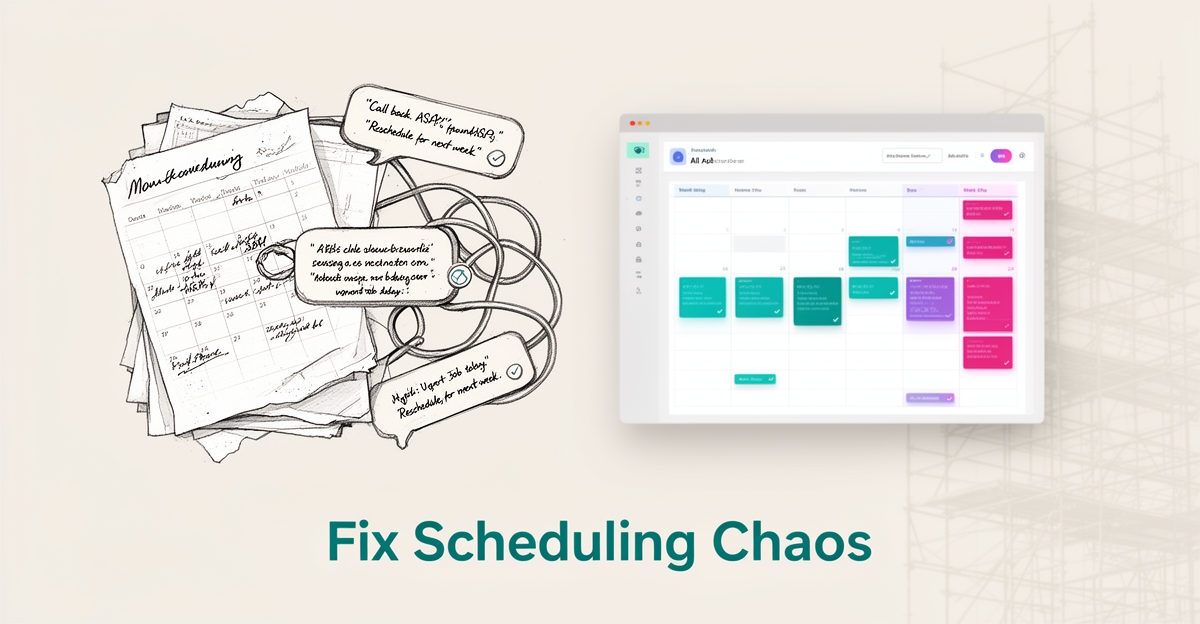
Why Most Scaffolding Rental Companies Still Use Manual Job Scheduling (And How to Fix It)
Key Facts
- Many scaffolding companies spend several hours per week on emails, texts, and phone tag managing client communication
- Automated appointment reminders typically reduce no-shows substantially in field service operations
- A traditional front-office hire can cost tens of thousands of dollars annually, while managed AI staff typically run a fraction of that — AIQ Labs' AI Employees cost roughly 80% less than a human hire
- Business owners using AI automation commonly reclaim 15-20 hours per week of administrative time for billable work
- AI-powered online booking captures leads 24/7, stopping revenue loss while crews are on-site
- Smart routing by location and job duration increases billable jobs per day through optimized crew utilization
- Automated waitlist management fills cancellation gaps instantly without manual tracking
Hire a team member that works 24/7 — for less than a part-time wage.
AI receptionists, SDRs, dispatchers and 99+ roles. Trained on your business, fully managed.
Not sure where to start? Ask our AI planner
The Hidden Cost of Manual Scheduling in Scaffolding Operations
Every scaffolding rental company knows the frustration: a crew arrives on-site only to discover the client never confirmed, or worse, two jobs are booked for the same equipment on the same day. These aren't minor inconveniences—they're symptoms of a scheduling system that leaks revenue while owners remain buried in administrative work.
The scope of the problem is easy to see. Many scaffolding companies spend several hours per week managing emails, texts, and phone tag just to coordinate jobs. That's time spent chasing confirmations instead of securing new contracts or overseeing installations.
Double bookings represent the most visible failure of manual scheduling. When your calendar exists across sticky notes, text messages, and a whiteboard, conflicts become inevitable. Yet many companies still rely on these fragmented systems because they feel more adaptable to the unpredictability of the job site.
The hidden costs extend far beyond scheduling errors:
- Missed leads while crews are on-site — potential clients call, get voicemail, and book with a competitor within minutes
- No-show rates that drain profitability — without automated reminders, clients forget appointments, leaving crews idle and equipment unused
- Inefficient routing — crews zigzag across town instead of following optimized routes based on location and job duration
- Manual waitlist management — cancellations create gaps that could be filled automatically but instead sit empty
The financial impact compounds quickly. Field service operators that add automated appointment reminders typically see a substantial reduction in no-shows. For a company running 20 jobs per week, even a modest improvement translates to several recovered appointments monthly—revenue that simply vanishes under manual systems.
Consider the opportunity cost. Business owners using AI automation commonly report saving 15-20 hours per week on administrative tasks. For a scaffolding operation, those hours represent the difference between managing three active job sites and scaling to five or six.
The traditional solution—hiring office staff—creates its own burden. A receptionist, office manager, and marketing coordinator can easily exceed $100,000 annually in combined salaries, an overhead structure that makes sense only at significant scale. Small to mid-sized operations need the coordination capacity without the payroll weight.
This is where intelligent automation changes the equation. AIQ Labs builds scheduling systems for field service operations that eliminate double bookings through real-time calendar synchronization, respond to inquiries within seconds rather than hours, and automatically optimize routing based on job location and equipment requirements. The technology exists—the question is whether your operation can afford to keep losing revenue while competitors modernize.
Why Digital Planning Tools Haven't Solved the Problem
Despite the availability of digital planning tools like PERI's project planning software and digital assistants, scaffolding rental companies continue to face daily chaos in their yards due to a fundamental mismatch between these tools and operational realities. PERI's solutions excel at material planning and static project scheduling but fall short when it comes to the dynamic, real-time demands of rental operations—such as last-minute dispatch changes, equipment availability tracking across multiple sites, and urgent client communication. These tools were designed for construction project workflows, not the fluid, appointment-driven nature of scaffolding rentals where jobs shift hourly based on site readiness, weather, and contractor availability.
As a result, rental yards remain trapped in manual scheduling cycles that create avoidable inefficiencies. Companies still lose hours every week to emails, texts, and phone tag trying to confirm deliveries and pickups—a direct consequence of tools that don't automate client communication or sync with field teams in real time. Without intelligent routing or waitlist management, dispatchers manually juggle spreadsheets and whiteboards, leading to double-booked equipment and missed jobs that damage client trust. Even when digital planners exist, they often operate in isolation from the scheduling and dispatch systems that drive daily yard operations, creating silos that force staff to re-enter data across multiple platforms.
The core issue isn't a lack of technology—it's that existing digital planning tools weren't built for the rental business model. They optimize for material lists and project timelines, not for the constant rescheduling, emergency dispatches, and client-facing coordination that define scaffolding rental success. Until solutions address the full lifecycle of a rental job—from initial inquiry to equipment return—companies will continue to rely on manual processes simply because they're more adaptable to the unpredictability of the job site, even as they drain productivity and revenue. This gap between planning software and operational execution is why AI-powered workflow automation, not just digital planning, is needed to truly eliminate scheduling chaos in scaffolding rental yards.
How AI-Powered Scheduling Eliminates the Chaos
Manual scheduling creates double-bookings, phone tag, and missed revenue. AI-powered scheduling replaces that chaos with four capabilities built for field service.
Online booking removes the bottleneck of phone and text. Clients book directly from your website or Google listing with no phone calls needed. This instant access stops leads from being lost while crews are on site.
Smart routing turns a static calendar into an optimized route. AI optimizes your schedule based on location, travel time, and job duration. This reduces windshield time and increases billable jobs per day.
Calendar integration and waitlist auto-fill keep capacity full without manual tracking. Systems integrate with Google Calendar, Outlook, and existing tools. When cancellations happen, AI fills the slot from your waitlist automatically.
Automated reminders directly protect revenue. Field service operations that add automated appointment reminders typically see a substantial reduction in no-shows. That reliability compounds with time savings, as most companies spend hours every week on emails, texts, and phone tag.
Together these capabilities deliver the core transformation:
- Online booking from web and Google Business Profile for 24/7 lead capture
- Smart routing by location and job duration to maximize crew utilization
- Calendar sync with automatic waitlist backfill on cancellations
- Automated reminders that meaningfully cut no-shows
The result is fewer missed jobs and higher availability without adding office staff. Business owners using AI automation commonly report 15-20 hours per week saved on admin tasks—time that can be redirected to billable work or growth.
For field service operations, reliability matters as much as speed. Production-ready AI systems need orchestration, validation, and human-in-the-loop controls, with fallback mechanisms for scheduling-critical workflows. Any system touching your live calendar should degrade gracefully, not fail silently.
AIQ Labs implements intelligent, automated workflows tailored to field service operations through AI Workflow Builds—rebuilding the one workflow that costs you the most, at a fixed price, in phases. The approach replaces manual coordination with owned systems that improve accuracy and availability across crews and sites.
The Business Case: Replacing Office Overhead with AI Staffing
The math behind manual scheduling is brutal: scaffolding companies routinely pay well into six figures a year for three support roles while losing jobs to double bookings and slow callbacks. A receptionist, an office manager, and a marketing person can easily exceed $100,000 in combined salaries—before you add benefits, payroll taxes, or turnover costs.
The alternative isn't a stripped-down compromise. Managed AI staff handle the same core functions for roughly 80% less than a human hire, and the system works around the clock instead of 40 hours a week. AIQ Labs' AI Employees cover receptionists, SDRs, dispatchers and 99+ other roles—no fake prices, no invented case-study numbers, just a clear cost comparison you can verify on the pricing page.
Here's what that monthly investment actually replaces:
- Front-office coverage: AI receptionists answer calls, texts, and online inquiries instantly, 24/7—eliminating the leads lost while your crew is on a job site.
- Scheduling and dispatch: Smart routing optimizes bookings by location, travel time, and job duration, syncing directly with Google Calendar or Outlook to prevent conflicts.
- Marketing execution: Automated review requests, email campaigns, and local SEO keep your pipeline full without a dedicated marketing hire.
- Billing and follow-up: Invoices go out automatically upon job completion, with payment reminders and online payment processing built in.
But the real leverage isn't just cost avoidance—it's time recovery. Business owners using AI automation commonly report saving 15-20 hours per week on administrative tasks. For a scaffolding operation billing $75 to $150 per hour, that's $1,125 to $3,000 in weekly capacity redirected from phone tag and paperwork to billable erection, dismantle, and inspection work.
The compounding effect matters more than the headline savings. When your office manager isn't manually confirming appointments, your no-show rate drops through automated reminders. When inquiries get answered in seconds instead of hours, you stop losing bids to competitors who simply responded faster. When review requests go out automatically after every job, your local search ranking climbs and inbound calls increase without additional ad spend.
This is the operational shift AIQ Labs builds for field service companies: not a chatbot bolted onto your website, but an integrated system that handles intake, scheduling, dispatch, and follow-up as a single workflow. The scaffolding companies scaling past $200K annually aren't doing it with bigger office staffs—they're doing it with infrastructure that doesn't call in sick, doesn't miss a callback, and doesn't require a salary review every year.
Implementation Roadmap: From Manual to Automated in 6 Steps
You don't have to automate everything at once — and honestly, you shouldn't. The scaffolding companies that succeed with AI roll it out in phases, proving value at each step before expanding, so trust in the system grows alongside your operations.
The smart sequence starts where the pain is cheapest to fix: communication. Most scaffolding companies spend hours every week on emails, texts, and phone tag. Automating instant inquiry responses, appointment reminders, and follow-up sequences first delivers fast wins—including a meaningful reduction in no-shows through automated texts and emails.
From there, move to the core problem: scheduling. AI handles online booking from your website or Google listing, smart routing based on location and travel time, calendar sync, and automatic waitlist filling when cancellations happen. Then layer on marketing automation, invoicing and payment reminders, and a review engine. The final phase is full office operations: an AI receptionist, dispatcher, marketing team, and bookkeeper replacing what would otherwise cost six figures in traditional staffing overhead.
Whatever phase you're in, apply the reliability standards that production AI deployments demand. Before any system touches your live calendar, insist on:
- Fallback mechanisms — retries, graceful degradation, and validation checks so a failed automation never means a missed job
- Human-in-the-loop controls — configurable escalation when a request exceeds the AI's authority, so you always make the final call on critical bookings
- Observability — complete logging and audit trails, so you can see exactly what the system did and why
- Tool boundaries — hard limits on what the AI can and cannot change without approval
These aren't nice-to-haves. Production-grade AI means shaping everything around the model: orchestration, state persistence, retries, fallbacks, validation, and human review. Any vendor who can't explain their fallback behavior when a booking fails is selling you a prototype, not a production system.
This phased approach mirrors how AIQ Labs structures implementations — starting with a single critical workflow, then expanding department by department, with monitoring, guardrails, and human escalation built in from day one. Whether you Start Monthly, Build in Milestones, or Own It Outright, you move at the pace that fits your operation. Owners who follow this path typically reclaim 15-20 hours per week of admin time, hours that go straight back into billable work and growing the business.
Still paying for 10+ subscriptions that don’t talk to each other?
We build custom AI systems you own outright. No vendor lock-in. Full control.
Not sure where to start? Ask our AI planner
Frequently Asked Questions
Why do scaffolding rental companies still use manual scheduling if it's so inefficient?
How much time does manual scheduling actually waste each week?
Do automated reminders really reduce no-shows?
Is AI scheduling expensive compared to hiring office staff?
Can AI handle double bookings and equipment conflicts?
How much admin time can owners actually save with AI automation?
Stop Bleeding Revenue on the Scheduler
Manual scheduling isn't a tradition to preserve, it's a leak that's costing scaffolding companies hours, jobs and trust. Double bookings, phone tag, missed callbacks and idle crews all trace back to fragmented calendars and reactive coordination. The companies scaling past $200K aren't adding office staff, they're replacing manual chaos with real-time booking, smart routing, automated reminders and automatic waitlist backfill that keep crews billable and clients confident. AI-powered workflow automation built for field service delivers that shift without the six-figure overhead of a receptionist, office manager and marketer. Start where the pain is cheapest to fix: automate instant inquiry responses and reminders first, then layer online booking and calendar sync, and expand to dispatch and follow-up as trust grows. If you're ready to map your biggest bottleneck to a high-ROI automation plan, take the 2-minute Fit Check at aiqlabs.ai/apply and book a free 30-minute strategy call at aiqlabs.ai/book. No obligation, just clarity on what to automate first.
Make AI your competitive advantage — not just another tool.
Strategy, implementation and ongoing optimization. One partner, end to end.
Not sure where to start? Ask our AI planner