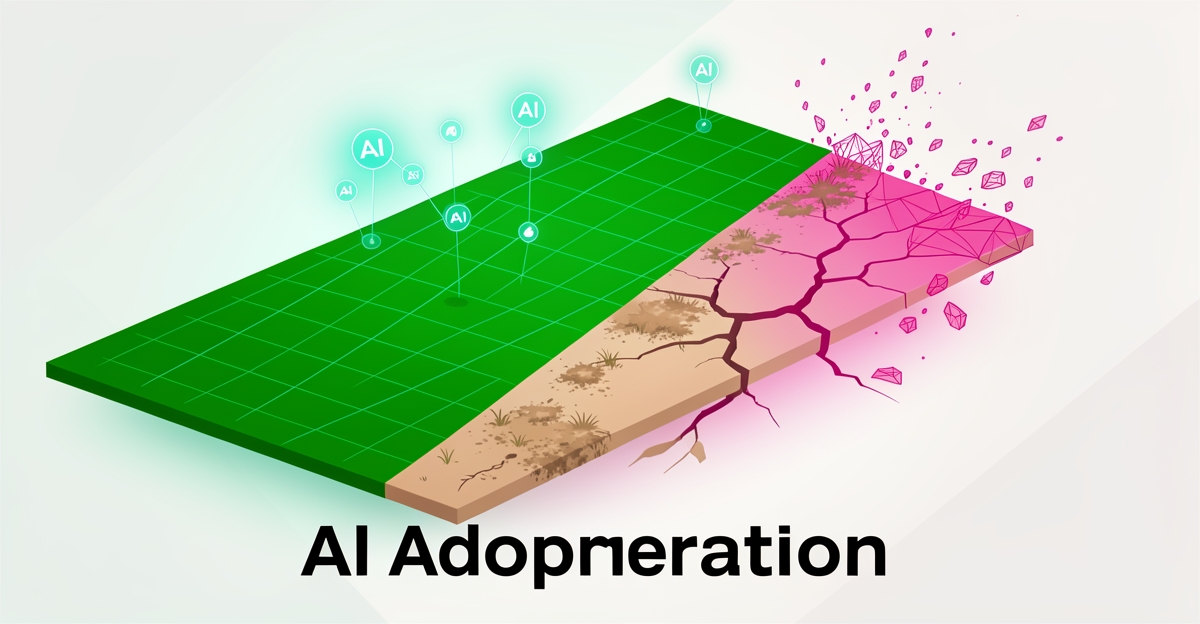
Why Most Sod Installation Businesses Fail at AI Implementation, And How to Avoid It
Key Facts
- A substantial share of generative AI projects are abandoned after proof of concept, industry analyses have pointed to figures around 30% or higher according to industry research
- Combining accelerated decision-making with faster execution has been shown to deliver roughly 400 basis points improvement in service level and about a 5.5% increase in gross margin per KPMG research
- Poor integration with existing tools causes staff to toggle between systems, eroding trust quickly per AI adoption analysis
- Lack of staff training on AI means crews don't know when to rely on the model versus override it per operational research
- Unrealistic expectations and unclear goals create a gap between leadership promises and pilot delivery per AI initiative studies
Hire a team member that works 24/7 — for less than a part-time wage.
AI receptionists, SDRs, dispatchers and 99+ roles. Trained on your business, fully managed.
Not sure where to start? Ask our AI planner
The AI Adoption Gap: Why Landscaping AI Projects Stall After the Pilot
Most sod installation AI pilots look promising in the demo and then disappear once the crew goes back to the field. The technology rarely fails on its own; it fails on introduction.
Industry research has consistently found that a large share of generative AI projects, figures around 30% or higher have been cited, are abandoned after proof of concept. In landscaping and sod installation, that pattern shows up as a working prototype for estimating, dispatch or inventory that never connects to the tools the team already uses daily.
The stall is rarely technical. It is operational. Poor integration with existing tools and processes leaves staff toggling between systems, which erodes trust quickly. Lack of staff training and education on AI means the crew does not know when to rely on the model and when to override it. Unrealistic expectations and unclear goals create a gap between what leadership promised and what the pilot actually delivers.
Resistance to change and emotional discomfort also slow adoption. As adoption analysis notes, AI doesn't create emotions, it reveals them. And AI initiatives stall when leaders treat adoption as a systems rollout rather than a psychological transition.
Sod businesses feel this acutely because margins depend on fast execution and accurate decisions. Integrated AI planning research found that combining accelerated decision-making with faster execution can deliver roughly 400 basis points improvement in service level and about a 5.5% increase in gross margin. Without adoption, that upside stays theoretical.
Pilots stall for repeatable reasons:
- Integration gaps with CRM, scheduling, accounting and field apps
- Insufficient data quality and availability for reliable models
- No change management and training program for crews and office staff
- Unclear goals, metrics and evaluation frameworks before launch
A proven transformation path starts with assessment, then pilot testing, then change management. AIQ Labs builds this into every engagement, whether that means rebuilding the one workflow that costs you the most or connecting your operation into one AI operating layer. That approach mirrors the research-backed steps for successful AI adoption: define clear goals, assess tools and data, build training, and iterate with agile methodologies.
When AI is introduced as a workflow partner rather than a bolt-on, teams use it. The gap between pilot and production closes when integration, training and expectations are designed in from the start.
The Three Failure Points: Broken Integrations, Untrained Crews, and Hype-Driven Expectations
Most sod installation businesses don't fail at AI because the technology falls short, they fail because the implementation ignores the reality of daily operations. The gap between a promising demo and a working system shows up in three places: the scheduling tool that won't talk to the new AI dispatcher, the crew that never learned how to use it, and the leadership that expected instant transformation without defining what success looks like.
According to industry research, a large share of generative AI projects, commonly cited at 30% or more, are abandoned after proof of concept. The pattern is consistent: companies buy capabilities they can't integrate, deploy tools their teams don't trust, and measure outcomes they never defined. As Joshua Miller notes, "AI doesn't create emotions. It reveals them. And AI initiatives stall when leaders treat adoption as a systems rollout rather than a psychological transition."
- Scheduling, invoicing, and dispatch platforms that don't share data with new AI tools create duplicate work instead of eliminating it
- Crews resist tools they weren't trained on, especially when the old way "still works fine"
- Vague goals like "modernize operations" produce vague results and no accountability
- Leadership underestimates the cultural shift required to move from manual decisions to AI-augmented workflows
These aren't technology problems, they're business problems wearing a tech disguise. The fastest deployments start with assessment, not acquisition: mapping current workflows, identifying integration points, and defining measurable outcomes before a single model is selected. AIQ Labs structures every engagement around this reality, treating integration, training, and expectation-setting as deliverables, not afterthoughts.
The Proven Transformation Path: Assess, Pilot, and Manage the Change
Many sod installation businesses jump into AI without first understanding where they stand, leading to tools that don't fit their workflows or teams that aren't ready to use them. This misstep often results in abandoned projects and wasted investment, especially when integration with existing systems like scheduling or invoicing software is overlooked. The research shows that poor integration with existing tools and processes is one of the top reasons AI initiatives fail in field services, making an upfront assessment critical. Industry research confirms that a large share of generative AI projects are abandoned after proof of concept, often due to these foundational gaps.
A proven transformation path begins with an AI readiness assessment that evaluates current tools, data quality, and team capabilities, exactly what AIQ Labs builds into every engagement, whether you start with AI Employees for roles like dispatchers and receptionists, a fixed-price Workflow Build, or a phased AI Operating System. This step ensures that any AI solution aligns with real operational needs, such as optimizing crew dispatch or improving material tracking, rather than forcing technology onto outdated processes. Following assessment, businesses should run a focused pilot with clear, measurable goals, like reducing scheduling errors by a defined percentage or cutting invoicing turnaround time, to test AI in a controlled environment before scaling. Pilots allow teams to see tangible benefits early, build confidence, and identify adjustments needed for broader rollout.
Equally important is pairing every AI rollout with a structured change management and training program, as highlighted in the research. Without this, even the most advanced tools sit unused due to resistance, confusion, or fear of job displacement. The data notes that lack of staff training and unrealistic expectations are persistent barriers to adoption, especially in hands-on industries like sod installation where workers may view AI as a threat rather than a support tool. Experts emphasize that AI initiatives stall when leaders treat adoption as a systems rollout rather than a psychological transition, underscoring the need for empathy, communication, and role-specific training.
To drive lasting change, businesses should implement the following steps: assess readiness across tools, processes, and data; launch a pilot with defined success metrics; and deploy targeted training and change management alongside the technology. This approach transforms AI from a risky experiment into a reliable asset that crews trust and use daily. By grounding each phase in preparation, proof, and people-first planning, sod installation businesses can avoid common pitfalls and move confidently toward AI-powered efficiency. For those ready to begin, AIQ Labs offers a two-minute Fit Check at https://aiqlabs.ai/apply, leading to a free 30-minute strategy call at https://aiqlabs.ai/book, no obligation, just clarity on where AI can deliver real value.
Making It Real: What Successful AI Looks Like for a Sod Installation Business
Successful AI implementation starts with defining clear, measurable goals tied to operational pain points, like reducing scheduling errors or cutting invoice processing time by a specific percentage. Rather than chasing vague promises of "efficiency," top-performing sod businesses set concrete targets, such as decreasing manual data entry hours each week or improving first-time installation accuracy through AI-driven site analysis. These goals create accountability and allow teams to track progress in real time, turning AI from an experiment into an accountable business function. Integrated AI planning research points to measurable outcomes, roughly 400 basis points improvement in service level and about a 5.5% increase in gross margin, when decision-making accelerates alongside execution, a sign that clarity drives results.
Integration is non-negotiable. AI must work within existing CRM, scheduling, and invoicing systems, not as a disconnected add-on that creates more complexity. When AI agents sync directly with tools like Jobber, QuickBooks, or Google Calendar, they eliminate duplicate data entry and ensure every team member sees the same real-time information. This seamless connection is what transforms AI from a novelty into an operational backbone. A large share of generative AI projects are abandoned after proof of concept, often because they fail to integrate with daily workflows, leaving staff juggling multiple platforms and losing trust in the technology.
Adoption happens through agile, iterative rollouts, not big-bang launches. Start with one high-impact workflow, like automating lead follow-up or optimizing delivery routing, test it with a small team, gather feedback, and refine before expanding. This approach reduces risk, builds confidence, and allows staff to see tangible wins early. AIQ Labs supports this journey with payment models that match your commitment level, start monthly, build in milestones, or own the system outright, so each phase aligns with business readiness and delivers measurable value before scaling. Teams that embrace this iterative path are far more likely to sustain AI use long-term, turning pilot success into lasting transformation.
Still paying for 10+ subscriptions that don’t talk to each other?
We build custom AI systems you own outright. No vendor lock-in. Full control.
Not sure where to start? Ask our AI planner
Frequently Asked Questions
Why do AI projects fail in sod installation businesses?
What are the biggest mistakes landscaping companies make with AI?
How can sod companies successfully implement AI?
What ROI can sod businesses expect from AI?
How long does it take to implement AI in a landscaping business?
Do crews resist AI tools in field service businesses?
From Pilot to Production: Making AI Stick in Sod Installation
AI fails in sod installation not because the models are weak, but because pilots launch without integration, training, and clear expectations. The pattern is familiar: a promising demo for estimating, dispatch or inventory stalls once crews return to the field, leaving tools that don't talk to CRM, scheduling or accounting and staff unsure when to trust the system. Success requires treating adoption as a workflow and people transition, not a software rollout. Start with an honest readiness assessment of tools, data and team capabilities, run a focused pilot with measurable targets like reduced scheduling errors or faster invoicing, and pair it with role-specific training and change management. When AI is built as a partner to existing workflows, the gap between pilot and production closes and the operational upside becomes real, with integrated AI planning research pointing to roughly 400 basis points improvement in service level and about a 5.5% increase in gross margin when decision-making accelerates alongside execution. If you want clarity on where AI can deliver real value for your operation, start the two-minute Fit Check at https://aiqlabs.ai/apply for a free 30-minute strategy call at https://aiqlabs.ai/book to map high-ROI opportunities with AIQ Labs.
Make AI your competitive advantage — not just another tool.
Strategy, implementation and ongoing optimization. One partner, end to end.
Not sure where to start? Ask our AI planner