Why Most Specialty Food Manufacturers Fail at AI Adoption, And How to Avoid It
Key Facts
- Most food and beverage manufacturers have increased AI spending in recent years, yet only a small fraction have scaled projects across all sites, as of late 2026.
- Industry research has repeatedly found that the large majority of enterprise generative AI pilots deliver no measurable P&L impact.
- Gartner has predicted that a majority of AI projects will be abandoned for lack of AI-ready data, a risk food plants are uniquely exposed to.
- Predictive maintenance in food manufacturing typically drives significant reductions in emergency maintenance spend and unplanned downtime.
- Modern AI quality control can achieve detection accuracy above 99% at high line speeds, consistently across shifts.
- A large share of equipment failures are detectable days before they occur with AI monitoring.
Hire a team member that works 24/7 — for less than a part-time wage.
AI receptionists, SDRs, dispatchers and 99+ roles. Trained on your business, fully managed.
Not sure where to start? Ask our AI planner
The AI Adoption Trap: Why Pilots Fail to Scale in Food Manufacturing
Specialty food manufacturers are pouring money into AI while watching pilots stall on the factory floor. The gap between investment and impact has become the defining frustration of 2026, with aggressive spending failing to translate into scaled operations.
Industry surveys through 2025 and 2026 consistently show most food and beverage manufacturers planned to increase AI spending, yet only a small minority have successfully scaled more than half of their AI projects across all sites. The divide is not about model capability; it is about readiness and fit.
MIT research widely cited in industry analysis finds that roughly 95% of enterprise generative AI pilots deliver no measurable P&L impact. The failure point is rarely the model itself. Generic tools trained on broad internet data hallucinate trends, lack verifiable sourcing, and miss the operational nuance between a quick-service line and a specialty production run.
Data readiness is the hidden choke point. Gartner has predicted that a majority of AI projects will be abandoned for lack of AI-ready data, and food plants are uniquely exposed. Production data lives on clipboards, in spreadsheets, or in retiring veterans’ heads, while MES, ERP and quality systems report separately and rarely communicate.
Pilots fail to scale because teams start with the wrong assumptions:
- Generic AI tools are deployed for operational decisions without historical, proprietary context
- Data remains fragmented across siloed systems with no automated pipelines or quality checks
- Projects skip process mapping and attempt to automate messy manual workflows instead of clean digital ones
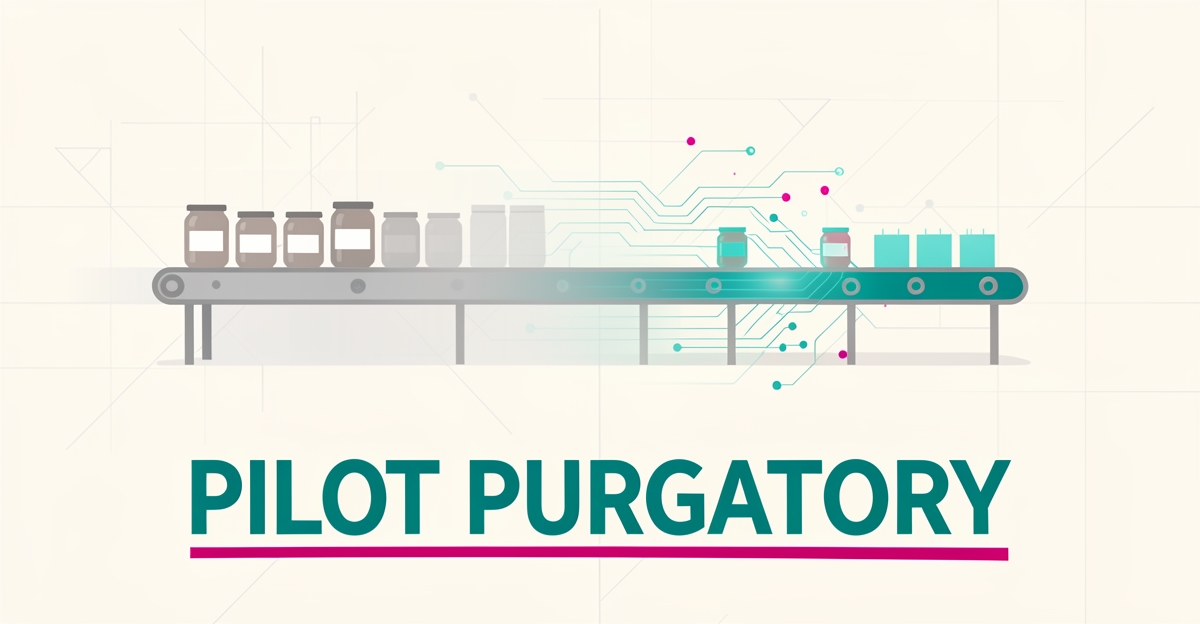
The result is pilot purgatory: impressive demos that cannot survive real production variability, compliance pressure, or multi-site standardization. Manufacturers who avoid this trap start where data already exists, such as demand forecasting and inventory, and build phased rollouts from point solutions to integrated systems.
This is where a contrarian approach matters. Instead of chasing the latest generative model, successful programs treat AI as an operational integration problem first. AIQ Labs works with specialty manufacturers to map existing workflows, assess data readiness, and design phased implementation roadmaps that prioritize decision-grade intelligence over generic chat. For a single high-cost workflow, a fixed-price AI Workflow Build is often the fastest way to prove value.
When AI is anchored in proprietary data, integrated with MES and ERP, and governed for food safety compliance, pilots move from curiosity to measurable margin. The shift is from buying a tool to building a system that learns the plant’s specific quirks and scales with it.
From Generic AI to Decision-Grade Intelligence: What Actually Works in Food Production
Generic LLMs sound authoritative in food manufacturing, but that confidence masks a dangerous gap between plausible language and production reality. When decisions affect safety, margins and compliance, hallucination-prone tools create risk rather than value.
Decision-grade intelligence starts with data that is proprietary, verifiable and operationally grounded. Generic models trained on broad internet text lack verifiable sourcing, historical context and the nuance to distinguish quick-service economics from fine dining or regional ingredient availability. That illusion of insight is a key reason MIT-cited research finds the overwhelming majority of enterprise generative AI pilots deliver no measurable P&L impact.
Specialized systems built for food production integrate directly with Manufacturing Execution Systems and Enterprise Resource Planning platforms, feeding on sensor data, batch records and quality logs rather than web summaries. The result is verifiable sourcing and audit trails that stand up to FSMA 204 and internal reviews, not confident guesses.
Where generic AI falters, industry-specific AI delivers measurable operational gains. Predictive maintenance models analyze vibration, temperature and pressure signals to flag failures before they stop a line. Food manufacturers using these platforms typically report substantial reductions in emergency maintenance spend and unplanned downtime within the first year.
Quality control shows the same divide. Manual inspection misses a meaningful share of defects and accuracy degrades noticeably after extended continuous monitoring. Modern AI inspection systems can achieve 99%+ detection accuracy at high line speeds, classifying dozens of defect categories consistently across shifts.
Decision-grade AI in food production typically includes:
- Proprietary data pipelines with asset-level governance and automated quality checks
- Integration with MES, ERP and CMMS for real-time, closed-loop actions
- Longitudinal historical context for demand, trends and equipment behavior
- Human-in-the-loop guardrails for safety, compliance and escalation
This shift from generic chat to operational intelligence is why phased, process-mapped implementation matters. AIQ Labs approaches AI strategy and transformation consulting with that reality in mind, focusing on high-impact operational areas first and building data readiness before scale.
The payoff is not theoretical. With a large share of equipment failures detectable days before they occur, manufacturers can move from reactive repairs to planned maintenance, protecting both output and brand trust.
A Phased, Integrated Roadmap to AI Success: Avoiding Fragmentation and Building for Scale
The difference between the manufacturers who successfully scale AI and the rest isn't superior technology, it's a disciplined, phased implementation strategy that respects the complexity of food production. While most organizations rush to deploy comprehensive solutions, the winners treat AI adoption as an engineering project, not a software purchase.
Success begins with AI-ready data pipelines. Gartner has predicted that a majority of AI projects will be abandoned due to poor data foundations, and food manufacturers are particularly vulnerable with critical information trapped on clipboards and siloed spreadsheets. Before deploying any algorithms, you must connect ERP, MES, and IoT sensors into unified data lakes with continuous validation.
Rather than attempting a full operational overhaul, start with targeted point solutions that deliver rapid validation. Vision inspection systems and predictive maintenance tools typically deploy in weeks, compared to a year or more for comprehensive platforms. These focused implementations generate early ROI, such as meaningful reductions in emergency maintenance spend reported by early adopters, while establishing the data infrastructure for broader scaling.
As these pilots mature, integrate them with your existing MES and ERP systems to create a unified operational layer. This phased approach avoids the fragmentation that kills most initiatives:
- Digitize and standardize data collection from production lines, quality checks, and inventory systems
- Deploy specialized point solutions for high-impact areas like predictive maintenance or vision-based quality control
- Integrate these tools with existing MES/ERP platforms to eliminate data silos
- Scale to a comprehensive AI operating system only after validating data integrity and workflow compatibility
Throughout this journey, maintain human-in-the-loop oversight. Most consumers continue to insist on human supervision of AI systems, so your implementation must augment, not replace, operator expertise. Ensure every automated decision includes audit trails compliant with FSMA 204 requirements, transforming compliance from a manual burden into an automated byproduct of your data architecture.
AIQ Labs structures client engagements around this exact methodology, beginning with targeted workflow fixes that prove value in weeks before expanding to department-wide systems. Where the goal is a fully connected plant, an AI Operating System is built in phases and owned outright, not rented. And where the bottleneck is staffing rather than systems, managed AI Employees handle roles like dispatch, scheduling, and customer follow-up at a fraction of a human hire's cost. By respecting the sequence of data readiness, point solution validation, and gradual integration, manufacturers avoid the pilot purgatory that claims most AI investments.
Still paying for 10+ subscriptions that don’t talk to each other?
We build custom AI systems you own outright. No vendor lock-in. Full control.
Not sure where to start? Ask our AI planner
Frequently Asked Questions
Why do most AI pilots in specialty food manufacturing never scale?
What makes generic AI risky for food production decisions?
How bad is the data readiness problem in food plants?
What is decision-grade intelligence and why does it matter?
How fast can we see ROI with a focused AI point solution?
Should we start with a full AI operating system or a smaller pilot?
From Pilot Purgatory to Production-Grade Profit
The gap between AI investment and impact in specialty food manufacturing isn’t a technology problem, it’s a readiness problem. Pilots stall when generic tools meet fragmented data on clipboards and siloed MES/ERP systems, while most enterprise generative AI pilots deliver no measurable P&L impact. The manufacturers who scale start with proprietary, decision-grade intelligence: clean data pipelines, process-mapped workflows, and specialized point solutions for predictive maintenance and vision-based quality control that integrate with existing systems and comply with FSMA 204. Avoiding pilot purgatory means treating AI as an operational integration project first, not a software purchase. Map where data already lives, validate with high-impact point solutions in weeks, then build toward a unified operating layer with human-in-the-loop guardrails. That phased discipline is how AI moves from demo to margin. If you’re assessing where your plant sits on that curve, start with a clear-eyed fit check. AIQ Labs offers a free 30-Minute Strategy Call to map your biggest bottleneck and identify high-ROI automation opportunities, with no obligation and no sales pitch. Start the Fit Check to see if there’s a clear win for your operation, or reach us at [email protected].
Make AI your competitive advantage — not just another tool.
Strategy, implementation and ongoing optimization. One partner, end to end.
Not sure where to start? Ask our AI planner