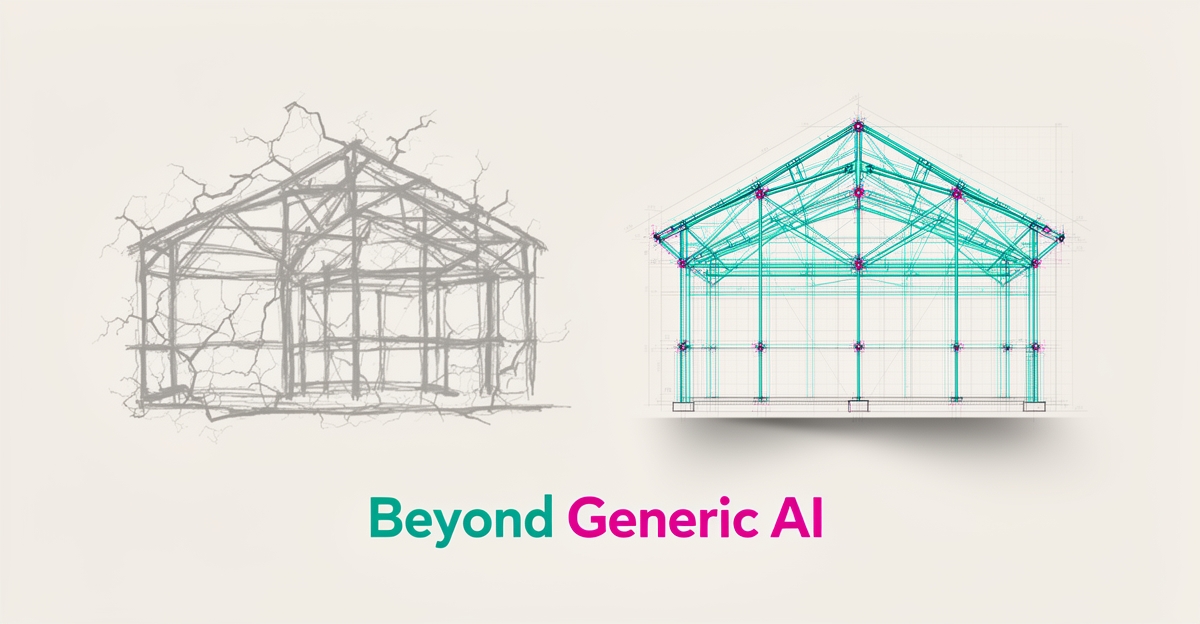
Why Structural Engineering Firms Should Avoid Off-the-Shelf AI Tools
Key Facts
- Generic AI tools can typically reclaim several hours per week on routine work like report drafting for structural engineers according to AI tools analysis.
- Specialized structural design tools have reported meaningful reductions in concrete volume and design time in industry testing per civil engineering tool analysis.
- Domain-specific platforms can produce preliminary structural designs in roughly 30 minutes from best AI tools coverage.
- No AI system currently bears legal liability for structural failures per AI exposure research.
- A large share of structural design documentation work has significant automation potential according to AI changing work analysis.
Hire a team member that works 24/7 — for less than a part-time wage.
AI receptionists, SDRs, dispatchers and 99+ roles. Trained on your business, fully managed.
Not sure where to start? Ask our AI planner
The Illusion of Efficiency: Why Generic AI Fails Structural Engineering
Off-the-shelf AI tools promise efficiency but deliver only the illusion of it for structural engineering firms. While they can reclaim several hours per week on routine tasks like drafting reports or generating code snippets, they lack the domain-specific knowledge required for safety-critical work. This gap becomes dangerous when engineers rely on these tools for calculations that demand code compliance and structural integrity.
Generic AI assistants like ChatGPT or GitHub Copilot are designed for broad productivity, not engineering precision. They cannot interpret complex loading conditions, validate seismic designs, or optimize connections against evolving building codes. As a result, they often produce plausible but technically incorrect outputs—answers that sound authoritative yet violate fundamental engineering principles. In a field where a single miscalculation can lead to catastrophic failure, this risk is unacceptable.
The consequences extend beyond technical inaccuracy to significant liability exposure. No AI system currently bears legal responsibility for structural failures; the burden falls entirely on the licensed engineer who signs off on the work. When off-the-shelf tools generate flawed recommendations, engineers must still verify every output manually—negating any time savings and increasing the chance of oversight. This creates a false sense of efficiency that actually heightens risk.
Specialized tools built for structural engineering avoid these pitfalls by embedding domain knowledge directly into their architecture. Platforms like Daisy.AI and Structure Pal are engineered to handle timber design, concrete optimization, and steel detailing with built-in code awareness and integration into professional software like STAAD Pro and AutoCAD. Industry testing has reported meaningful reductions in design time and material use—benefits generic tools cannot match because they lack the underlying engineering logic.
For firms seeking real efficiency without compromising safety, the path forward is clear: invest in AI systems designed for the unique demands of structural engineering. Custom-built solutions, trained on firm-specific workflows and validated against industry standards, deliver the accuracy and accountability that off-the-shelf tools inherently lack. In a profession where judgment and liability are inseparable, only purpose-built AI can augment—not undermine—the engineer’s critical role. Schedule a free 30-minute strategy call to explore how AIQ Labs develops domain-specific AI systems that enhance productivity while preserving compliance and reducing liability risk.
The Specialized Alternative: How Industry-Built AI Delivers Real Engineering Value
Off-the-shelf AI can write reports, but it cannot be trusted with load paths. For structural engineering, real value comes from systems built around codes, software and liability, not generic chat.
Industry-built tools are purpose-built for the discipline. Daisy.AI is specifically for timber structural design and can turn an empty floor plan into a production-ready structural timber floor design in roughly 30 minutes. Specialized engineering coverage shows similar speed for concrete, with Structure Pal delivering optimal preliminary designs in around 30 minutes.
The gains are measurable and repeatable. Structure Pal is designed specifically for civil and structural engineers to eliminate overdesign in concrete structures, with reported average reductions in concrete volume of around 15%. Civil engineering tool analysis reports design time cuts of up to 50% and cost savings in the same range. Daisy.AI has reported construction cost reductions of up to 10%. Best AI tools for structural design
These tools augment rather than replace engineering judgment. The automation eliminates the tedious parts of design — while amplifying the parts that require engineering judgment. Research on AI exposure in structural engineering confirms the profession sits in an augmentation zone, with no AI system currently bearing legal liability for structural failures. AI and structural engineering liability analysis
Specialized AI integrates where work actually happens. Unlike generic assistants, domain-specific systems connect to the modeling and analysis stack engineers already use.
- Software integration: Structure Pal integrates directly with AutoCAD and Robot Structural Analysis Pro
- Code-aware optimization: Structure Plus automatically optimizes designs for steel and concrete with ductile detailing support
- Connection libraries: Pathw.AI provides a library of pre-designed steel connections compatible with STAAD Pro, SAP2000 and RFEM
Generic tools can reclaim several hours per week on routine work for an experienced structural engineer. AI tools for structural engineers That productivity is useful, but it does not deliver code-compliant, liability-ready designs.
This is why vendor selection matters in technical fields. AIQ Labs helps firms evaluate build-versus-buy decisions through its AI Workflow Builds service—rebuilding the one workflow that costs the most, at a fixed price, in phases—so firms adopt purpose-built systems instead of off-the-shelf models that compromise accuracy and compliance.
The shift is clear. Firms that adopt purpose-built AI reduce material use, compress design cycles and keep a licensed engineer in control of every decision.
Why Custom AI Systems Are the Only Viable Path Forward for Firms
Off-the-shelf AI tools, even those marketed as "specialized" for engineering, fall short when structural engineering firms need systems that integrate deeply into their workflows and adapt to evolving project demands. Generic tools like GitHub Copilot or ChatGPT may reclaim several hours per week on routine tasks such as report writing or code generation, but they lack the domain-specific knowledge to handle code-compliant calculations or safety-critical design decisions. As research confirms, no AI system bears legal liability for structural failures, meaning firms remain fully responsible for verifying any output—making unverified generic outputs a significant risk. Industry analysis emphasizes that human judgment remains irreplaceable for complex, non-routine projects, such as seismic renovations or unusual loading conditions, where AI’s limitations become critical.
Custom-built AI systems, by contrast, are engineered to align with a firm’s exact processes, regulatory requirements, and liability frameworks. Unlike off-the-shelf tools that require engineers to constantly validate and correct outputs, custom systems embed structural engineering principles, code libraries, and workflow logic directly into their architecture. This ensures outputs are not only accurate but also audit-ready and compliant from the start. Purpose-built tools like Structure Pal and Daisy.AI—built specifically for concrete and timber design—demonstrate how domain-specific AI can compress design cycles, reduce material use, and deliver production-ready preliminary designs in around 30 minutes. These gains are only possible when AI is purpose-built for the task, not adapted from a general-purpose model. Evidence from industry-specific tools shows they integrate natively with platforms like STAAD Pro, SAP2000, and AutoCAD, eliminating the friction of manual data transfer and enabling seamless workflow automation.
AIQ Labs’ approach delivers exactly this: owned, engineered systems that grow with the firm. Through AI Operating Systems, we build one connected operating layer for the firm in phases—using multi-agent frameworks, integrating with existing CRM, accounting, and project management tools, and embedding human-in-the-loop controls for critical decisions. Clients retain full ownership of the code, data, and intellectual property under our Own It Outright model, avoiding vendor lock-in while gaining a system that evolves alongside their practice. This is not about replacing engineers; it’s about augmenting their expertise with AI that understands the weight of their responsibility—literally and professionally. Research confirms that the most effective AI applications in structural engineering combine machine precision with human judgment, a balance only achievable through custom design. For firms seeking sustainable advantage, the path forward isn’t found in generic subscriptions—it’s in building AI that belongs to them.
Still paying for 10+ subscriptions that don’t talk to each other?
We build custom AI systems you own outright. No vendor lock-in. Full control.
Not sure where to start? Ask our AI planner
Frequently Asked Questions
Can off-the-shelf AI tools like ChatGPT be trusted for structural engineering calculations?
How much time do generic AI tools actually save structural engineers on routine tasks?
What measurable benefits do specialized AI tools like Structure Pal and Daisy.AI provide for structural engineering firms?
Why can't AI replace structural engineers, even with advanced tools?
How do custom-built AI systems differ from off-the-shelf tools in ensuring compliance and reducing risk?
Is it worth investing in custom AI development for a structural engineering firm, or should we stick with generic tools?
Building Smarter, Not Just Faster: The Right AI for Structural Engineering
The evidence is clear: off-the-shelf AI tools create a dangerous illusion of efficiency in structural engineering, where generic outputs may save time on routine tasks but introduce unacceptable risks in safety-critical work. True value comes not from broad productivity assistants, but from purpose-built systems like Daisy.AI and Structure Pal—engineered with domain knowledge, code awareness, and seamless integration into professional workflows. These tools deliver measurable gains in design speed and material efficiency, all while keeping licensed engineers in control of judgment and liability. For firms ready to move beyond generic tools and invest in AI that understands the weight of their responsibility, the next step is a focused conversation. Schedule a free 30-minute strategy call to explore how AIQ Labs develops custom AI systems that enhance productivity, ensure compliance, and reduce risk—without compromising the engineer’s essential role.
Make AI your competitive advantage — not just another tool.
Strategy, implementation and ongoing optimization. One partner, end to end.
Not sure where to start? Ask our AI planner