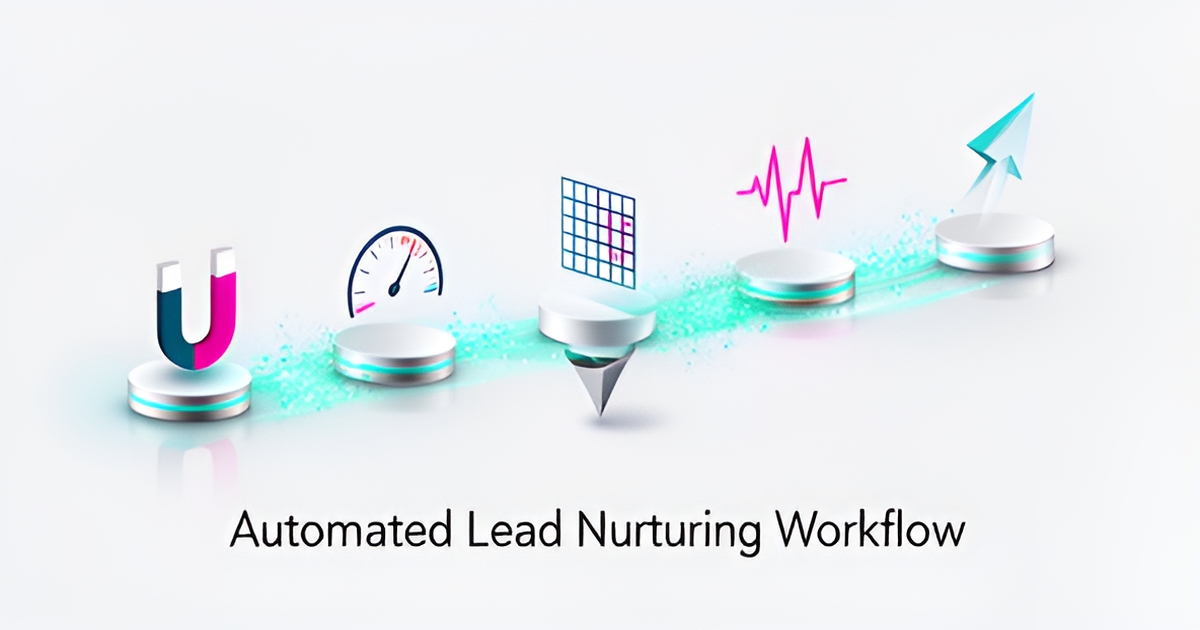
Automated Lead Nurturing AI Workflow Overview
Key Facts
- Sales reps spend 60% of their week on nonselling work, their biggest challenge is time, not skill, per Salesforce's State of Sales research.
- 75% of businesses have adopted AI lead scoring, reporting an average 25% improvement in conversion rates across finance, SaaS, and insurance.
- AI-powered nurture delivers 45% higher engagement rates and 30% faster pipeline velocity than traditional drip campaigns, per Forrester's 2026 B2B Marketing Automation report.
- Progressive Insurance used AI to identify hot leads with 90% accuracy, generating $2 billion in new premiums in a single year.
- A peer-reviewed AI prospecting system achieved roughly 90% precision and recall in lead qualification, with F1 scores improving from 0.77 to 0.92.
- HES FinTech processed 40% more loans per week after adopting AI lead scoring, while a FinTech startup saw 215% more qualified leads.
- Companies excelling at lead nurturing generate 50% more sales-ready leads at 33% lower cost per lead, according to Madison Logic data.
One AI employee doing one job, 24/7, for less than a part-time wage.
Receptionist, lead follow-up, intake or dispatch. Trained on your business and fully managed. From $700/mo.
Why Most Lead Nurturing Still Fails: Static Rules, Leaky Funnels, and Wasted Rep Time
Every lead gets the same five-email drip, regardless of what they actually did. That's the quiet failure at the heart of most nurturing programs: traditional campaigns treat every lead identically, ignoring industry context, buyer role, and real-time engagement signals, as Tofu HQ's analysis of AI nurture tools points out. The "whitepaper download = sequence A" model was built for a buying process that no longer exists.
Meanwhile, your sales team pays the price. According to Salesforce's State of Sales research, reps spend 60% of their average week on nonselling work like data entry and planning. Salesforce puts it bluntly: the greatest challenge for reps isn't a lack of skill or drive to win, it's a lack of time. When nurturing fails upstream, that lost time compounds.
The tooling makes it worse. Most companies stack point solutions that each handle one slice of the funnel: a form for capture, a scoring tool, a drip platform, a sales engagement app. A peer-reviewed study of AI prospecting systems found that existing tools "address only parts of the problem" and that few offer a holistic, end-to-end solution (PMC). Every seam between those tools is a place where leads leak.
The marketing-to-sales handoff is where most programs break down completely. Tofu HQ identifies it as a critical nurture stage, with marketing automation handling top and mid-funnel while separate sales engagement platforms manage MQLs and stalled opportunities. Salesforce agrees, noting that successful automation depends on coordinated sales and marketing efforts and alignment on a lead scoring plan. When those two systems don't share context, hot leads go cold in the gap.
The cost of staying static is measurable. AI-powered nurture delivers 45% higher engagement rates and 30% faster pipeline velocity than traditional drip campaigns, per Forrester's 2026 B2B Marketing Automation report (cited by Tofu HQ). And 75% of businesses have already adopted AI lead scoring, with an average 25% conversion improvement (SmartLead). The gap between static and adaptive programs is widening, not closing.
This is the problem AIQ Labs built its lead nurturing workflow to solve: one connected system that moves prospects from capture through scoring, segmentation, and personalized nurture into a sales handoff with full context intact, so reps spend their time selling instead of reconstructing what happened.
The Five-Stage AI Lead Nurturing Workflow: Capture, Score, Segment, Nurture, Hand Off
Ask ten vendors how to automate lead nurturing and you'll get the same answer. That's a good thing, because when vendor frameworks and peer-reviewed research converge on one architecture, you can trust it. Both Salesforce's lead nurturing guidance and the peer-reviewed Scrapus paper describe the same five-stage pipeline: capture, score, segment, nurture, hand off.
Stage 1: Capture. Every workflow starts with clean data. Salesforce is blunt about this: "AI systems are only as good as the data they're trained on, so having clean, accurate CRM data is critical." The Scrapus system demonstrates what modern capture looks like, crawling the open web and extracting lead intelligence with roughly 90% precision and recall in qualification.
Stage 2: Score. This is where AI earns its keep. Static rules assign points mechanically; predictive models find patterns humans miss. The results are documented: 75% of businesses have adopted AI lead scoring, with an average 25% improvement in conversion rates, according to a compilation of case studies spanning finance, SaaS, and insurance.
Stage 3: Segment. Instead of fixed lists, AI segments dynamically based on industry, buyer role, account stage, and real-time engagement. The segment a lead sits in can change this afternoon based on what they did this morning.
Stage 4: Nurture. Here's the core shift. Salesforce describes it as replacing predefined workflows ("whitepaper download = sequence A") with fluid, behavior-responsive nurturing. The payoff is measurable. A Forrester 2026 B2B Marketing Automation report found AI-powered nurture delivers 45% higher engagement rates and 30% faster pipeline velocity than traditional drip campaigns.
Stage 5: Hand off. Both Salesforce and Tofu HQ flag the marketing-to-sales transition as the stage where programs most often fail. A good system routes leads with context: what they engaged with, their score trajectory, and what to say first.
This is the architecture we build at AIQ Labs when we rebuild a lead follow-up workflow end to end: capture through scoring through personalized nurture through CRM handoff, with the client owning the whole system. The five stages are the standard. The difference is whether your system actually responds to behavior, or just schedules emails.
What the Numbers Show in Finance: Documented Results from AI Lead Scoring and Nurturing
Finance is where AI lead nurturing has its receipts. While other industries debate whether the technology works, lenders, insurers, and FinTech companies have already published the numbers.
The documented case studies are hard to argue with. HES FinTech processed 40% more loans per week after adopting AI lead scoring. An unnamed FinTech startup saw a 215% increase in qualified leads. ProPair delivered 46% more sales for mortgage lenders, lifting conversion rates from 1.7% under traditional methods to 2.5% in a Q2 2024 study. Progressive Insurance went further still, using AI to identify hot leads with 90% accuracy and generating $2 billion in new premiums in a single year.
Here's the finance-sector scoreboard at a glance:
- HES FinTech: 40% more loans processed per week
- FinTech startup: 215% increase in qualified leads
- ProPair (mortgage lenders): 46% more sales, with conversion climbing from 1.7% to 2.5%
- Progressive Insurance: 90% accuracy identifying hot leads, $2 billion in new premiums in one year
These aren't outliers. According to the same research, 75% of businesses have now adopted AI lead scoring, and adopters report an average 25% improvement in conversion rates. Finance simply shows the effect more clearly because its sales cycles are measurable and its lead volumes are large.
The academic evidence backs the vendor claims. A peer-reviewed study of Scrapus, an end-to-end AI lead qualification pipeline, measured roughly 90% precision and recall in lead qualification, with F1 scores improving from about 0.77 to 0.92 through transformer-based NLP. That's the technical floor under the commercial results: modern models genuinely can tell a good lead from a bad one at scale.
One mortgage executive, Dan Stevens of NBKC Bank, put the shift plainly: "We look back at our pre-ProPair days and wonder why we relied on gut feelings for such big decisions." That's the real change. AI scoring replaces intuition with behavioral evidence.
This is the benchmark context AIQ Labs works against when building lead scoring and nurturing workflows for finance clients. The results above came from systems doing what the five-stage workflow does: capturing data, scoring it intelligently, and routing the right prospects to the right people at the right moment. The bar is set, and the data says it's reachable.
How AIQ Labs Builds It End-to-End: One Connected System from Capture to Conversion
Most lead nurturing stacks are a patchwork: one tool finds leads, another scores them, a third sends emails, and a human manually bridges the gaps. That fragmentation is exactly what the research flags. A peer-reviewed analysis of AI prospecting tools notes that existing platforms "address only parts of the problem" and that few offer a holistic, end-to-end solution that captures, qualifies, and acts on leads in one connected system.
AIQ Labs builds that connected system, mapping its capabilities onto the five stages the industry has converged on: capture, scoring, nurture, and handoff.
Stage 1: Capture. AI Lead Generation and Enrichment handles the top of the funnel with custom lead generation engines, automated web scraping against your ideal customer profile, and data enrichment and verification. This mirrors the academic pipeline (web crawling, information extraction, ICP matching) that achieved roughly 90% precision and recall in lead qualification, according to the published research.
Stage 2: Scoring. The Bespoke AI Lead Scoring System replaces gut-feel prioritization with predictive models trained on your own sales history, combining behavioral and demographic signals for real-time lead prioritization inside your CRM. This is the most documented high-impact stage in the industry: 75% of businesses have adopted AI lead scoring, with an average 25% improvement in conversion rates, per a case study compilation spanning finance, insurance, and SaaS.
Stage 3: Nurture. AI-Powered Sales Outreach Intelligence takes over mid-funnel with automated prospect research, personalized message generation, optimal timing recommendations, and objection handling scripts. The payoff of this adaptive approach is measurable. A Forrester 2026 B2B marketing automation report (cited by Tofu HQ) attributes 45% higher engagement rates and 30% faster pipeline velocity to AI-powered nurture versus traditional drip campaigns.
Stage 4: Handoff. AI Sales Call Automation closes the loop with natural-sounding outbound calling, qualification automation, direct calendar booking, and CRM documentation. This matters because both Salesforce and industry analysts identify the marketing-to-sales handoff as a critical stage where many programs fail.
What holds the whole thing together is how the build is delivered. Depending on your needs, AIQ Labs can rebuild a single broken workflow through an AI Workflow Build, deploy a managed AI Employee (an AI SDR or Lead Qualifier, for example) on a monthly plan, or construct a full AI Operating System that connects intake, communication, scheduling, and reporting in one layer you own outright. Clients keep full ownership of the code, agents, and data, so there's no vendor lock-in.
Safety is engineered in rather than bolted on. Every action passes through validation layers before execution, guardrails set hard limits per role, and human-in-the-loop escalation triggers when a situation exceeds the AI's authority. Complete audit trails support compliance review, which matters especially in finance and payment contexts.
One system, five stages, from first touch to booked appointment. That's the difference between a stack of point tools and a workflow that actually converts.
Ready to see where your lead flow breaks? Start the two-minute Fit Check at aiqlabs.ai/apply, then book a free 30-minute strategy call at aiqlabs.ai/book to map your biggest bottleneck with an AI engineer. If there isn't a clear win, we'll tell you that too.
Getting Started: Prove It on One Workflow Before You Scale
The biggest mistake businesses make with AI lead nurturing is trying to automate everything at once. The evidence says start smaller. Companies that excel at lead nurturing generate 50% more sales-ready leads at 33% lower cost per lead, according to Madison Logic data, but those results come from a focused, well-built workflow, not a sprawling half-finished rollout.
That's why the smartest path is to prove the concept on one broken follow-up process before you scale. Pick the single workflow that costs you the most, usually the leads that come in and never get a second touch, and rebuild just that one. Salesforce puts it plainly: successful lead nurturing automation depends on clean data, strategic segmentation, and alignment on a lead scoring plan, so getting one workflow right teaches you what your data and team actually need before you expand.
AIQ Labs structures this proof-first approach around three ways to pay, so you can match the investment to your confidence level:
- Start Monthly: deploy a single AI Employee, like an AI SDR or Lead Qualifier, on a flat monthly plan that costs less than a part-time hire, with build, training, integrations, and monitoring included. Pause or adjust anytime.
- Build in Milestones: rebuild one broken follow-up workflow in phases, approving and paying for each phase as it ships. Stop anytime and keep everything built so far.
- Own It Outright: commission a full lead-to-revenue operating system with one project price, taking full ownership of the code, agents, and data when complete.
The timeline matters as much as the model. Discovery and architecture typically run 1 to 2 weeks, where the team maps your process, assesses your data infrastructure, and designs the solution. Development and integration take 4 to 12 weeks depending on complexity. That second phase is where clean CRM data becomes non-negotiable. As Salesforce notes, AI systems are only as good as the data they're trained on, so a messy CRM will undermine even the best-built agent.
One more reason to start narrow: the results compound. Businesses that adopted AI lead scoring saw an average 25% improvement in conversion rates, and finance-sector cases show what's possible when the workflow is dialed in, from a FinTech startup's 215% increase in qualified leads to HES FinTech's 40% more loans per week (SmartLead case studies). You don't get there by automating five workflows badly. You get there by automating one workflow well, then scaling what works.
If you want to see whether this fits your business, start with the two-minute Fit Check at aiqlabs.ai/apply. It leads to a free 30-minute strategy call with an AI engineer, not a sales pitch. If there isn't a clear win, they'll tell you that too.
Still paying for 10+ subscriptions that don’t talk to each other?
We build connected AI systems you own. Pay upfront or on a payment plan; the code is yours once it’s paid off.
Frequently Asked Questions
Why do most lead nurturing programs fail even when companies use automation tools?
What does an AI lead nurturing workflow actually look like?
How much better is AI-powered nurture compared to traditional drip campaigns?
What results have finance companies actually seen from AI lead scoring?
Where do most lead nurturing programs break down?
Should I automate all my lead nurturing at once or start with one workflow?
Your Next Lead Deserves Better Than Sequence A
The pattern across this article is hard to ignore: static drip campaigns treat every lead the same, reps lose most of their week to nonselling work, and the seams between point tools are where your hottest leads go cold. Meanwhile, the results from connected, behavior-responsive systems keep stacking up, 75% of businesses have adopted AI lead scoring, with an average 25% improvement in conversion rates, and finance companies like HES FinTech and Progressive Insurance have published the receipts. The five-stage workflow, capture, score, segment, nurture, hand off, is the standard. The question is whether your system actually responds to what leads do, or just schedules emails. You don't need to automate everything at once. Pick the one follow-up workflow that costs you the most, rebuild it properly, and scale what works. AIQ Labs builds these systems end to end, and you own what's built. Start with the two-minute Fit Check at aiqlabs.ai/apply, then book a free 30-minute strategy call with an AI engineer to map your biggest bottleneck. If there isn't a clear win, we'll tell you that too.
See what AI would actually do in your business, in 60 seconds.
The planner shows which step fits, the agents we’d build and the published price. No email needed.