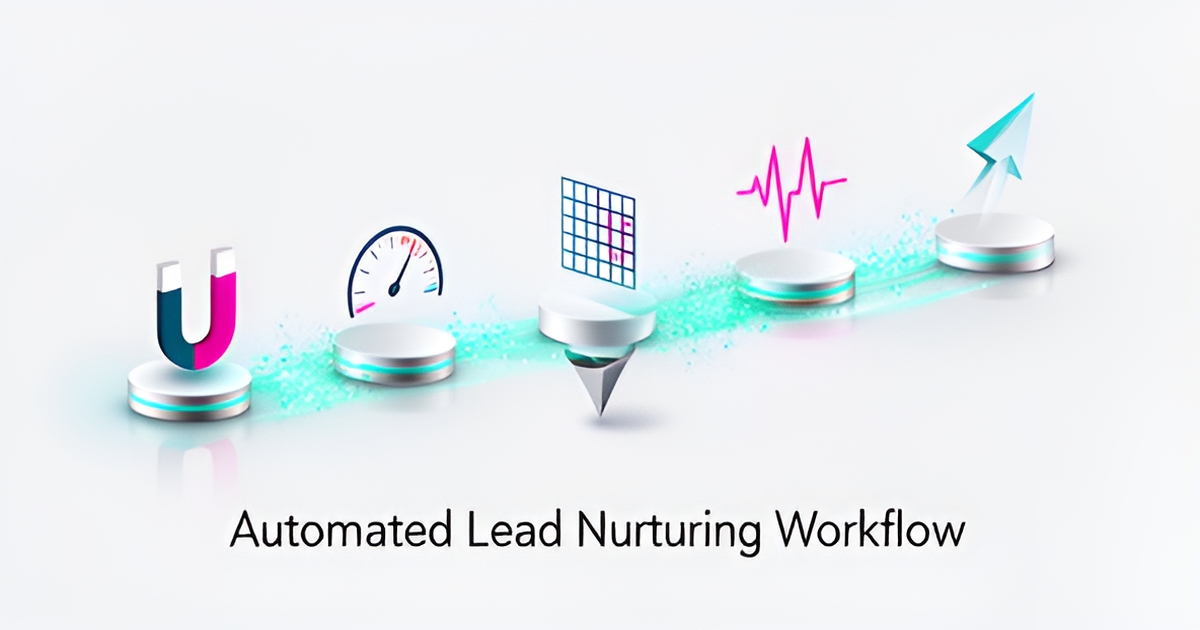
Automated Lead Nurturing AI Workflow Overview
Key Facts
- Most AI lead-gen tools handle fragments of the pipeline; peer-reviewed research finds few offer end-to-end solutions.
- Teams stitching together 2–3 AI lead tools still see 50% email bounce rates and sub-2% reply rates.
- Leads contacted within five minutes convert up to 9x better, per practitioner nurture benchmarks.
- HES FinTech lifted weekly loan origination volume 40% using a predictive scoring model.
- Mortgage provider ProPair raised conversion from 1.7% to 2.5% with AI-driven lead assignment.
- IBM defines eight pipeline stages, from inbound qualification to data enrichment, that complete AI SDR workflows must cover.
- Automated lead qualification hits roughly 90% precision and recall, per academic research.
One AI employee doing one job, 24/7, for less than a part-time wage.
Receptionist, lead follow-up, intake or dispatch. Trained on your business and fully managed. From $700/mo.
The End-to-End Gap: Why Stitched-Together Tools Fail Finance Teams
Most finance teams don't have a lead pipeline problem. They have a stitching problem: a CRM here, a dialer there, a payment system somewhere else, and a human being manually shuttling data between all three.
Peer-reviewed research backs this up. A study in Frontiers in Artificial Intelligence found that while existing tools "address parts of the problem through aggregated databases or keyword alerts, few offer a holistic, end-to-end solution" for automated lead pipelines. The market has plenty of point solutions. What it lacks is a pipeline that actually runs from first touch to funded loan without breaking in the middle.
Practitioner testing shows what happens when teams try to bridge that gap themselves. When Lindy evaluated leading AI lead generation tools, the testers concluded that "none of them did every job well (the ones claiming to do it all were usually the weakest at each one)," and that most sales teams end up combining two or three tools to cover the full process. One SaaS team they spoke with was paying for four separate tools and still seeing roughly 50% email bounce rates with reply rates below 2%. More tools, more spend, worse outcomes.
For finance teams specifically, the fragmentation costs show up in three predictable places:
- Missed after-hours calls. Loan inquiries don't arrive on a 9-to-5 schedule, and leads contacted within the five-minute window convert at dramatically higher rates, per practitioner benchmarks. A voicemail box can't hit that window.
- Slow lead-to-loan-offer cycles. When qualification, scoring, and follow-up live in separate tools, each handoff adds delay. Gartner-cited research on AI lead scoring reports a 25% reduction in sales cycle length when scoring is handled intelligently in one flow.
- Manual re-entry between CRM, dialer, and payment systems. Every copy-paste between platforms is a chance to lose context, mistype a figure, or drop a hot lead entirely.
The finance stakes are real. HES FinTech increased weekly loan origination volume by 40% with a predictive model, and mortgage provider ProPair lifted conversion from 1.7% to 2.5% using AI-driven lead assignment, according to documented case studies. Those gains came from better prioritization within a connected process, not from bolting another tool onto the stack.
This is precisely the gap an end-to-end workflow is built to close. AIQ Labs approaches it as a single connected system: one workflow that captures the lead, responds instantly, qualifies, nurtures across channels, and hands off to conversion with the CRM, calendar, and payment integrations already wired in. No stitched-together vendors pointing fingers at each other when a lead falls through the cracks, because there are no cracks.
The Capture-to-Conversion Pipeline: Eight Stages, One System
Most lead nurturing stacks break somewhere between capture and conversion. IBM's breakdown of AI SDR workflows names eight stages that a complete pipeline has to cover: inbound qualification, outbound prospecting, lead nurturing, multi-channel engagement, meeting scheduling, follow-up management, pipeline handoff, and data enrichment. Miss one, and deals leak out of the funnel.
That gap is well documented. Peer-reviewed research in Frontiers in Artificial Intelligence found that most tools handle fragments of the problem and few offer a holistic, end-to-end solution. A vendor roundup testing AI lead generation tools reached the same conclusion from the opposite direction: platforms claiming to do everything were usually the weakest at each job, so teams end up stitching together two or three tools to cover one pipeline.
The cost of that fragmentation shows up in response time. Practitioner benchmarks put the critical reply window at five minutes, with fast responders converting at roughly nine times the rate of slow ones, and 80% of sales requiring five or more touches before a close. Point tools stitched together rarely clear that bar, especially after hours.
AIQ Labs approaches the same eight stages as one connected system rather than a stack. Each stage maps to a defined AI Employee role:
- Inbound qualification and outbound prospecting run through AI SDR and AI Lead Qualifier roles
- Lead nurturing and multi-channel engagement cover email, SMS, chat, and voice from a single agent
- Meeting scheduling and follow-up management connect directly to calendars and CRM records
- Pipeline handoff escalates qualified conversations to your human team with full context attached
- Data enrichment keeps contact records current instead of decaying in a static list
The architecture behind those roles is multi-agent by design. Specialized agents handle research, communication, and data entry, while validation layers and human-in-the-loop escalation keep a person in control of decisions that exceed the AI's authority.
Speed-to-reply is where the design pays off. IBM notes that AI SDRs engage thousands of leads at once and operate continuously without breaks, and that buyers now expect fast, relevant responses from the first touchpoint. That always-on coverage is what makes a five-minute reply window realistic at 2 a.m. on a Sunday, not just during business hours.
The finance sector already shows what this looks like in practice. HES FinTech lifted weekly loan origination volume by 40% with a predictive scoring model, and ProPair pushed mortgage conversion rates from 1.7% to 2.5%. Both results came from scoring and routing leads intelligently, which is exactly what the enrichment and handoff stages exist to do.
If you want to see where your own pipeline leaks, start with the two-minute Fit Check at aiqlabs.ai/apply, then book a free 30-minute strategy call to map the bottleneck and the highest-ROI fix.
Finance-Specific Proof: What AI Lead Scoring Actually Delivers
Generic conversion claims are easy to find. Finance-sector numbers are harder to come by, and they're the ones that actually matter when payments, collections, and compliance are on the line. Here's what the documented cases show.
HES FinTech, a lending software provider, reports a 40% increase in weekly loan origination volume after deploying a predictive scoring model with a Gini index of 0.6. That's a lending operation, not a SaaS marketing team, which makes the number more relevant to finance payment workflows.
ProPair's mortgage case is even more concrete. Conversion rates rose from 1.7% to 2.5%, a 46% improvement over traditional lead distribution, and NBKC Bank's team later said they "look back at our pre-ProPair days and wonder why we relied on gut feelings for such big decisions." The biggest number in the set: Progressive Insurance generated $2 billion in new premiums in one year from an ML-enabled app feature that identified hot leads with 90% accuracy.
What these cases point to, in practical terms:
- Scoring quality matters more than volume. A model with real predictive power (HES FinTech's 0.6 Gini) changes who gets called first, not just how many calls happen.
- Small conversion deltas compound. Moving from 1.7% to 2.5% sounds modest until you apply it to a full pipeline of mortgage inquiries.
- The downstream workflow does the earning. Identifying a hot lead only pays off if the follow-up, payment arrangement, and handoff actually happen.
That last point is where AIQ Labs' finance roles fit. Its AI Collections Agent, AI Accounts Receivable Clerk, and AI Payment Agent handle the post-qualification work that finance teams usually lose leads on: payment arrangement negotiation, receivables follow-up, and payment processing. The company's AI Collections & Voice Platform runs compliant, multi-channel outreach (voice, SMS, email) with full audit trails, which matters in a regulated context where a sloppy follow-up sequence creates legal risk, not just lost revenue.
One honest caveat: these case-study figures are vendor-reported, and most come from promotional sources rather than peer-reviewed research. Read them as directional evidence, not guaranteed outcomes. The pattern across HES FinTech, ProPair, and Progressive is consistent enough to take seriously, but your results will depend on your data quality, your follow-up speed, and how well the scoring model is trained on your actual sales history. Treat the numbers as a reason to test, not a promise to bank on.
How the Workflow Runs in Practice: A 14-Day Nurture Cadence
Speed is where nurture workflows live or die. Leads contacted within five minutes convert dramatically better, and most sales need five or more touches before they close, which is exactly why a structured cadence beats ad-hoc follow-up (practitioner benchmarks suggest fast responders see up to 9x higher conversion).
Here's how a 14-day cadence actually runs, using the Digital Applied framework:
- Day 0 (Welcome): Instant personalized response the moment a lead is captured, confirming receipt and setting expectations for what comes next.
- Days 1–7 (Nurture): A structured email sequence delivers value content, case proof, and gentle calls to action, with each touch informed by how the lead responded to the last one.
- Days 8–13 (Re-engagement): Non-responders get varied angles and channels. Open rates typically run 20–30%, so persistence matters.
- Day 14 (Final): A clear last-touch message that either books the meeting or gracefully parks the lead for a future cycle.
Running this cadence by hand for hundreds of leads doesn't scale. That's where AIQ Labs' system takes over. An AI SDR engages leads the moment they arrive, 24/7, qualifying and nurturing across channels before passing genuine opportunities to your human team, the same hybrid model IBM describes as the emerging standard: AI handles high-volume tasks while people focus on high-value conversations.
Underneath the cadence sits tiered scoring. Every interaction feeds a score that sorts leads into Hot (80–100), Warm (50–79), Cool (20–49), and Cold (below 20). The academic literature backs this precision: peer-reviewed research on automated lead qualification reports roughly 90% precision and recall. In finance specifically, the payoff is measurable, with HES FinTech lifting weekly loan origination 40% and mortgage provider ProPair moving conversion from 1.7% to 2.5% (sector case studies).
The common objection is control. Won't automation send the wrong message, or worse, book the wrong meeting? AIQ Labs addresses this with validation layers that check every action before it executes, guardrails that cap what the AI can do per role, and configurable human-in-the-loop escalation whenever a situation exceeds the AI's authority. Audit trails log everything for review.
You set the escalation rules. A Hot lead can route straight to a human closer; a payment dispute can require sign-off before any commitment is made. The system works the cadence relentlessly so your team spends its hours where judgment actually matters, and nothing goes out the door that you haven't defined the boundaries for.
Building It Right: Ownership, Integration, and Getting Started
Here's the practical question: how do you deploy an automated lead nurturing workflow without stitching together four subscriptions and hiring someone to babysit them? The tool roundup testing found that most point tools claiming to "do it all" were actually weakest at each individual job, and sales teams typically end up combining two or three tools to cover the full process. That's subscription sprawl plus integration overhead, before a single lead gets nurtured.
AIQ Labs takes a different path: one partner builds the whole workflow, and you choose how you pay for it. There are three models, matched to how much risk you want to carry up front.
- Start Monthly: one AI employee (like an AI Lead Qualifier or Appointment Setter) on a flat monthly plan that costs less than a part-time hire. The build, training, integrations, monitoring, and improvements are all included, and you can pause or adjust anytime.
- Build in Milestones: one workflow or department system split into phases. You approve and pay for each phase as it ships, and if you stop, you keep everything built so far.
- Own It Outright: a full AI operating system with complete ownership of the code, agents, and data when it's done. One project price or a monthly Build Partnership, your choice.
No fake price anchors. Real numbers come in writing after a free strategy call, along with the cheapest way to get the win you're after.
On the integration side, the workflow connects to the systems you already run. AIQ Labs builds deep two-way integrations with CRMs like HubSpot, Salesforce, and Pipedrive, payment processors like Stripe and Square, and communication platforms like Twilio and SendGrid. That matters because the whole point of an end-to-end workflow is that capture, qualification, nurture, and payment all live in one connected layer rather than four disconnected tabs. Peer-reviewed research backs the need: existing tools "address parts of the problem," but few offer a holistic, end-to-end solution for automated lead pipelines.
There's also a human-in-the-loop layer built in. Every action gets validated before execution, with configurable escalation when a situation exceeds what the AI should decide on its own. That mirrors where the industry is heading: IBM describes a hybrid model where AI handles high-volume tasks and humans focus on higher-value interactions.
If you want to see whether this fits your business, start with the two-minute Fit Check at aiqlabs.ai/apply, then book the free 30-minute strategy call. It's a working session with an AI engineer, not a sales pitch. If there isn't a clear win, they'll tell you that too.
Still paying for 10+ subscriptions that don’t talk to each other?
We build connected AI systems you own. Pay upfront or on a payment plan; the code is yours once it’s paid off.
Frequently Asked Questions
Why do stitched-together lead tools fail finance teams?
How fast does AI need to respond to a new lead for it to matter?
Does AI lead scoring actually work in finance, or is it just hype?
What does a complete lead nurturing workflow actually include?
How many follow-ups does it take before a lead converts?
Won't automation send the wrong message or book the wrong meeting?
From Fragmented Tools to a Connected Pipeline: Where to Start
Finance teams don't lose leads because they lack tools, they lose them because the tools don't talk to each other. Across the eight stages from capture to conversion, every disconnected handoff is a chance for a hot lead to cool, a voicemail to go unanswered, or a payment arrangement to stall. The documented gains in lending and mortgage, HES FinTech's 40% lift in weekly loan origination and ProPair's jump from 1.7% to 2.5% conversion, came from treating scoring, routing, and follow-up as one connected process, not from adding another subscription to the stack. The fastest way to find your own leak is to map the pipeline against those eight stages and ask where context breaks. AIQ Labs builds that end-to-end workflow as a single system, with finance-specific roles for collections, receivables, and payment processing wired in from day one. If you want a working diagnosis instead of a sales pitch, start with the two-minute Fit Check at aiqlabs.ai/apply, then book the free 30-minute strategy call to see where the highest-ROI fix actually lives.
See what AI would actually do in your business, in 60 seconds.
The planner shows which step fits, the agents we’d build and the published price. No email needed.