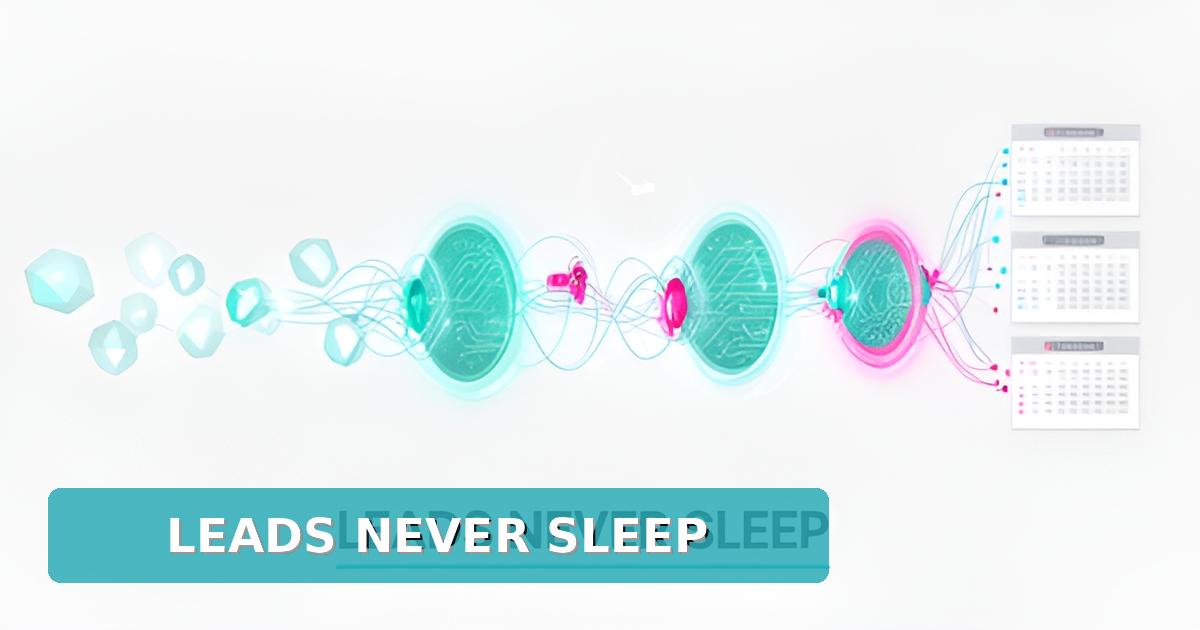
Automated Lead Nurturing AI Workflow Overview
Key Facts
- 78% of organizations used AI in 2024, up from 55% the year before per Stanford HAI.
- Marketing and sales is where AI most often generates revenue per McKinsey research.
- Nearly 75% of AI high performers redesign workflows rather than bolt AI onto existing ones per McKinsey.
- Inference costs for GPT-3.5-level performance dropped over 280-fold between 2022 and 2024 per Stanford HAI.
- 65% of consumers trust businesses using AI, but 36% disengage from AI-generated content per Menlo Ventures.
- Sales & Marketing is projected as the fastest-growing AI function segment through 2033 per Grand View Research.
- 40% of large enterprises now scale AI agents, while smaller organizations remain flat at 22% per McKinsey.
One AI employee doing one job, 24/7, for less than a part-time wage.
Receptionist, lead follow-up, intake or dispatch. Trained on your business and fully managed. From $700/mo.
Why Leads Go Cold: The Manual Follow-Up Problem
Picture this: a lead fills out your form at 2 p.m. on a Tuesday. By Friday, they've forgotten they did. Nobody called, nobody emailed, and the follow-up that could have converted them is sitting in a spreadsheet nobody opened. That's how most leads die, and it's rarely because the product wasn't right. It's because follow-up depends on manual data entry, memory, and whether someone happens to be free.
If that stings, you're not alone. One solopreneur describing their sales process on r/smallbusiness laid out the problem plainly: their CRM had a steep learning curve and demanded so much manual data entry that it pulled time away from actually selling. What they wanted was a system that was "mostly hands off" after setup. That's the real ask, and it's a reasonable one.
Here's the part that should concern you more than your own follow-up habits. The market has already moved. According to the 2025 AI Index Report from Stanford HAI, 78% of organizations reported using AI in 2024, up from 55% the year before. And the gains are concentrated exactly where you're weakest: McKinsey's research finds marketing and sales is the function where AI most often generates revenue.
But there's a widening gap inside those numbers. While 40% of large enterprises are now scaling AI agents, smaller organizations have stayed flat at roughly 20%. Translation: your bigger competitors are automating follow-up right now, and most small businesses are still doing it by hand.
Consider what manual follow-up actually costs you:
- Hours lost each week to copying lead details into a CRM instead of talking to prospects
- Leads contacted late, or never, because nobody remembered
- Inconsistent messaging, since every follow-up depends on who sends it and how busy they are
- Weekend and after-hours inquiries going cold because no one is available
McKinsey's research on AI high performers points to why patching this with another tool rarely works: the companies getting real results fundamentally redesign their workflows rather than bolting AI onto existing ones. Nearly three-quarters of high performers report doing exactly that.
The uncomfortable truth is that while you're manually typing lead details into a CRM, a competitor's automated system has already responded, qualified, and booked the job. That's not a hypothetical. It's what 24/7 AI follow-up looks like in practice, and it's why AIQ Labs builds end-to-end lead nurturing workflows that move prospects from capture to conversion without waiting on anyone's memory or availability.
The good news is the cost barrier has collapsed. Inference costs for GPT-3.5-level performance dropped more than 280-fold between November 2022 and October 2024, per the Stanford HAI report. The technology that enterprises use to never miss a lead is now priced for a five-person shop. The only question left is whether you deploy it before another lead goes cold.
What an End-to-End AI Nurturing Workflow Actually Looks Like
Most businesses treat AI as a plugin for their existing CRM. They bolt a chatbot onto Zoho or GoHighLevel and call it automation. This approach fails because it ignores the core workflow.
High performers understand a critical distinction. They fundamentally redesign workflows enabled by AI rather than inserting AI into legacy processes. McKinsey data shows nearly three-quarters of high performers redesign workflows, versus just one-quarter of others. You cannot optimize a broken process by adding speed to it. You must rebuild the process itself.
AIQ Labs builds these redesigned workflows from the ground up. We don’t add a layer to your existing stack. We replace the manual bottleneck with a multi-agent system. This architecture uses LangGraph to orchestrate specialized agents. Each agent handles a specific stage of the funnel.
Consider the capture-to-conversion flow.
- Capture and Scoring: Agents ingest leads from web forms, voice calls, and social channels. They score and qualify prospects in real-time using behavioral and demographic data.
- Multi-Channel Follow-Up: Managed AI Employees, such as AI SDRs and Appointment Setters, initiate contact via voice, SMS, and email. They maintain context across channels so the prospect never repeats their story.
- Booking and Sync: The system books calendar slots directly and syncs all interactions to your CRM. No manual data entry. No missed handoffs.
This is not a static script. It is a dynamic, stateful workflow. If a prospect hesitates, the AI Agent adapts its pitch. If they request a callback, the system schedules it and follows up. If the situation exceeds the AI’s authority, a human-in-the-loop escalation triggers immediately. This ensures precision where it matters most.
The market is moving this way for a reason. Recent analysis indicates that poor AI outcomes often stem from pilots that break down under real-world conditions. They fail because they remain poorly integrated into core processes. When you redesign the workflow, you eliminate the integration gap.
For finance and payment automation, this matters even more. Compliance and accuracy are non-negotiable. A bolted-on AI layer creates risk. A native workflow with validation layers and audit trails mitigates it. You get the speed of automation with the control of a structured process.
You don’t need to choose between human oversight and automated efficiency. You need a system that knows when to act and when to ask. That is the difference between a tool and a true digital employee.
Why Marketing and Sales Is Where AI Pays First
If you're deciding where to invest in AI first, the research points to one function more clearly than any other. Marketing and sales is where AI most often turns into actual revenue gains, and the market data backs that up with aggressive growth projections.
McKinsey's State of AI survey finds that marketing and sales is the function where AI most often generates revenue gains. Grand View Research projects Sales & Marketing as the fastest-growing AI function segment through 2033, with AI analyzing customer data to identify high-potential leads and personalize outreach at scale. For lead nurturing specifically, that's the bullseye.
The cost barrier that kept this out of reach for smaller businesses is collapsing fast. Stanford HAI's AI Index reports that inference costs for GPT-3.5-level performance dropped over 280-fold between November 2022 and October 2024. What used to require an enterprise AI budget now fits inside a monthly plan that costs less than a part-time hire.
But there's a trust line you can't cross. The research splits cleanly on this point:
- 65% of consumers trust businesses that use AI when it's deployed responsibly and transparently
- 36% of consumers disengage from content they recognize as obviously AI-generated
- Trustworthiness and accuracy rank ahead of ease of use as what AI users actually value
That gap between 65% trust and 36% disengagement is the entire game. The difference comes down to execution. Natural, human-sounding communication earns trust; robotic, templated outreach burns it.
This is why AIQ Labs designs its lead nurturing workflow around transparent communication and human handoff at every decision point. The AI handles research, qualification, and follow-up cadence, but messages read like a colleague wrote them. When a prospect hits a stage where judgment matters, the system routes to a person. No prospect ever feels like they're arguing with a bot.
The economics and the trust data now point the same direction. Automated lead nurturing is affordable enough to deploy and sophisticated enough to sound human, provided the workflow is built end to end rather than bolted onto existing tools. McKinsey's research reinforces this: high performers fundamentally redesign workflows around AI rather than inserting AI into broken ones. That redesign approach is what separates a nurturing system that converts from one that just sends more email.
How to Get a Nurturing Workflow Running Without the Scaling Pitfalls
Most failed AI rollouts don't fail at the model layer. They fail after the pilot, when the workflow meets real customers, real data, and real staff habits. McKinsey's research on AI adoption in finance functions names the pattern plainly: pilots break down under real-world conditions, teams automate fragmented processes, and change management gets skipped. AIQ Labs built its delivery model to sidestep all three.
The first defense is sequencing. Discovery and Architecture comes before any build, so the workflow gets mapped as it actually runs, not as the org chart claims. Development and Integration follows, connecting the CRM, calendar, and payment tools the business already uses. Deployment and Training puts real users behind the system before go-live, and ongoing Optimization catches drift as new data arrives. That mirrors what separates AI high performers: according to McKinsey's State of AI survey, nearly three-quarters of them fundamentally redesign workflows rather than bolt AI onto existing ones.
You also don't have to start with the whole funnel. Three entry points let you prove the concept before you scale it:
- Start Monthly: one AI Employee in a single role, like an AI Lead Qualifier, on a flat monthly plan that includes the build, training, integrations, monitoring, and improvements.
- Build in Milestones: one workflow rebuilt in phases, paid per phase, so you can stop anytime and keep what's been built.
- Own It Outright: a full AI operating system, priced as one project or a monthly Build Partnership, with full ownership of the code, agents, and data when it's done.
The cost math supports starting small. Inference costs for GPT-3.5-level performance fell more than 280-fold between late 2022 and late 2024, per the Stanford HAI AI Index, which is why a single-role pilot is now a realistic first step for an SMB rather than a budget line. AIQ Labs doesn't publish fake price anchors; you get real numbers in writing after the free strategy call, along with the cheapest path to the win you're actually after.
Still paying for 10+ subscriptions that don’t talk to each other?
We build connected AI systems you own. Pay upfront or on a payment plan; the code is yours once it’s paid off.
Frequently Asked Questions
Why do so many leads go cold before my team gets to them?
Is AI lead nurturing too expensive for a small business?
Should I just add a chatbot to my existing CRM instead of rebuilding my workflow?
Will my customers be turned off if they know I'm using AI?
How do I avoid the common pitfalls that cause AI pilots to fail?
What is the cheapest way to start testing an AI lead nurturing system?
The Cost of Waiting Is Measured in Cold Leads
Every lead that goes cold was a conversation someone meant to have. The problem was never your offer, it was that follow-up depended on memory, availability, and manual data entry. The fix isn't another plugin bolted onto a broken process. It's rebuilding the workflow end to end, which is exactly what separates high performers from everyone else: nearly three-quarters of them redesign workflows around AI rather than inserting AI into existing ones. That distinction is the difference between a system that converts and one that just sends more email. The good news is the barrier has collapsed, inference costs fell more than 280-fold, and a single-role pilot now fits an SMB budget. So here's your next step: pick the one workflow costing you the most, whether that's lead follow-up, intake, or scheduling, and prove it works before you scale it. AIQ Labs builds these systems as AI Employees, Workflow Builds, or a full Operating System, and you can start with a two-minute Fit Check at aiqlabs.ai/apply, then a free strategy call to map your biggest bottleneck. If there isn't a clear win, they'll tell you so.
See what AI would actually do in your business, in 60 seconds.
The planner shows which step fits, the agents we’d build and the published price. No email needed.