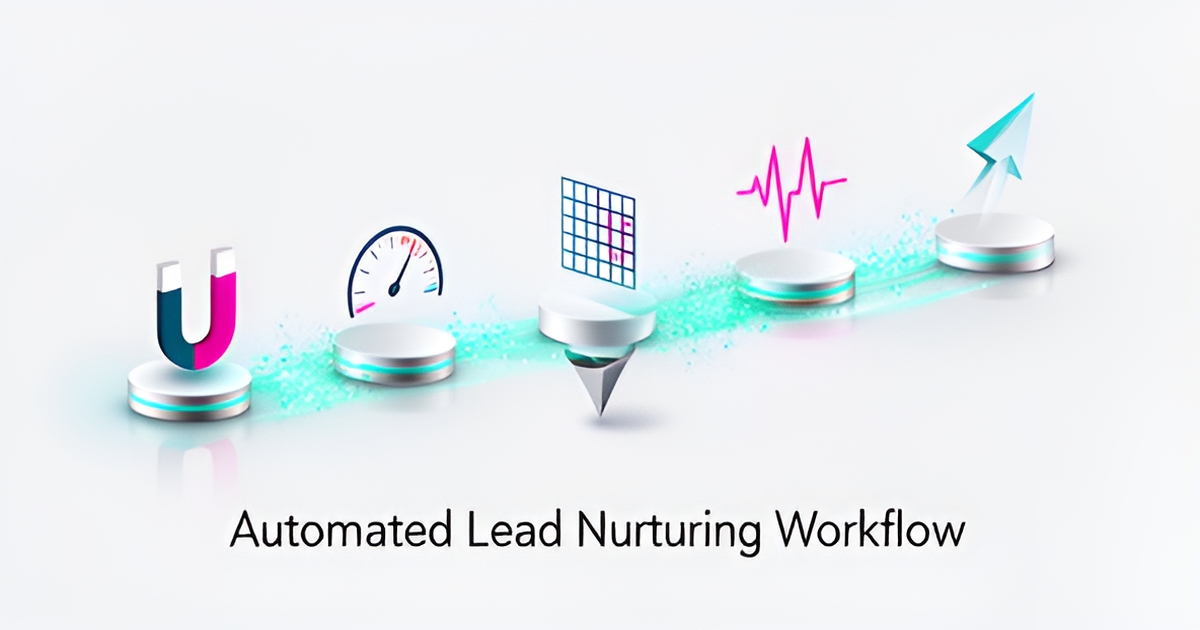
Automated Lead Nurturing AI Workflow Overview
Key Facts
- Sales reps spend 60% of their average week on non-selling work like data entry and prospect research, according to Salesforce research.
- Contact success rates drop more than tenfold within the first hour after a prospect shows interest, lead response research shows.
- AI agents now handle up to 80% of SDR tasks including prospecting, outreach, and scheduling, freeing reps for high-value conversations.
- Manual prospect research takes 30–45 minutes per lead, capping reps at 20–30 prospects daily, while agents research hundreds simultaneously, per monday.com's analysis.
- AI-driven personalization can boost conversions by up to 57%, according to industry data.
- 62% of organizations are now experimenting with AI agents and 23% are already scaling agentic systems, McKinsey's 2025 state of AI report finds.
- By 2028, 60% of B2B seller interactions will happen through AI-driven conversational interfaces, up from under 5% in 2023, Gartner predicts.
One AI employee doing one job, 24/7, for less than a part-time wage.
Receptionist, lead follow-up, intake or dispatch. Trained on your business and fully managed. From $700/mo.
The Cost of Slow Follow-Up
Speed kills deals, and most small sales teams are running slow without knowing it. The operational drag starts long before a rep ever picks up the phone.
Sales reps spend 60% of their average week on non-selling work like data entry, prospect research, and planning. That's three days out of five spent on tasks that never touch a buyer. For an SMB sales team, that's not a time-management problem. It's a revenue problem.
The cost compounds the moment a lead raises a hand. According to lead response research, contact success rates drop more than tenfold within the first hour after a prospect shows interest. Manual nurturing can't keep pace with that clock. Reps are in meetings, off shift, or buried in admin while the window closes.
The downstream effects show up across the pipeline:
- Reps spend over 20% of each day on admin tasks instead of selling
- Manual prospect research takes 30 to 45 minutes per lead, capping daily output at 20 to 30 prospects
- Stalled deals leak out of the pipeline because nobody follows up in time
- SMBs absorb the cost of hiring more reps just to cover the gaps
A solopreneur on r/smallbusiness described the trap exactly: too much time manually inputting data instead of actually selling, and a need for something that runs "mostly hands off." That's the real definition of the problem. Manual nurturing is too slow to catch modern demand, and too expensive to scale. The fix isn't working harder. It's rebuilding the workflow so follow-up happens in minutes, not days, and keeps happening while your team sleeps.
From Static Sequences to Adaptive Agents
The old playbook was simple: load a lead into a sequence, send email one, wait three days, send email two, and hope someone replies. That approach treats every prospect identically, which is exactly why so many of them disengage before a human ever gets involved.
Static sequences break down because they can't see what a prospect actually does. Adaptive AI systems can. Instead of a fixed drip, AI lead nurturing automates the whole lifecycle from capture to conversion, qualifying, scoring, segmenting, researching, and following up based on specific actions rather than a calendar. That's the shift AIQ Labs builds around, and it's the difference between messaging a list and working a pipeline.
Four specialized agent types carry that work, each owning a stage:
- Research agents scan markets, profile companies, identify contacts, and detect buying signals.
- Qualification agents handle ICP matching, intent analysis, dynamic scoring, and routing.
- Engagement agents personalize messages, orchestrate channels, and manage warm handoffs to human reps.
- Nurturing agents run trigger-based engagement, maintain relationships, and re-qualify prospects when they're sales-ready.
That last group matters most for pipeline leakage. Nurturing agents keep prospects warm until they're ready to buy, and they continuously reassess leads as new signals emerge, like a funding announcement or a leadership change, rather than locking in a score at capture. One documented case shows a dormant lead converted into an active opportunity with no manual review or list re-scoring at all.
The timing advantage is just as real. A lead response study found that success rates drop more than tenfold within the first hour after a prospect shows interest, and an AI agent is never on vacation when that moment arrives. Meanwhile, reps spend 60% of their average week on non-selling work, according to Salesforce research, while AI agents now handle up to 80% of SDR tasks like prospecting, outreach, and scheduling.
None of this runs on autopilot forever. AI sales tools aren't born geniuses, and treating nurturing as a set-and-forget system is how teams end up back where they started. The agents need training on your tone and messaging, monitoring of early outputs, and regular tuning as your market shifts. Done well, that's a pipeline that stays warm without a human chasing every touch.
The Hybrid Human-AI Workflow
The most effective AI lead nurturing systems don't replace your sales team. They restructure it, letting machines absorb the repetitive work while humans handle the conversations that actually close deals.
The numbers explain why this split matters. Sales reps spend 60% of their average week on non-selling work like data entry and planning, according to Salesforce. Meanwhile, AI agents now handle up to 80% of SDR tasks, from prospecting to scheduling, freeing reps for high-value conversations.
The practical pattern looks like this: AI drafts the first 80% of an email, handling personalization and the value proposition, then a rep adds the final human touch before sending. Teams using this approach report significantly higher response rates than generic blasts. Salesforce recommends drawing clear boundaries: AI owns autonomous actions like follow-up emails, while humans keep objection handling and deal negotiation.
This hybrid model works only when the underlying data is solid. Connecting AI tools to your CRM provides full context on company details, purchase history, and past interactions, which enables smarter sequencing and prevents duplicated outreach. The rule is simple: generative AI is only as good as the information it's fed. Poor CRM data produces poor outreach, no matter how sophisticated the model.
Channel choice matters just as much. Effective nurturing spreads contact across email, LinkedIn, SMS, and chat rather than hammering one inbox. Seven cold emails in seven days reads as borderline stalking; the same seven messages distributed across mediums comes across as persistent, high-quality nurturing.
At AIQ Labs, this is how we structure the workflow: AI employees handle the research, qualification, and follow-up cadences around the clock, while your team steps in for demos, negotiations, and relationship building. Because the system isn't set-and-forget, ongoing monitoring and retraining are built into the engagement, adjusting tone, messaging examples, and escalation rules as performance data comes in.
The dividing line is clear. AI does the volume work. Humans do the judgment work. Neither does the other's job.
Continuous Optimization and Ownership
The biggest mistake companies make with AI lead nurturing is treating it like software they can configure once and never touch again. It's not. Practitioners who run these systems daily are blunt about it: AI lead nurturing is not a "set-and-forget" system, and the teams that treat it that way watch performance decay within weeks.
An AI system drifts. Your messaging gets stale. New objection patterns show up that the model hasn't seen. A competitor changes pricing and suddenly your follow-up cadence feels off. Without someone monitoring early outputs, feeding in new tone and messaging examples, and adjusting escalation rules, the automation quietly starts working against you.
What ongoing optimization actually looks like:
- Retraining on new messaging examples and objection-handling patterns as your market shifts
- Monitoring early outputs to catch tone drift or logic errors before prospects see them
- Regular performance reviews that adjust workflows, triggers, and channel mix
- Updating qualification criteria as new buying signals emerge (funding events, leadership changes, expansion news)
- Rebalancing human-in-the-loop boundaries as the AI proves reliable on specific task types
This is where most DIY implementations fall apart. The build is the easy part. The hard part is the second month, when someone has to sit down, read the transcripts, score the outputs, and decide what to retrain. Small teams don't have that person. So the system runs on autopilot until the numbers dip, and by then recovering trust takes longer than maintaining it would have.
That's exactly the gap AIQ Labs' managed AI Employee model closes. Every flat monthly plan includes the build, training on your specific business, tool integrations, monitoring, and continuous improvements. You're not buying a tool and inheriting the maintenance burden. You're hiring a role that someone else keeps sharp.
There's also the ownership question. Plenty of AI lead nurturing platforms lock you into their ecosystem with non-cancellable contracts and credit-based pricing that scales unpredictably. The model here is different: you own the system. No vendor lock-in, no platform dependencies. You can pause or adjust the plan anytime, and if you ever take the build in-house, the code and data come with you.
The businesses winning with AI lead nurturing right now aren't the ones with the flashiest models. They're the ones who committed to treating these systems like a team member that needs coaching, feedback, and clear boundaries. Build it right, keep someone accountable for its performance, and it compounds. Ignore the maintenance, and you'll wonder why the pipeline dried up.
Start with the two-minute Fit Check to see if an AI Employee fits your workflow, or book a free 30-minute strategy call to map out exactly what continuous optimization would look like for your business. If there isn't a clear win, you'll hear that too.
Still paying for 10+ subscriptions that don’t talk to each other?
We build connected AI systems you own. Pay upfront or on a payment plan; the code is yours once it’s paid off.
Frequently Asked Questions
How quickly do I actually need to follow up with a new lead?
Will AI lead nurturing replace my sales reps?
How is AI lead nurturing different from a regular email drip sequence?
Is AI lead nurturing a set-it-and-forget-it system?
How many channels should I use for lead nurturing outreach?
Does CRM data quality really matter for AI outreach?
Building a Pipeline That Works While You Sleep
The shift from static sequences to adaptive AI agents isn't just a technological upgrade; it's a structural change in how sales teams operate. By offloading the 60% of weekly time spent on admin tasks, your reps can focus on the high-value conversations that actually close deals. As the market matures, the teams that win will be those treating AI as a continuous partnership rather than a one-time software purchase. This requires ongoing monitoring, retraining, and clear boundaries between autonomous actions and human judgment. At AIQ Labs, our managed AI Employee model handles this maintenance for you, ensuring your system stays sharp, accurate, and aligned with your evolving market. You don't have to build this infrastructure alone or guess at the configuration. Start with the two-minute Fit Check to see if an AI Employee fits your workflow, or book a free strategy call to map out exactly what continuous optimization looks like for your business. If there isn't a clear win, we'll tell you that too. It’s time to stop letting pipeline leakage define your growth.
See what AI would actually do in your business, in 60 seconds.
The planner shows which step fits, the agents we’d build and the published price. No email needed.