Mapping The Process For Due Diligence Automation SaaS
Key Facts
- 83% of private equity leaders admit their due diligence practices are outdated, according to a 2024 Accenture survey cited by industry research.
- Junior analysts routinely work 100+ hours per week during live deals, with diligence timelines stretching 3 to 12 months.
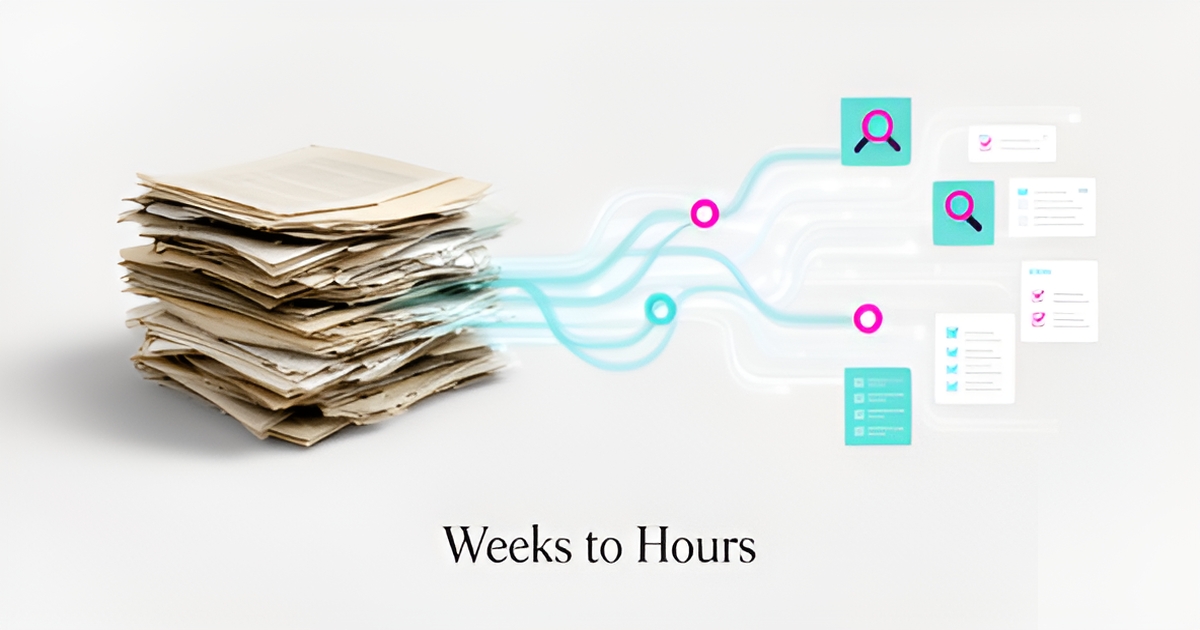
- Manual review of large data rooms takes weeks, while automated systems compress that to hours, according to M&A automation experts.
- Only 3% of small and medium firms have implemented AI for due diligence versus 29% of large firms, a 26-point adoption gap.
- The due diligence investigation market is projected to nearly double from USD 8.5 billion in 2024 to USD 16.7 billion by 2034.
- A typical buyout target carries 500+ customer contracts requiring change-of-control review, work that automation compresses from weeks to hours.
- General-purpose LLMs failed at diligence due to context collapse and hallucination, paving the way for specialized AI agents, per software analysis.
Hire a team member that works 24/7 — for less than a part-time wage.
AI receptionists, SDRs, dispatchers and 99+ roles. Trained on your business, fully managed.
Not sure where to start? Ask our AI planner
Why Manual Due Diligence Breaks Under Modern Deal Pressure
Ask any deal team what due diligence looks like today and the answer is rarely a process, it's a scramble. According to a 2024 Accenture survey, 83% of private equity leaders say their current DD practices are outdated, even as deal complexity keeps climbing.
The numbers behind that frustration are stark. Junior analysts routinely work 100+ hours per week during live deals, and timelines stretch from three to twelve months depending on deal complexity. A single buyout target can carry 500+ customer contracts requiring change-of-control review, and large acquisitions may involve tens of thousands of documents spread across multiple jurisdictions.
The workload itself has also outgrown the old playbook. Due diligence scope is expanding well beyond financials and legal into IT, cybersecurity, and ESG, domains where most firms have no established review muscle. The tooling hasn't kept pace: 75% of PE leaders say increasing investment complexity is at odds with the tools available to them.
The most dangerous failure is the quiet one. When reviewers run out of hours, they prioritize high-priority documents and apply less rigorous scrutiny to secondary files, exactly where hidden liabilities are often embedded. A change-of-control clause buried in contract four hundred and twelve doesn't announce itself; it surfaces after the LOI is signed.
Many firms tried to fix this with general-purpose LLMs after 2023, and the results were instructive. Two failure modes dominated:
- Context collapse, models lose coherence when reasoning across hundreds of disconnected files in a data room, losing track of which entity, clause, or period each document belongs to.
- Hallucination, fabricated findings are a fatal flaw in an industry where accuracy is the only currency that matters.
- No auditability, answers without traceable evidence to a source document can't be relied on in a deal setting.
The industry has since moved into what analysts describe as the agentic era: specialized AI agents built for diligence workflows rather than generic chat. The distinction matters because traditional virtual data rooms are passive, they host files, while modern systems actively interrogate them, performing document classification, data extraction, anomaly detection, and risk flagging against firm-defined rules.
This is the gap that purpose-built automation is designed to close. When AIQ Labs maps a due diligence workflow for automation, the starting point is precisely this pain analysis: which manual steps create variance, which files get skipped under time pressure, and where human judgment must remain in the loop. Manual review of a large data room takes several weeks; well-architected automated systems reduce that to hours, without sacrificing the secondary files where liabilities hide.
The Anatomy of an Automatable Due Diligence Process
Before you can automate due diligence, you have to be able to draw it, every workstream, every handoff, every decision point. A large acquisition can involve tens of thousands of documents across multiple jurisdictions, and mapping the process is what turns that chaos into something a machine can execute reliably.
The blueprint starts with five automatable workstreams: Legal, Financial, Compliance/Regulatory, HR/Organizational, and IT/Cybersecurity. Each workstream maps to four core AI functions, document classification, data extraction, anomaly detection, and risk flagging. This structure matters because M&A due diligence automation only works when the underlying process is standardized; automation reduces variance and brings reliability to a repeatable process, not an improvised one.
Each workstream needs a clear owner, stages with defined entry and exit criteria, central visibility into blockers and overdue items, and embedded audit trails. Those components, drawn from traditional-versus-automated workflow analysis, are what make the process legible to both humans and agents.
Concrete agent workflows show what the map looks like in practice:
- Financial spreading: converting PDF financial statements into structured models automatically.
- Contract review: a typical buyout target has 500+ customer contracts requiring change-of-control and assignment analysis, work that manual review stretches across weeks but automated systems compress to hours.
- Rule-based red flags: flagging conditions like customer concentration above 10% of revenue against firm-defined thresholds.
- Cap table analysis and litigation screening against pending-litigation benchmarks.
The consensus model across every credible source is hybrid: AI surfaces structured findings, humans keep judgment. As one analysis puts it, automation doesn't replace human judgment, it lets deal teams focus expertise where it matters most. That's also why trust mechanisms belong in the map from day one: clickable citations that open the source document and highlight the exact paragraph, plus human-in-the-loop escalation for anything the AI can't resolve.
This is the approach AIQ Labs applies when mapping processes for due diligence automation builds, anchoring each workstream in a repeatable structure before any agent is deployed, so the system the client owns is auditable, accurate, and built around the deal realities of M&A, which represents 52% of due diligence applications.
From Map to Build: The Four-Phase Implementation Path
A process map is only worth the software it becomes. The gap between a diagram on a whiteboard and an automated platform that actually runs diligence is where most automation projects die, so the build path matters as much as the map itself.
AIQ Labs structures this translation into four phases. Discovery & Architecture runs one to two weeks, turning the mapped workstreams into buildable requirements: named owners for Legal, Financial, Compliance, HR, and IT/Cybersecurity workstreams; stages with defined entry and exit criteria; and digitized checklists that replace tribal knowledge. As workflow analysis makes clear, the real value isn't a nicer checklist, it's anchoring diligence in a repeatable, improvable process.
Development & Integration takes four to twelve weeks, and this is where trust mechanisms get engineered in rather than bolted on:
- Agents built for the four core functions: document classification, data extraction, anomaly detection, and risk flagging
- Citation-based validation, so every finding links back to the exact source paragraph
- Complete audit trails for compliance and post-deal review
- Human-in-the-loop escalation for anything exceeding AI authority
This hybrid design reflects an industry consensus: automation experts agree AI should surface structured findings while humans retain judgment calls. Given that hallucination has proven a fatal flaw for general-purpose LLMs in diligence, citation-based validation isn't optional, it's the foundation.
Deployment & Training follows over one to two weeks: production go-live, role-specific user training, documentation, and performance monitoring setup. Optimization & Scale then runs indefinitely, tracking ROI and expanding capabilities as deal volume grows.
The timing matters. Manual review of large data rooms takes weeks; automated systems cut that to hours, and 83% of PE leaders admit their current practices are outdated. Yet adoption research shows only 3% of small and medium firms have implemented AI for due diligence, versus 29% of large firms. That 26-point gap is the opportunity: mid-market deal teams paying full manual costs without enterprise automation budgets. A phased, milestone-based build, where you approve each phase as it ships and keep everything built, makes the entry point manageable for exactly those firms.
Trust Mechanisms and Benchmarks That Make the System Deal-Ready
Automation without verification is a liability in diligence, where accuracy is the only currency that matters. General LLMs already failed here because of hallucination and "context collapse" across hundreds of disconnected files, so the trust layer isn't optional, it's the product.
The strongest trust mechanism is the clickable citation: every extracted finding links back to the exact source paragraph in the uploaded document, so a reviewer can verify an AI conclusion in seconds instead of re-reading the file. Layer on embedded audit trails, a core workflow component alongside defined owners per workstream and stages with entry/exit criteria, and every flag becomes defensible in front of a deal committee or regulator.
Escalation controls complete the picture. Human-in-the-loop checkpoints ensure that when a situation exceeds the AI's authority, a pending litigation flag above 10% of net worth, or a customer concentration breaching firm-defined rules, the finding routes to a person, not a report. As one analysis puts it, automation "surfaces structured findings that allow deal teams to focus their expertise where it matters most" rather than replacing judgment.
How do you measure success? The headline benchmark is speed: manual review of large data rooms takes several weeks, while automated systems reduce this to hours. Extraction accuracy is murkier. One vendor insists 99% is unacceptable and claims 100% accuracy, a self-reported marketing claim. Others treat 99%+ as a strong benchmark, provided every extraction carries a citation and a confidence threshold below which a human reviews it. The honest framing: accuracy percentages matter less than whether the system makes errors visible instead of silent.
Your validation layer should track:
- Time-to-first-findings across the data room (weeks → hours baseline)
- Extraction accuracy on sampled documents, verified against clickable citations
- Escalation rate, what percentage of flags route to humans, and whether that rate falls as prompts refine
- Coverage: percentage of documents receiving full scrutiny, since manual reviewers under time pressure apply less rigor to secondary files, exactly where hidden liabilities live
AIQ Labs builds this validation-first: every action validated before execution, configurable escalation, and complete audit logging as standard. If you want to see what this looks like against your own workflow, start with the two-minute Fit Check at aiqlabs.ai/apply, then a free 30-minute strategy call to map your highest-cost diligence workflow. The Build in Milestones model keeps entry risk low, the build splits into phases, you approve and pay for each as it ships, and you can stop anytime and keep everything built so far.
Still paying for 10+ subscriptions that don’t talk to each other?
We build custom AI systems you own outright. No vendor lock-in. Full control.
Not sure where to start? Ask our AI planner
Frequently Asked Questions
How long does due diligence actually take, and how much can automation speed it up?
Can AI really handle due diligence, or will it hallucinate findings?
Which parts of the due diligence process can actually be automated?
Isn't manual review good enough if we prioritize the important documents?
How long does it take to build an automated due diligence system?
Are we too small for AI due diligence automation?
From Scramble to System: Your Next Deal Deserves a Map
The pattern across this article is hard to miss: manual due diligence doesn't just strain your team, it quietly skips the secondary files where hidden liabilities live, and general-purpose LLMs already failed to fix that. What works is a mapped process: five workstreams, four core AI functions, trust mechanisms like clickable citations and human-in-the-loop escalation, and a phased build that ships value at every milestone. The opportunity is especially sharp for mid-market firms, only 3% of small and medium firms have implemented AI for due diligence, versus 29% of large firms, while deal complexity climbs for everyone. Your next step doesn't have to be a platform commitment. Start by drawing one workstream, Legal or Financial, on paper, naming its owner and stages. Then take the two-minute Fit Check at aiqlabs.ai/apply and book a free 30-minute strategy call, where AIQ Labs will help map your highest-cost diligence workflow. With the Build in Milestones model, you approve each phase as it ships and keep everything built, no obligation, just clarity.
Make AI your competitive advantage — not just another tool.
Strategy, implementation and ongoing optimization. One partner, end to end.
Not sure where to start? Ask our AI planner